Parameter Tuning
The illusion of architectural control through turning knobs and numbers such as server constants or budgets, even though it often leaves overall system behavior unchanged.
Why it matters
Interventions matter when they do more than ease symptoms and instead shift system behavior sustainably.
Next step
Link the intervention to tools and decision rituals so it remains effective in day-to-day work.

System Problem
The backend has performance problems, so the first reaction is to double the database connection pool. Developer velocity drops, so management raises the IT budget by five percent and tweaks bonus payouts. The entire company behaves like the driver of a wrecked car who believes it can be repaired by turning the volume knob on the radio.
Intervention
Parameter tuning sits at level twelve in Meadows's hierarchy, the weakest leverage point. As a standalone answer to chronic crises, it is close to useless. The intervention here is mainly a refusal: recognize when the team is trapped in parameter mania and stop spending hours debating whether a Kubernetes timeout should be ten or fifteen seconds before anyone has even asked the higher-level design questions.
Expected Impact
Avoiding parameter wars frees an large amount of time for highly paid architects. Parameters are psychologically seductive because they are easy to write into tickets and they make people feel as if they are doing visible, concrete work. If you prohibit tuning without a real bottleneck diagnosis, you force the team back into actual design thinking.
Side Effects and Risks
When parameter tuning is used as a universal remedy, it hides the structural defect beneath it. If the real problem is an O(n^2) algorithm and ops responds by doubling available RAM, the alarm may quiet down for now, but the underlying disease survives. At the next scale jump, the system fails again.
Diagram
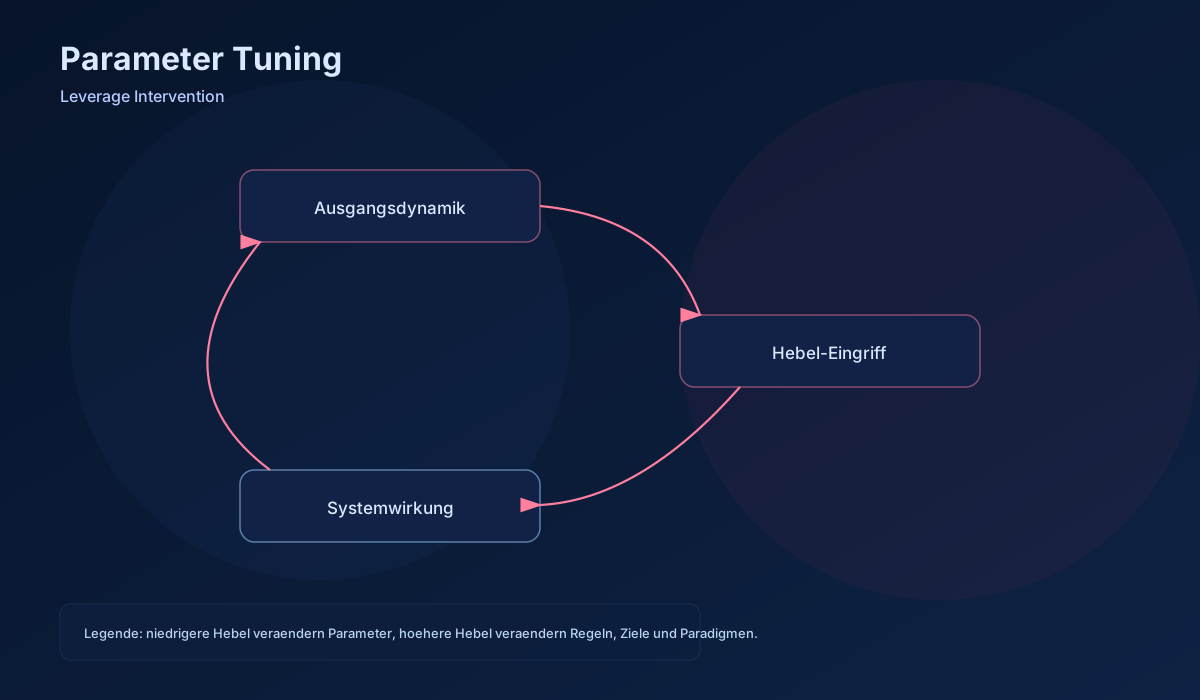
When This Intervention Becomes Effective
Meadows notes, with some sarcasm, that pushing parameters is what politicians love to do most. IT departments behave the same way. Constants matter when you are fine-tuning a healthy system, just as tire pressure matters in Formula 1. But in a broken system, parameter tuning will never save you. You cannot save the Titanic by increasing lifeboat capacity from forty to forty-two.
What Distinguishes This Intervention from Other Levers
Feedback Loop Redesign rewires the car's actual control system. Goal Reframing decides which city the car should drive toward. Parameter Tuning is merely adjusting the cruise control once the rest already works.
How to Introduce the Intervention Cleanly
Apply a factor-of-ten test. If a team proposes increasing a timeout from 30 seconds to 40, ask whether the project would be saved if the timeout were 300 seconds instead. If the answer is still no, then the parameter is not a meaningful leverage point and the ticket should be closed in favor of deeper work.
First Implementation Steps
Understand sensitive parameters. There are rare cases, especially in chaotic or exponential systems, where a tiny change in one number can matter largely. But if you are going to turn a parameter, you should know mathematically whether you are acting on a linear slope or an exponential threshold, not just guessing from intuition.
How to Recognize Impact
Do our incident post-mortems include the authority to reject a closure that says only "We raised the threshold from 80% to 90%" because everyone understands that this may be merely cosmetic?
Sources
Donella Meadows — Leverage Points, Point 12: Numbers and Constants (1999)
John Sterman — Business Dynamics, Ch. 8: Parameter Estimation (McGraw-Hill, 2000)
Authors & Books
Go to referencesRelevant references for Parameter Tuning.
Leverage indicator
Leverage level 12 · Constants, parameters, numbers
Category: Parameters
Go to interventions wheelContinue reading
Explore related topics from Interventions
Boundary Design
The physical and logical redrawing of boundaries such as APIs and team structures to drastically reduce friction and handoffs across the system.
Boundary Reframing
The strategic act of showing management that it shares responsibility for the current architecture problem because it defined the observation space too narrowly.