Causal Loop Diagrams
Visual maps that clarify complex architecture problems by making circular cause-and-effect structures explicit.
Why it matters
Diagnostics turn assumptions into grounded structural hypotheses for architecture and organization.
Next step
After that, derive interventions that specifically change rules, boundaries, or feedback loops.

Purpose
Causal Loop Diagrams, or CLDs, are maps for systems work. Instead of documenting architecture problems in long linear prose, they force us to visualize the world as variables and causal links. They expose the biggest weakness in management thinking: the assumption that A causes B in a straight line. In real technology systems there are loops, not lines. A affects B, B amplifies C, and C returns with delay to change A again.
Context of Use
Use causal loop diagrams whenever the patch no longer works. If a team tells you, "We have optimized this interface for six months, but the core system is still getting slower," that is a strong signal to move from isolated fixes to systemic mapping. The problem is often not the interface itself but the surrounding network of dependencies and delayed side effects.
Step by Step
1.Name the theme: What are we examining? For example, declining code quality.
2.Collect variables: Identify the critical variables. They should be observable or at least discussable as states, including soft factors such as cognitive load or management pressure.
3.Draw causal links: Connect the variables. If A rises, does B rise as well, or does it fall?
4.Identify loops: Find the closed circles. Are they reinforcing or balancing?
5.Mark delays: Highlight places where cause and effect are separated in time. This is where many crises hide.
Example
A tribe wants to increase velocity. Management raises ticket pressure. More pressure creates more time pressure for developers. Time pressure reduces time for refactoring. Less refactoring produces more technical debt. More technical debt leads, with delay, to more bugs. More bugs cause context switching, which ultimately damages real team velocity. A CLD makes the contradiction visible at a glance: the management intervention triggered a reinforcing loop that achieves the opposite of its intent.
Diagram
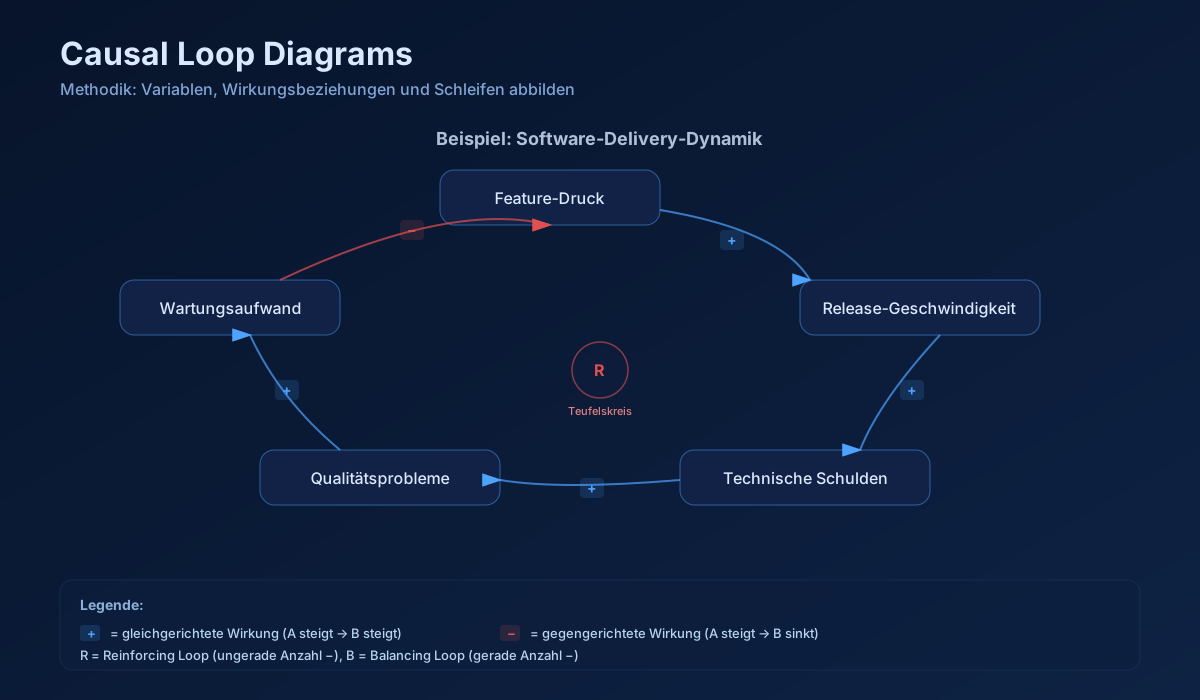
How Diagnosis Turns into Action
The value of a CLD does not lie only in describing the current state. Its real power is in locating leverage points. A map with one hundred variables is not automatically useful. A strong CLD reduces overwhelming complexity to the five to seven loops that matter most. The team can then search for the one link that needs to be cut, reversed, or shortened in delay to change the whole pattern.
When This Method Fits Best
CLDs are a diagnostic technique. They help teams reconstruct system archetypes at the whiteboard instead of jumping straight to solutions. They also mark the point where more formal system dynamics or stock-and-flow simulation may begin. CLDs are qualitative, not numerical.
How to Use the Diagnosis in Everyday Work
Pull product owners and stakeholders to the whiteboard before architecture decisions are made. If someone proposes disabling a security check to ship faster, ask them to draw the consequences as a CLD. Once the loop includes security incidents, recovery work, and delayed business impact, weak ideas often collapse under their own logic.
First Analysis Steps
Use strict naming rules for variables. Variables should not be verbs such as "testing" or "building." They should be states such as "number of tests" or "size of the build backlog" that can rise or fall. Otherwise the logic of the causal links becomes muddy.
How You Recognize a Useful Diagnosis
In your post-mortem practice, do important incidents require a small causal loop diagram rather than only a linear Five Whys narrative?
Sources
The Systems Thinker: Causal Loop Construction — The Basics
Donella Meadows — Thinking in Systems, Chapter 1: Feedback Loops
John Sterman — Business Dynamics, Chapters 5–6 (McGraw-Hill, 2000)
Authors & Books
Go to referencesRelevant references for Causal Loop Diagrams.
Example analysis artifact
CLD of a platform scaling problem with amplifying load and balancing capacity.
Continue reading
Explore related topics from Diagnostics
Assumption Mapping
A diagnostic tool for strictly exposing, categorizing, and deliberately testing unspoken assumptions in architecture design.
Behaviour over Time Charts
A visualization tool that reveals how system variables such as metrics, debt, or productivity change over time.