Boundary Design
The physical and logical redrawing of boundaries such as APIs and team structures to drastically reduce friction and handoffs across the system.
Why it matters
Interventions matter when they do more than ease symptoms and instead shift system behavior sustainably.
Next step
Link the intervention to tools and decision rituals so it remains effective in day-to-day work.

System Problem
When software is delivered slowly, the reason is rarely that programmers type too slowly. The real culprit is handoffs. The frontend team waits for the backend team, which waits for the ops team. Poorly drawn system boundaries create significant coordination overhead, endless ticket ping-pong, and they fragment end-to-end ownership into useless functional silos.
Intervention
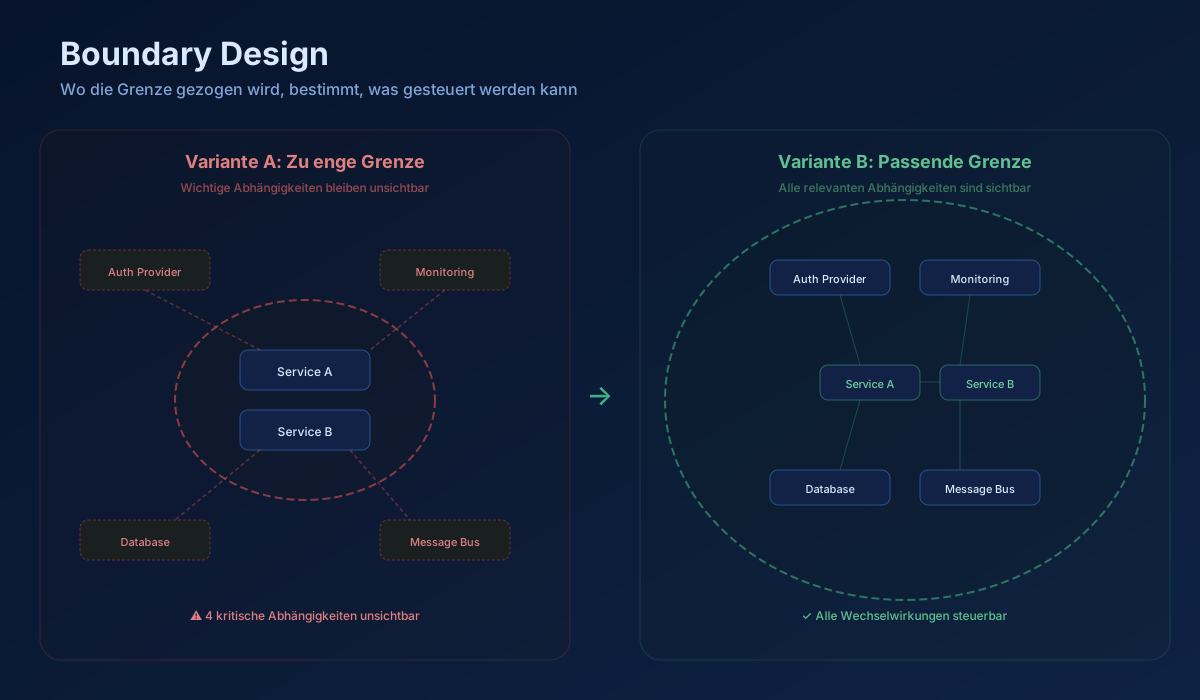
"Boundary Design" is surgery on the open heart of the organization. You dissolve old boundaries, often inherited from history, and draw smarter ones. Instead of drawing boundaries by function, such as putting all database administrators together, you draw them around the value stream. One team gets all the resources and rights it needs, across frontend, backend, and ops, to deliver a customer feature autonomously from idea to production. This is the logic behind cross-functional teams and bounded contexts.
Expected Impact
The system breathes easier almost immediately. Cycle time for feature deployment often drops by 50 to 80 percent because blocking handoffs to other departments disappear. Developers also experience lower cognitive load because they no longer need to understand the whole company, only the clean contract at the edge of their new boundary.
Side Effects and Risks
Boundary design is highly disruptive. People hate seeing their familiar team identity broken apart. In the short term, productivity can fall sharply as the organization moves through the J-curve of change. Another risk is duplication: if five autonomous cross-functional teams all build their own login systems, architectural chaos is not far away.
Diagram
When This Intervention Becomes Effective
In the Team Topologies framework, boundary design sits at the center. Conway's Law predicts that software structure will mirror communication structure. If you want a loosely coupled microservice architecture, you have to start by redesigning team boundaries. If you leave the old boundaries in place, your shiny microservice landscape will likely collapse into a distributed monolith within months.
What Distinguishes This Intervention from Other Levers
Boundary Critique is the diagnostic phase, where you ask whether a boundary is ethically and structurally meaningful. Boundary Design is the act itself. This is where API specifications are written, AWS accounts are separated, and repositories are protected with new access policies so the new boundary becomes real.
How to Introduce the Intervention Cleanly
Test every boundary with a pain test. If Team A builds a feature, but Team B gets paged in the middle of the night when it fails, the boundary is drawn badly. The rule should be "You build it, you run it." Cause and consequence must live inside the same boundary container.
First Implementation Steps
Never draw boundaries in a vacuum on a whiteboard. They should follow the fracture planes of the domain. The boundary between credit card fraud detection and newsletter mailing is natural. The boundary between Java backend and React frontend for the same product is often an artificial technical silo that creates friction.
How to Recognize Impact
Can developers within a bounded context deploy a release without asking another team in Slack for permission or synchronization even once?
Sources
Donella Meadows — Thinking in Systems, Ch. 3: Boundaries
Matthew Skelton & Manuel Pais — Team Topologies, Ch. 6: Team Boundaries
Authors & Books
Go to referencesRelevant references for Boundary Design.
Leverage indicator
Leverage level 11 · Buffer sizes
Category: Structure
Go to interventions wheelContinue reading
Explore related topics from Interventions
Boundary Reframing
The strategic act of showing management that it shares responsibility for the current architecture problem because it defined the observation space too narrowly.
Capability Building over Fixes
A strict architectural ban on local quick fixes and self-service, with all energy redirected toward giving the system the fundamental ability to repair itself.