Feedback Loop Redesign
The radical shortening and rerouting of technical and human signals so that failures hurt immediately instead of exploding only after release.
Why it matters
Interventions matter when they do more than ease symptoms and instead shift system behavior sustainably.
Next step
Link the intervention to tools and decision rituals so it remains effective in day-to-day work.

System Problem
Why do brilliant developers produce broken code? Because the feedback loop is severed. If a developer introduces a memory leak today and the leak fails a customer system four months later, the brain has no real chance to connect action and consequence. The traditional silo model, where dev writes code, QA tests it, and ops deploys it, is a large delay generator that suppresses learning.
Intervention
"Feedback Loop Redesign" is a core mission of DevOps. It works through two mechanical levers:
1.Loop shortening: automate everything possible so the signal returns within seconds, not days.
2.Loop rerouting: send the pain to the person making the decision. "You build it, you run it" and developer-facing on-call are examples of closing the loop directly around the actor.
Expected Impact
The system begins to heal itself. If PagerDuty wakes the developer whose code failed, the team will often redesign its own habits without being told. Better tests, safer retries, and more resilient patterns emerge because sleeping through the night becomes a personal incentive. The redesigned feedback loop drives capability building without speeches from management.
Side Effects and Risks
The classic risk is alert fatigue. If every warning is shoved into the same Slack channel, developers drown in noise. Once a channel produces thousands of red alerts per day, people stop seeing any of them. Successful loop redesign values signal quality over signal volume.
Diagram
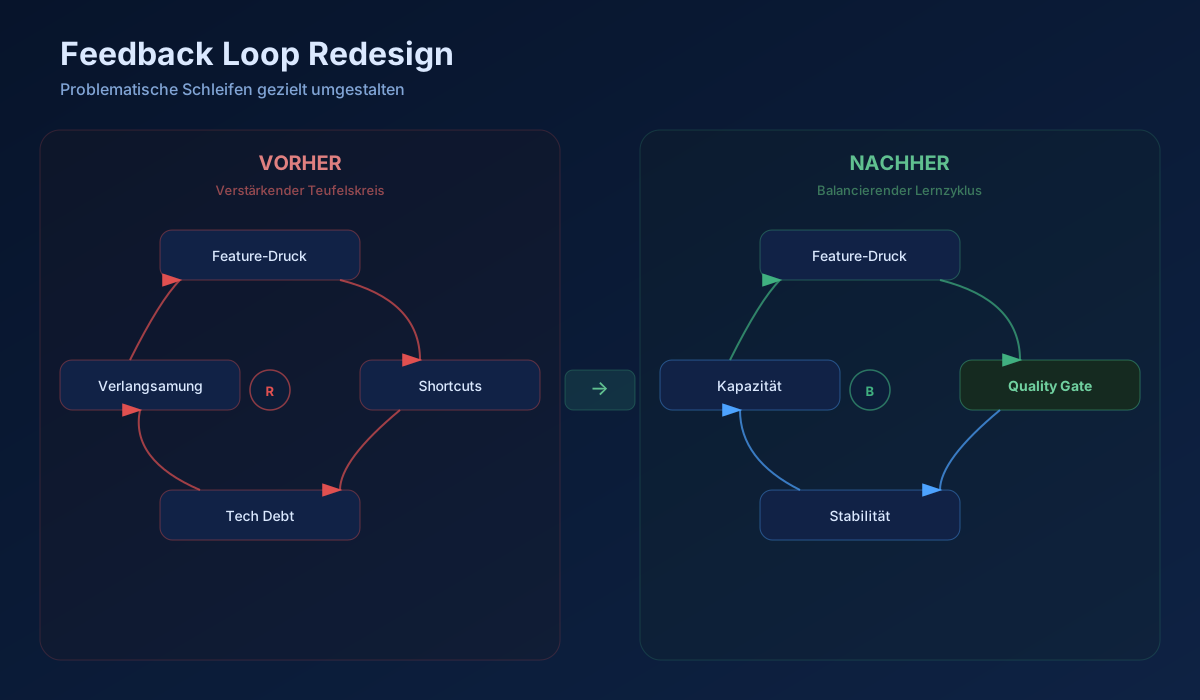
When This Intervention Becomes Effective
Donella Meadows describes missing information flows as one of the strongest leverage points in a system. Sometimes fixing a loop is remarkably cheap. Moving a latency dashboard from an executive-only screen into the workspace of frontend developers can change coding behavior dramatically because the consequence becomes visible where action happens.
What Distinguishes This Intervention from Other Levers
Boundary Design is often the physical precondition for rewiring feedback loops. Information Flow Design is closely related but broader, because it looks at the whole information network. Feedback Loop Redesign focuses specifically on the hard cybernetic action-consequence cycle.
How to Introduce the Intervention Cleanly
Destroy local optimization loops. If testers are rewarded for finding bugs while developers are rewarded for shipping features, you have created two competing loops that damage the company. Force both sides into a shared loop such as safe lead time to production, where both feel the outcome at the same lever.
First Implementation Steps
Distinguish between reinforcing loops and balancing loops. A vicious reinforcing loop might be burnout leading to more bugs, which leads to more burnout. Your job as an architect is to weld a balancing loop in front of it, such as a WIP limit that reduces new feature intake when bug volume rises.
How to Recognize Impact
Have we shortened the path from user feedback to developer action so much that, in the best case, the engineer who built a feature can watch its A/B test outcome in near real time?
Sources
Donella Meadows — Thinking in Systems, Ch. 1: Feedback Loops
Gene Kim et al. — The DevOps Handbook, Ch. 3: Feedback (IT Revolution, 2016)
Authors & Books
Go to referencesRelevant references for Feedback Loop Redesign.
Leverage indicator
Leverage level 8 · Balancing feedback loops
Category: Structure
Go to interventions wheelContinue reading
Explore related topics from Interventions
Boundary Design
The physical and logical redrawing of boundaries such as APIs and team structures to drastically reduce friction and handoffs across the system.
Boundary Reframing
The strategic act of showing management that it shares responsibility for the current architecture problem because it defined the observation space too narrowly.