Goodhart's Law
When a metric becomes a target, it loses explanatory value because the system starts optimizing for the proxy instead of the underlying outcome.
Why it matters
Use this concept to explain observable behavior structurally rather than merely naming it.
Next step
Next, check which archetype or diagnostic method makes the pattern visible in the concrete system.

Definition
Goodhart's Law describes a recurring steering problem: once a metric is no longer only observed but turned into a target with consequences, the behavior of the system begins to move toward the metric itself. At that point the measure no longer reliably reflects the quality it was supposed to stand in for. It increasingly reflects adaptation to the measurement logic. In short: when a measure becomes a target, it becomes a worse measure.
This matters far beyond KPI design. In practice, the metric is usually only a proxy for something deeper such as customer value, architectural quality, learning speed, resilience, or coordination quality. As soon as the proxy is linked to rewards, visibility, priorities, or sanctions, the system starts producing the proxy directly. That is why Goodhart's Law often shows up as gaming, local optimization, reporting polish, queue shifting, or the neglect of important but less visible system qualities.
System Mechanism
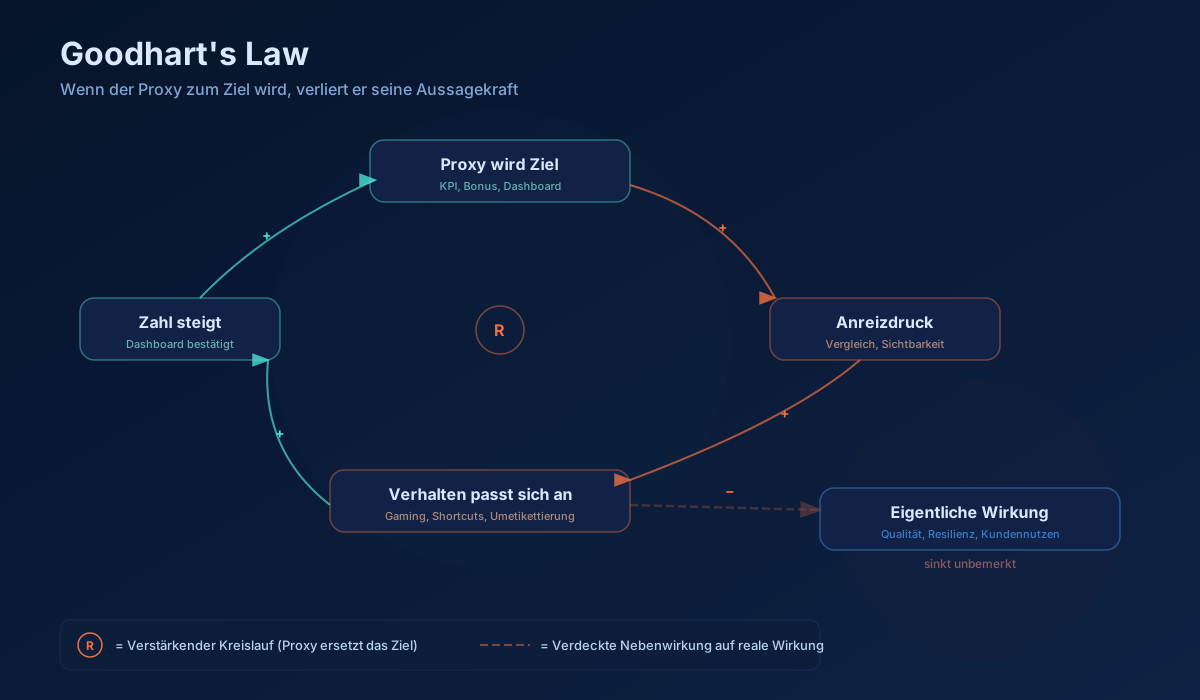
From a systems perspective, Goodhart's Law is not mainly about bad intent. It is an expected adaptation in a feedback-rich environment. An organization introduces a metric such as deployment frequency, utilization, ticket throughput, budget adherence, or SLA compliance. The metric becomes visible, comparable, and consequential. Teams react rationally. They change decomposition, prioritization, escalation paths, reporting practices, and even definitions of done in ways that improve the number. Through that adaptation, however, the overall system changes as well: what is measured becomes amplified, and what is not measured loses protection.
That usually creates at least three effects at the same time. First, attention narrows around a proxy while other outcome dimensions fall outside the boundary of steering. Second, new feedback loops emerge: good scores on the metric lead to more trust, budget, or influence, which further reinforces metric-oriented behavior. Third, diagnostic quality deteriorates because the number may still look healthy while correlating less and less with actual system performance. Goodhart's Law is therefore closely related to feedback loops, local optimization, policy resistance, and incentive design.
Architecture Example
A company wants to improve delivery performance and starts steering platform and product teams primarily through deployment frequency. At first this sounds reasonable because frequent releases often correlate with smaller batch sizes and faster learning. After a few months the logic flips. Teams slice changes into artificial micro-deployments, hide risky architecture work in opaque preparation tasks, or postpone stabilization work into later quarters. The metric improves, but incident load, cognitive strain, and hidden coupling rise at the same time. The number now measures release tactics more than delivery capability.
The same dynamic appears when uptime is treated without context. If a team is judged mainly by a single availability score, it may delay useful releases, redefine incidents more narrowly, or move support pain outside the reporting frame. The system appears more stable on paper while becoming less resilient and less adaptive in reality. The proxy improves while the underlying capability erodes.
Organizational Example
In a matrix organization, department leaders are measured on budget adherence and utilization. That creates pressure to keep everyone fully allocated, avoid lending specialists to other areas, and block cross-functional improvements that do not immediately help the local dashboard. For the individual department this is rational. For the overall system it is harmful: queues grow, priorities harden, and value streams slow down. No single actor has to behave irrationally for the result to be dysfunctional. The system simply rewards proxy optimization more strongly than shared impact.
The risk becomes even greater when metrics pull in different directions across hierarchy levels. Executives want customer impact, middle management reports cost stability, and delivery teams optimize for throughput. At that point Goodhart's Law is not just a KPI mistake. It is a sign that the steering architecture itself is incoherent.
Diagnostic Questions
1.Which metric has more practical power in our system than the underlying goal it was meant to approximate?
2.What behavior is being rewarded rationally even though it weakens overall system performance?
3.Where do dashboards look healthy while friction, workaround behavior, or side effects keep increasing in day-to-day work?
Diagram
Why This Concept Helps in Architecture
Architecture work often suffers because hard-to-measure qualities such as decoupling, changeability, learning speed, or decision quality get replaced by simple proxies. Some form of approximation is unavoidable in complex systems, but Goodhart's Law helps us avoid mistaking the proxy for the real thing. It reminds us that measurement is itself an intervention in the system and therefore changes behavior.
That is especially useful in architecture because many misleading signals look like progress at first: more completed tickets, more services created, more standards formally checked, more utilization, more reporting precision. None of these necessarily mean the system has become healthier. With Goodhart's Law in mind, we look not only at targets, but at behavioral shifts, omitted effects, and the quality dimensions that were pushed out of view.
How to Distinguish It from Similar Topics
Goodhart's Law is related to local optimization, but it is more specific. Local optimization says that parts optimize for themselves and damage the whole. Goodhart's Law explains how metrics and targets trigger or intensify that pattern. It is also related to policy resistance. There the system pushes back against an intervention. In Goodhart's Law the distortion sits specifically in turning an observational measure into a steering variable.
How to Use the Concept in Practice
Treat metrics as prompts for inquiry, not as self-contained truth. Robust steering combines at least three perspectives: a performance metric, a side-effect metric, and qualitative observation from the real work system. Equally important is the question of consequence: a metric with no sanctions behaves differently from one tied to budget, bonuses, or visibility.
It also helps to review each metric against the outcome it was originally meant to represent. If the number improves while complaints, rework, political friction, or technical debt also rise, the measurement logic itself needs review. In that situation the answer is usually not stronger enforcement. It is better proxy design, better boundaries, and better incentives.
First Implementation Steps
Start with a small metric inventory. For each important steering metric, write down the underlying outcome it is supposed to approximate, the unwanted adaptations it could provoke, and a second observation that would reveal distortion early. That simple exercise often leads to more robust dashboards, healthier governance conversations, and better intervention design.
How You Recognize Impact
You know the concept is taking hold when teams no longer report only target values, but also discuss trade-offs, blind spots, and side effects openly. At that point the organization is no longer steering toward the number alone. It is learning from the system.
Sources
Marilyn Strathern — Improving ratings: audit in the British University system
Manheim & Garrabrant — Categorizing Variants of Goodhart's Law
Authors & Books
Go to referencesRelevant references for Goodhart's Law.
Concept Visual
Goodhart's Law: A metric used as a target changes behavior and devalues the proxy.