System Dynamics Modeling Tools
Tools that turn static causal diagrams into mathematical simulations with stocks, flow rates, and delays.
Why it matters
Tools help make systems thinking practical in analysis, communication, and implementation.
Next step
Always combine the tool with a diagnostic or intervention logic instead of using it in isolation.

System Purpose
A causal loop diagram on a whiteboard shows that a burnout loop exists. It does not prove when the team will collapse or how deep the collapse will be. The hard numbers are missing. System Dynamics (SD), originally developed at MIT by Jay Forrester, solves that problem. It translates qualitative sketches into quantitative mathematics. Tools in this class define the system as a hydraulic network of stocks and flows, bathtubs and valves, and let architects calculate the true latency of decisions and the force of escalation curves.
Tool Mechanics
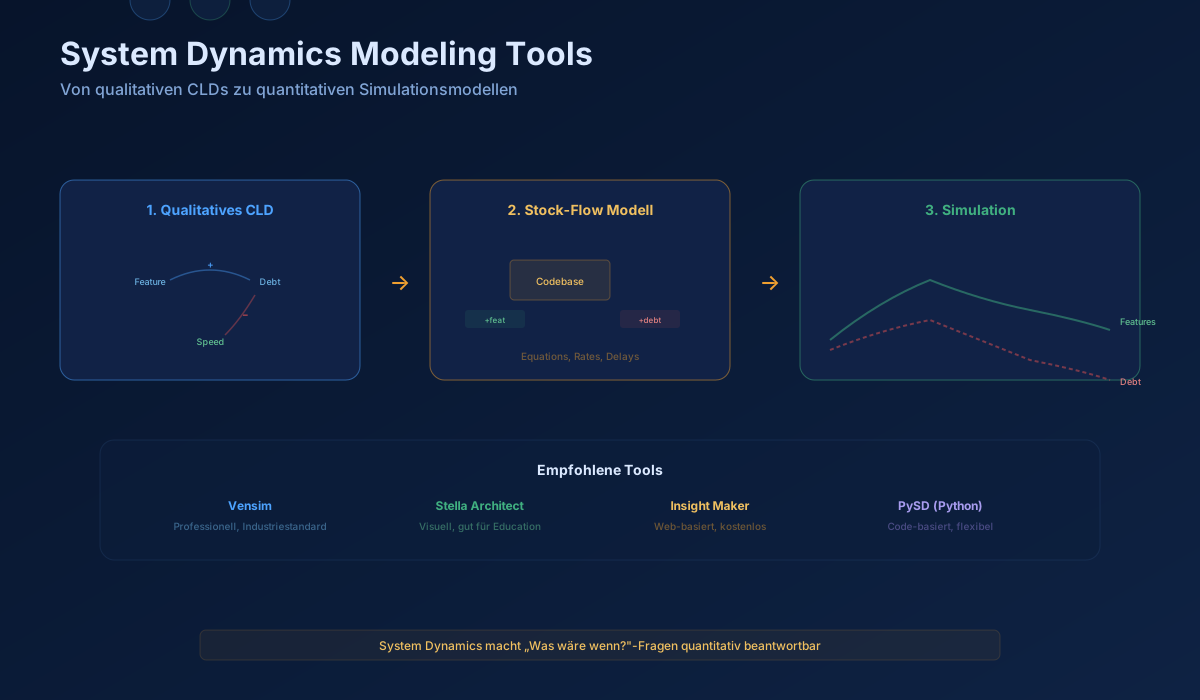
SD tools such as Stella, Vensim, or Insight Maker are built around stock-and-flow models:
1.Stocks: Variables that accumulate, such as money, technical debt, lines of code, or burned-out developers. They are usually drawn as rectangles.
2.Flows: Valves that fill or drain those stocks, such as refactoring rate, feature development rate, or attrition rate.
Behind the scenes the tool solves differential equations. You move a slider, for example "management pressure rises from 2 to 5," and the graph plots a 36-month curve that indicates when the project is likely to implode.
Architecture Use
SD tools are among the strongest weapons against management short-termism, the reflex that says "we just need to hire more developers." If the architect encodes Brooks's Law, adding manpower to a late software project makes it later, the tool can show visually that hiring five developers today may reduce delivery mathematically in the first month because of onboarding delay and senior training load. The model can save the budget from panic hiring.
Limits and Risks
False precision. SD models require a large number of parameters and equations. If an architect defines developer productivity as Productivity = 10 * Morale, why is the factor 10 instead of 8? Why morale and not sleep? If the mathematical construct is based on guesses, the tool produces curves that look professional but represent fantasy. Management often mistakes a polished dashboard for an unavoidable future. A model is only as strong as the strict validity of its formulas.
Diagram
Differentiation
Causal Loop Tools draw causal circles without metrics. Agent-Based Modeling simulates many individual actors bottom-up. System Dynamics renders the macro picture top-down as interconnected fluid dynamics for the organization and its aggregated volumes.
Decision and Practice Guide
Never use system-dynamics tools such as Vensim or Stella to tell management, "We will run out of money exactly on August 4." Use them to test understanding instead: "What happens to our technical debt over five years if the refactoring flow drops from 20% to 0%?" Browser-based SD tools such as Insight Maker are often preferable when you want models to be shared easily across the company without desktop license friction.
Sources
Ventana Systems — Vensim Software
Authors & Books
Go to referencesRelevant references for System Dynamics Modeling Tools.
Continue reading
Explore related topics from Tooling
Agent-Based Modeling Tools
Tools that simulate the behavior of many autonomous actors — for example how teams respond to new architecture rules — to surface emergent effects before rollout.
Architecture Observability Tooling
Traces, metrics, and logs as architecture diagnostics: they make gradual structural decay visible before it turns into incidents.