Causal Loop Tools
Digital tools for drawing causal loop diagrams: they keep feedback structures readable and support collaborative modeling.
Why it matters
Tools help make systems thinking practical in analysis, communication, and implementation.
Next step
Always combine the tool with a diagnostic or intervention logic instead of using it in isolation.

System Purpose
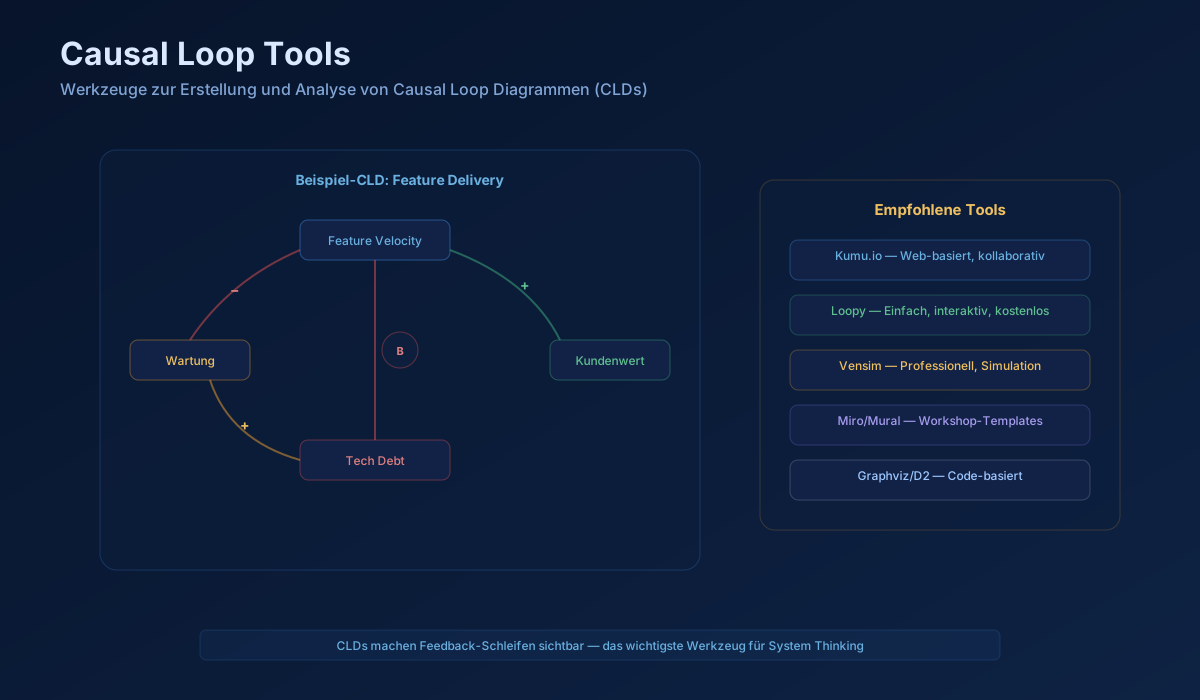
The biggest obstacle for Causal Loop Diagrams (CLDs) in companies is readability. An architect draws a large CLD with 40 variables and 80 feedback arrows on a physical whiteboard. One day later the cleaning staff has wiped half of it away, and to the new colleague on Slack a photo of the board looks like confusing diagram. Causal Loop Tools such as Kumu.io or Loopy digitize these chains of causality. They enforce cleaner syntax, let you hide noise dynamically, and make system architecture distributable and versionable like a knowledge graph.
Tool Mechanics
Simple CLD tools such as Nicky Case's Loopy use playful animation. You draw nodes such as "bug count" or "time pressure" and connect them with positive (+) or negative (-) edges. When you click a node, you can watch simulated pixels flow through the loop. That immediately reveals whether you modeled a balancing loop for stability or a reinforcing loop for escalation.
Advanced tools such as Kumu manage relationships in JSON-like structures or graph backends, allow filters like "show only the management silo," and automatically highlight the most connected nodes as leverage points.
Architecture Use
CLD tools are sensemaking instruments during iceberg-model work.
1.Root-cause analysis postmortems: After an architectural burnout, the lead team assembles digitally and visualizes the sociotechnical pathways in the CLD tool, for example "high AWS cost" leads to "pressure from the CFO," which leads to "architecture shortcuts," which leads to "higher latency."
2.Onboarding senior hires: The CLD of the company's core problems is embedded in Confluence. A new staff engineer can understand in ten seconds why the migration has been failing for the last two years.
Limits and Risks
The death-by-complexity trap. There is a powerful urge to make the CLD model inside these tools ever larger and ever more "accurate." Soon the model has 150 variables. A model that explains everything explains nothing. Donella Meadows warned that a good model must stay highly abstract. If your digital CLD looks like a printed circuit plan for an Intel processor, you missed the point of visualization.
Diagram
Differentiation
Diagramming Tools such as Visio or Draw.io are generic drawing boards. They do not understand what a feedback loop is. Causal Loop Tools carry an internal systems grammar based on graph logic. They know mathematically when a loop closes and can highlight cycles automatically.
Decision and Practice Guide
Use Loopy for live workshops with non-technical management. Few things make technical debt feel real faster than watching simulated loops rise sharply on an iPad in real time. Use enterprise graph tools such as Kumu mainly for durable staff-level documentation and knowledge management rather than as a sketchpad for every conversation.
Sources
Kumu.io — Systems Mapping Platform
Authors & Books
Go to referencesRelevant references for Causal Loop Tools.
Continue reading
Explore related topics from Tooling
Agent-Based Modeling Tools
Tools that simulate the behavior of many autonomous actors — for example how teams respond to new architecture rules — to surface emergent effects before rollout.
Architecture Observability Tooling
Traces, metrics, and logs as architecture diagnostics: they make gradual structural decay visible before it turns into incidents.