Agent-Based Modeling Tools
Tools that simulate the behavior of many autonomous actors — for example how teams respond to new architecture rules — to surface emergent effects before rollout.
Why it matters
Tools help make systems thinking practical in analysis, communication, and implementation.
Next step
Always combine the tool with a diagnostic or intervention logic instead of using it in isolation.

System Purpose
In pure software architecture, we can predict server loads with mathematical precision through queueing theory. What we cannot predict nearly as well is the behavior of the 500 developers building the system. When management introduces a new rule, such as "every commit now requires 95% test coverage," how does the cybernetic system respond? Do developers slow down? Do they fake the tests? Agent-Based Modeling (ABM) is the simulation technique architects can use to probe exactly that before they accidentally paralyze the company in reality.
Tool Mechanics
ABM tools such as NetLogo or Mesa for Python let you place tens of thousands of tiny "robots" (agents) on a grid. You give each agent extremely simple local rules, for example: "If you see an empty Jira ticket, take it. If the ticket is too large, pass it to the neighbor." Then you press play. The tool simulates millions of ticks (steps). What you observe is not the code itself but emergence, the unplanned macro-behavior. Suddenly you can watch a significant traffic jam form around the virtual QA agent.
Architecture Use
Do not use ABM for technical architecture, where System Dynamics Simulation is usually the better fit. Use ABM for sociotechnical architecture and Conway's Law.
1.The open-plan office problem: Simulate how often developers interrupt one another through context switching when two teams must work against the same database.
2.Platform adoption: If you are rolling out a new internal developer platform (IDP), simulate how long it will take for the network effect of adoption to reach critical mass.
Limits and Risks
GIGO: garbage in, garbage out. ABM simulations often fascinate management so much with their colorful moving dots that people mistake the result for pure truth. If your assumptions about human behavior, the "rules" of the agents, are wrong, the tool will deliver brilliant and mathematically perfect simulations of a colossal lie. A simulation is never proof. It is a "what if" laboratory for damageing your own cognitive biases.
Diagram
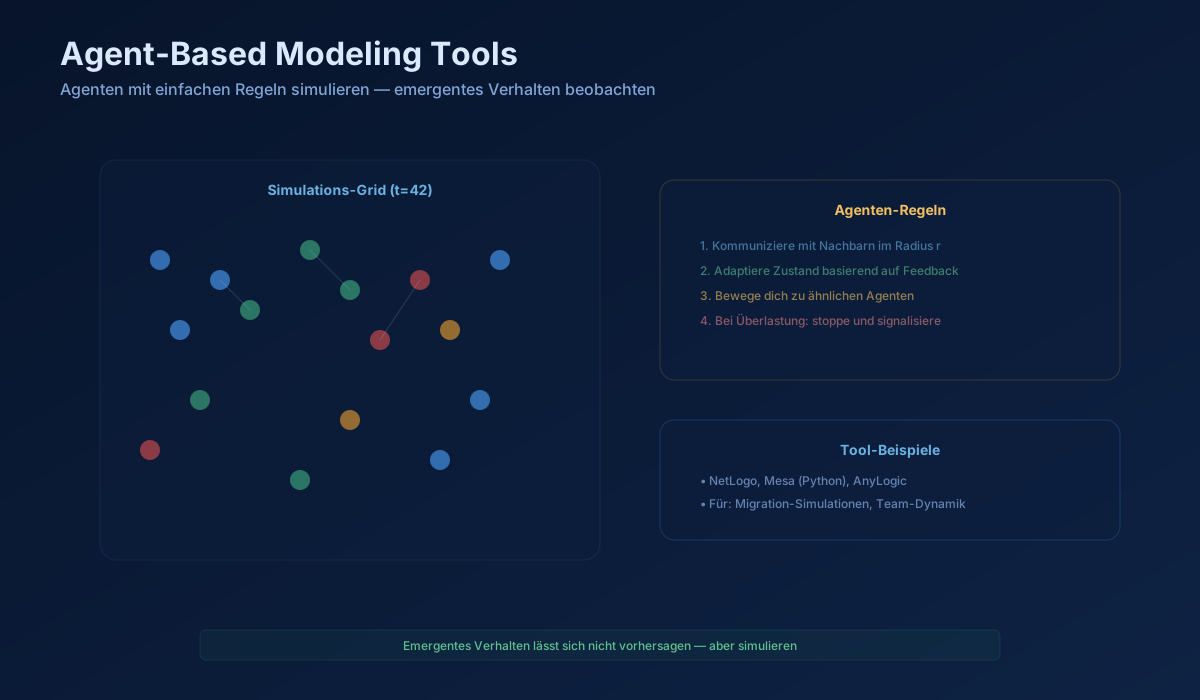
Differentiation
Causal Loop Tools (CLDs) are static pictures made of circles and arrows. System Dynamics models flowing stocks and rates, like water in bathtubs. Agent-Based Modeling models individuals: bird flocks, developers, customers. It is the only tool class here that can seriously simulate deeply human herd behavior.
Decision and Practice Guide
ABM frameworks require learning real programming languages, such as Python for Mesa or NetLogo syntax, as well as a strong grasp of statistics. Use them only when the cost of a wrong decision reaches into the millions, for example during a complete redesign of a Spotify-style agile operating model. For ordinary whiteboard discussions, a static causal loop diagram is usually more than enough.
Sources
Uri Wilensky — NetLogo Home (Northwestern University)
David Masad & Jacqueline Kazil — Mesa: Agent-Based Modeling in Python (2015)
Authors & Books
Go to referencesRelevant references for Agent-Based Modeling Tools.
Continue reading
Explore related topics from Tooling
Architecture Observability Tooling
Traces, metrics, and logs as architecture diagnostics: they make gradual structural decay visible before it turns into incidents.
Causal Loop Tools
Digital tools for drawing causal loop diagrams: they keep feedback structures readable and support collaborative modeling.