Critical Systems Heuristics
A philosophical diagnostic tool that asks which actors gain power from a software architecture and who is disempowered by it.
Why it matters
Diagnostics turn assumptions into grounded structural hypotheses for architecture and organization.
Next step
After that, derive interventions that specifically change rules, boundaries, or feedback loops.

Purpose
In an era where algorithms, from GenAI to scoring systems, shape careers and life chances, purely technical system diagrams are not enough. Critical Systems Heuristics, or CSH, from Werner Ulrich, is not a checklist for APIs. It is a checklist for structural power and violence. CSH questions the assumed truth of an architecture and exposes the uncomfortable fact that architecture is never neutral. Every tool you introduce, even something as simple as Jira, systematically empowers one control layer while disempowering an executing layer.
Context of Use
Use CSH before rolling out major enterprise-governance tools such as company-wide monitoring systems, AI code assistants with metric tracking, or strict architecture board structures. Whenever highly paid architects on the fifth floor define rules that five hundred developers in the basement must live under, the situation calls for a CSH diagnosis.
Step by Step
CSH works with twelve aggressive heuristics grouped into four domains. Each block must be answered once for the current state and once for the desired state:
1.Sources of motivation: Whose purposes does this system actually serve?
2.Sources of control: Who has the physical power to alter infrastructure resources in this architecture?
3.Sources of knowledge: Whose expertise counts? Why do cloud certifications count while the daily operational experience of customer support is ignored?
4.Sources of legitimacy: Who may stop the project if it becomes harmful? Which worldviews are suppressed?
Example
A platform enablement team adds DORA-metric tracking to every developer repository. The declared goal is higher velocity. CSH reveals a different story:
In the current power structure, management sees the metrics and punishes slow teams, while developers have no control over the display.
In the current knowledge structure, the tool measures lines of code but ignores the refactoring judgment of senior developers because that knowledge is not machine-readable.
The diagnosis shows that the tool is not enablement but a top-down control instrument. Without the CSH perspective, management only wonders why developers game the tool by writing meaningless code.
Diagram
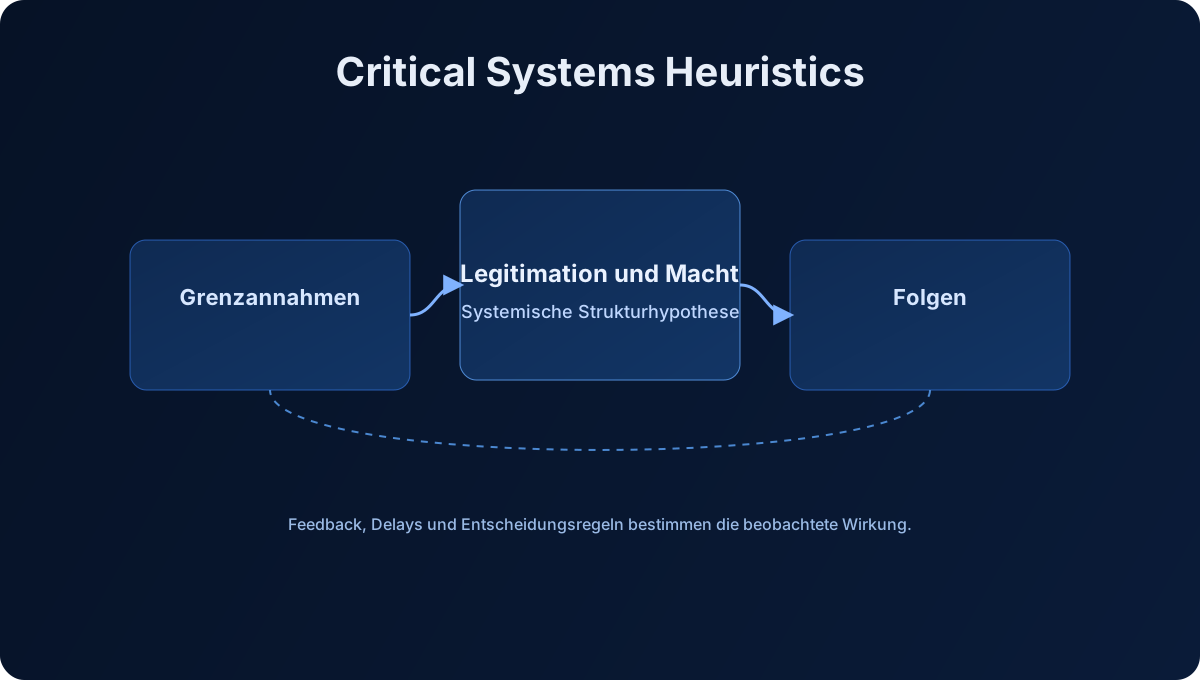
How Diagnosis Turns into Action
Software architecture is often discussed dogmatically, as in "Is event sourcing the best solution?" CSH changes the question to: "Best for whom?" Many architectural frameworks marketed as company standards are thinly disguised manifestations of power structures. If a central architecture board removes all tech-stack choice from feature teams, that is not primarily efficiency. It is also an instrument of power preservation.
When This Method Fits Best
CSH is the intellectual hammer behind Boundary Critique. While Stakeholder Mapping often focuses on managing emotions or buy-in, CSH is uncompromisingly focused on emancipation: how do we give disadvantaged nodes in the system real operational veto power?
How to Use the Diagnosis in Everyday Work
As an architect, dare to ask CSH questions at the board table. When a C-level executive proposes a huge reorg and new software, ask directly: "Who suffers from this system? How do we anchor a veto right for the people who must execute it if we are wrong?" Architecture designs that do not allow feedback loops from the bottom upward are not mature systems. They are technical feudal systems heading toward resistance and failure.
First Analysis Steps
Bring external skeptics into the review. The best CSH analysis of an internal developer platform is usually not written by the chief architect but by the most frustrated junior frontend engineer who fights the broken system every day.
How You Recognize a Useful Diagnosis
Do security systems in your company, such as device-management algorithms, include transparent opt-out clauses, or do they enforce safety through total disempowerment of employees?
Sources
Werner Ulrich — Critical Heuristics of Social Planning (Haupt, 1983)
Werner Ulrich — A Brief Introduction to Critical Systems Heuristics (CSH)
Authors & Books
Go to referencesRelevant references for Critical Systems Heuristics.
Example analysis artifact
CSH question grid for motivation, control, expertise and legitimacy of a system boundary.
Continue reading
Explore related topics from Diagnostics
Assumption Mapping
A diagnostic tool for strictly exposing, categorizing, and deliberately testing unspoken assumptions in architecture design.
Behaviour over Time Charts
A visualization tool that reveals how system variables such as metrics, debt, or productivity change over time.