Transparency by Design
Absolute visibility into system health through radical observability design so developer feedback loops close in minutes rather than weeks.
Why it matters
Interventions matter when they do more than ease symptoms and instead shift system behavior sustainably.
Next step
Link the intervention to tools and decision rituals so it remains effective in day-to-day work.

System Problem
Systems that operate in the dark are ungovernable. If an e-commerce checkout becomes slow and developers only hear about it three days later through angry customer emails, feedback has failed. Delay in information is problematic. In heavily intertwined microservice architectures, it is physically impossible for a human to reconstruct the full path of a single customer request in their head. Without transparency, developers spend most of incident time blindly searching logs instead of fixing the failure itself.
Intervention
"Transparency by Design," often called observability, treats visibility as a priority-zero feature on the same level as security and business value. The intervention builds high-cardinality telemetry directly into the code and requires traces, metrics, and logs to appear in one correlated view. No code should reach production unless the team can explain how a failure in that code would immediately reveal itself and its cause.
Expected Impact
The organization shifts from reactive hoping to proactive seeing. Deployments no longer feel like a blind leap but like a controlled experiment watched in real time. Teams can observe latency, error rates, and business transactions directly after release. Mean time to recovery often falls from days to minutes because the system finally speaks clearly.
Side Effects and Risks
The biggest risk is data flood and runaway cost. Logging everything is not good transparency. It is expensive chaos. Poor observability leads to the classic monitoring bill shock where teams emit billions of useless events and pay more for the tooling than for the infrastructure itself. Good transparency requires disciplined reduction: log only what helps answer meaningful and unknown questions about the system.
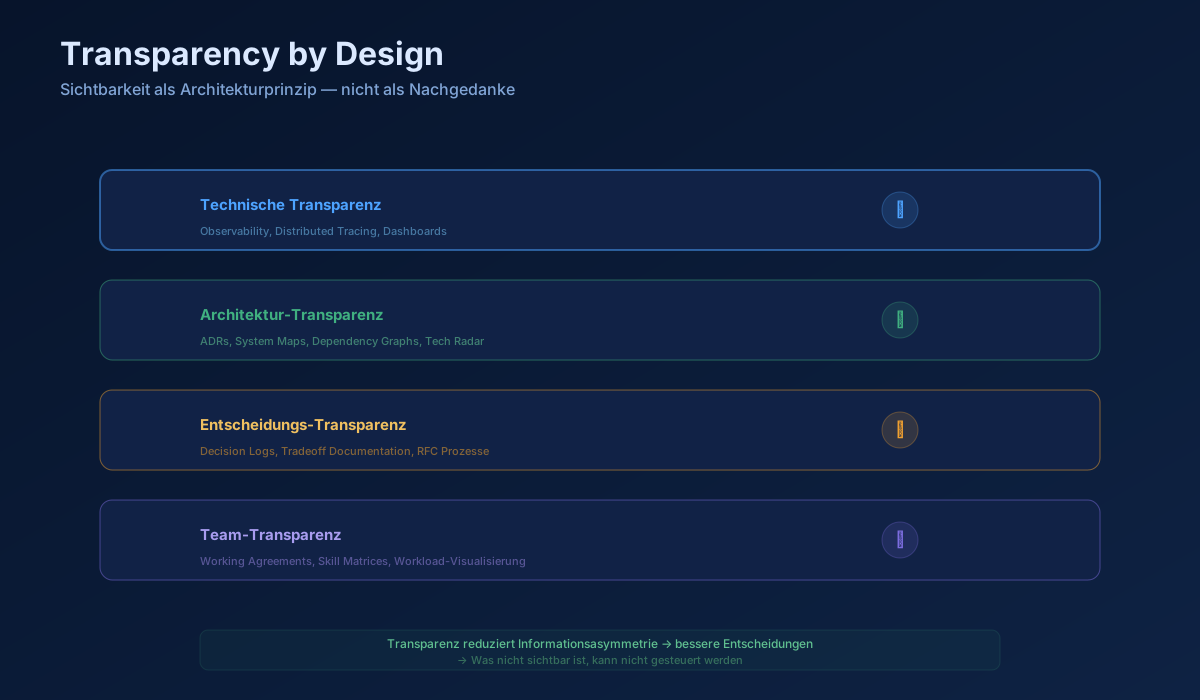
Diagram
When This Intervention Becomes Effective
Charity Majors makes an important distinction: classic monitoring answers known unknowns with predefined dashboards, while observability allows you to ask new questions you did not anticipate ahead of time. Systems thinking in modern software increasingly depends on that ability, because many failures emerge from novel combinations rather than familiar patterns.
What Distinguishes This Intervention from Other Levers
Information Flow Design decides how much information should flow to whom across the organization. Transparency by Design ensures the system can generate truthful raw signals from deep inside the application in the first place.
How to Introduce the Intervention Cleanly
Redefine the definition of done. When a developer says a ticket is finished, the architectural response should be: show me how we will know it works in production. If there is no dashboard or trace validating the business transaction tied to that ticket, the work is not done yet.
First Implementation Steps
Use open standards such as OpenTelemetry. Do not lock the architecture to one vendor's proprietary agent. Observability is an architectural right of the company, not a luxury rented from a tool provider. If the system emits standardized traces, the analysis backend can be replaced later without rewriting the application.
How to Recognize Impact
Can we follow a complete trace of a customer transaction from the first frontend click through a chain of backend services all the way to the final database commit in one tool?
Sources
Donella Meadows — Leverage Points, Point 6: Information Flows (1999)
Charity Majors — Observability Engineering (O'Reilly, 2022)
Gene Kim et al. — Accelerate: Visibility & Transparency (IT Revolution, 2018)
Authors & Books
Go to referencesRelevant references for Transparency by Design.
Leverage indicator
Leverage level 11 · Buffer sizes
Category: Structure
Go to interventions wheelContinue reading
Explore related topics from Interventions
Boundary Design
The physical and logical redrawing of boundaries such as APIs and team structures to drastically reduce friction and handoffs across the system.
Boundary Reframing
The strategic act of showing management that it shares responsibility for the current architecture problem because it defined the observation space too narrowly.