Structural Coupling Adjustment
The surgical separation or reconnection of teams and systems to dissolve tight coupling and radically increase the innovation speed of individual squads.
Why it matters
Interventions matter when they do more than ease symptoms and instead shift system behavior sustainably.
Next step
Link the intervention to tools and decision rituals so it remains effective in day-to-day work.

System Problem
In historically grown systems, teams are often joined like conjoined twins through the same database, the same branch, and the same deployment rhythm. The overall speed of the company then collapses to the pace of the slowest team. If frontend Team A waits for backend Team B and Team B waits for database Team C, lead time is damaged. Architects end up spending most of the week in synchronization meetings just to manage dependency issues.
Intervention
"Structural Coupling Adjustment" is Conway's Law with a machete. The intervention cuts the blood vessels that force teams to move together. If two teams are glued to the same monolithic database, you remove that physical link. Team B must provide Team A with a clean, versioned API instead of direct database access. In parallel, the organization itself is redesigned using team topologies so that teams can breathe autonomously again.
Expected Impact
Each decoupled team regains local decision freedom. Frontend Team A can deploy several times a day even if backend Team B is on vacation or fighting incidents. Coordination overhead implodes. The architecture shifts from a rigid dictatorship toward a federal and asynchronous organism where failures hit API boundaries rather than cascading through the whole company.
Side Effects and Risks
The main trap is believing in total decoupling. Decoupling is never free. What you save in synchronous meeting time, you pay for in asynchronous architecture such as event sourcing, distributed transactions, and contract management. If you split the system without clear interface agreements, you may end up with a distributed monolith that is even harder to debug than the original.
Diagram
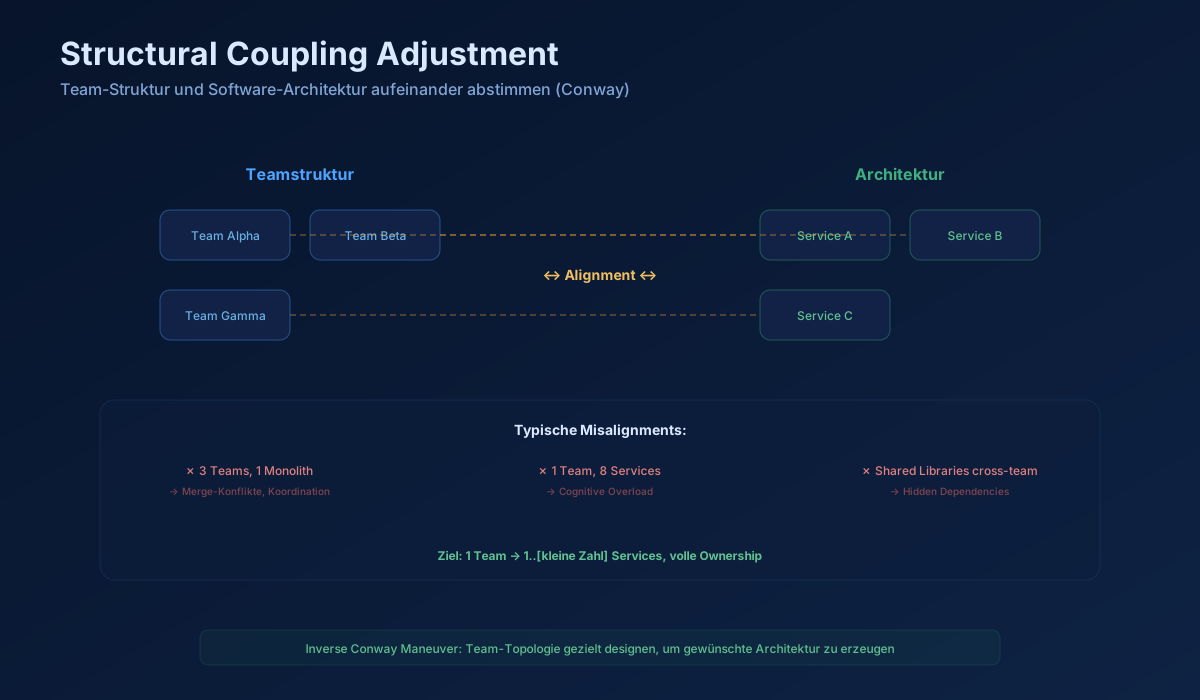
When This Intervention Becomes Effective
Skelton and Pais transformed this field by showing that there should be only a few intentional interaction modes between teams: close collaboration for discovery, X-as-a-service for stable consumption, and facilitating when one team teaches another. The architect's job is to force the landscape toward these intentional patterns. Permanent collaboration between everyone is a recipe for burnout.
What Distinguishes This Intervention from Other Levers
Boundary Design determines who belongs on the same playing field. Structural Coupling Adjustment determines how strongly and through which mechanisms that field is connected to the rest of the organization.
How to Introduce the Intervention Cleanly
Attack the shared database pattern first. When two applications communicate through SQL queries against the same database, they are structurally married. Ban database-based integration and push communication up to the application level through REST, gRPC, or events. The API should be the only legitimate contract another team needs to know.
First Implementation Steps
Use the two-pizza-team principle as a rough coupling limit. A responsible team should be small enough to keep the service within human cognitive load. If a service grows so large that ten teams have to coordinate to change it, the system is over-coupled and needs to be split.
How to Recognize Impact
Do our stream-aligned teams have a reliable state in which they can ship their code to production in most cases without needing approval or review from neighboring teams?
Sources
Matthew Skelton & Manuel Pais — Team Topologies (IT Revolution, 2019)
Authors & Books
Go to referencesRelevant references for Structural Coupling Adjustment.
Leverage indicator
Leverage level 4 · Power to self-organize
Category: Rules
Go to interventions wheelContinue reading
Explore related topics from Interventions
Boundary Design
The physical and logical redrawing of boundaries such as APIs and team structures to drastically reduce friction and handoffs across the system.
Boundary Reframing
The strategic act of showing management that it shares responsibility for the current architecture problem because it defined the observation space too narrowly.