Rule Redesign
The strong cybernetic lever of rewriting the governing laws, incentives, and constraints that define the playing field of IT architecture in the first place.
Why it matters
Interventions matter when they do more than ease symptoms and instead shift system behavior sustainably.
Next step
Link the intervention to tools and decision rituals so it remains effective in day-to-day work.

System Problem
Developers behave exactly as the rules allow. If a company runs on a harmful rule set such as "Only release management may deploy to production, every Tuesday at 4 a.m.," then it breeds harmful delivery behavior. Teams stop caring about continuous quality, build large pull requests, and throw them over the wall in one big bang. The system manufactures bugs because the rules suppress healthier forms of action.
Intervention
"Rule Redesign" corresponds to leverage point number five in Meadows's model. Whoever writes the rules owns the system. You abolish the Tuesday deployment ritual and replace it with a new rule: any pull request that meets agreed test and pipeline standards deploys automatically without human gatekeeping. You replace a permission rule rooted in hierarchy with a physical rule rooted in automation.
Expected Impact
The system begins to regulate itself. Architects no longer need to chase a hundred developers with reminders to write tests. The new rule changes incentives directly. If following the rule means nobody has to stay up for manual release night anymore, developers immediately feel the benefit in their own lives. The architecture improves through the rule itself.
Side Effects and Risks
Rules shape power, so redesigning them always triggers sabotage. If you change the rule from "The architecture board must approve all cloud services" to "Teams may self-provision up to a clear budget limit," then the central board loses part of its reason to exist. Poorly designed rules can also create tragedy-of-the-commons effects, such as runaway cloud spending.
Diagram
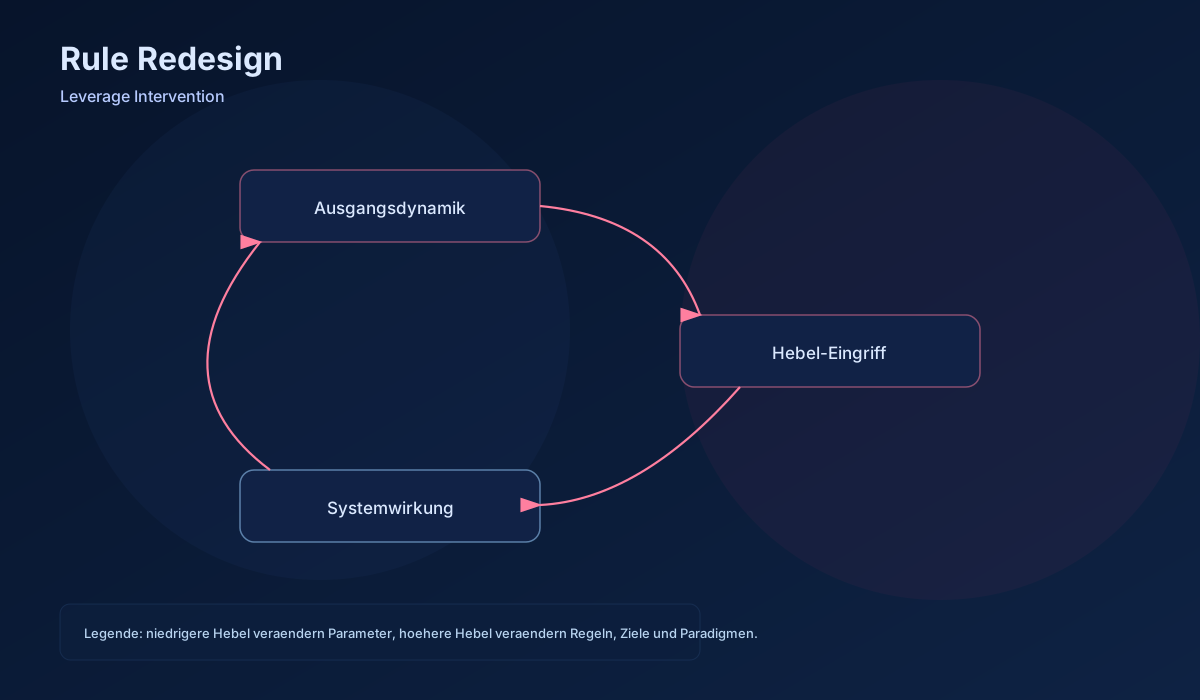
When This Intervention Becomes Effective
Meadows offered many examples of rule design in society, and the same logic applies to architecture. One of the strongest rules in modern engineering is "You build it, you run it." If teams are expected to write stable code, the rule has to connect their decisions to the lived consequence, including being paged at night when their service fails.
What Distinguishes This Intervention from Other Levers
Parameter Tuning changes the numbers inside a process. Rule Redesign changes the process itself. Instead of discussing the QA budget, you may change the rule so QA no longer acts as a bug-hunting gatekeeper but instead coaches teams in practices like TDD.
How to Introduce the Intervention Cleanly
Find the company's core bottleneck and identify the silent rule protecting it from repair. Many IT rules are nothing more than inherited conventions. Convert implicit prohibition into explicit freedom where appropriate. Encode architecture fitness functions so that rules become machine-enforced laws, not polite suggestions.
First Implementation Steps
Rules without consequences are not rules at all. A redesigned rule in software architecture should never live only as a Confluence page. If a new security rule matters, it should be embodied in IAM policies, CI checks, and build breakers. Cybernetic rules have to be enforced in the physics of the system.
How to Recognize Impact
Are there sacred-cow ITIL-style process rules in our company that could already be replaced by fully automated CI/CD verification if we had the political courage to remove them?
Sources
Donella Meadows — Leverage Points, Point 5: Rules (1999)
Elinor Ostrom — Governing the Commons, Ch. 3: Design Principles (Cambridge UP, 1990)
Authors & Books
Go to referencesRelevant references for Rule Redesign.
Leverage indicator
Leverage level 5 · Rules of the system
Category: Rules
Go to interventions wheelContinue reading
Explore related topics from Interventions
Boundary Design
The physical and logical redrawing of boundaries such as APIs and team structures to drastically reduce friction and handoffs across the system.
Boundary Reframing
The strategic act of showing management that it shares responsibility for the current architecture problem because it defined the observation space too narrowly.