Learning Loop Institutionalization
Hardwiring retrospection into the architecture system so the organization not only fixes errors but also rewrites the rules that produced them.
Why it matters
Interventions matter when they do more than ease symptoms and instead shift system behavior sustainably.
Next step
Link the intervention to tools and decision rituals so it remains effective in day-to-day work.

System Problem
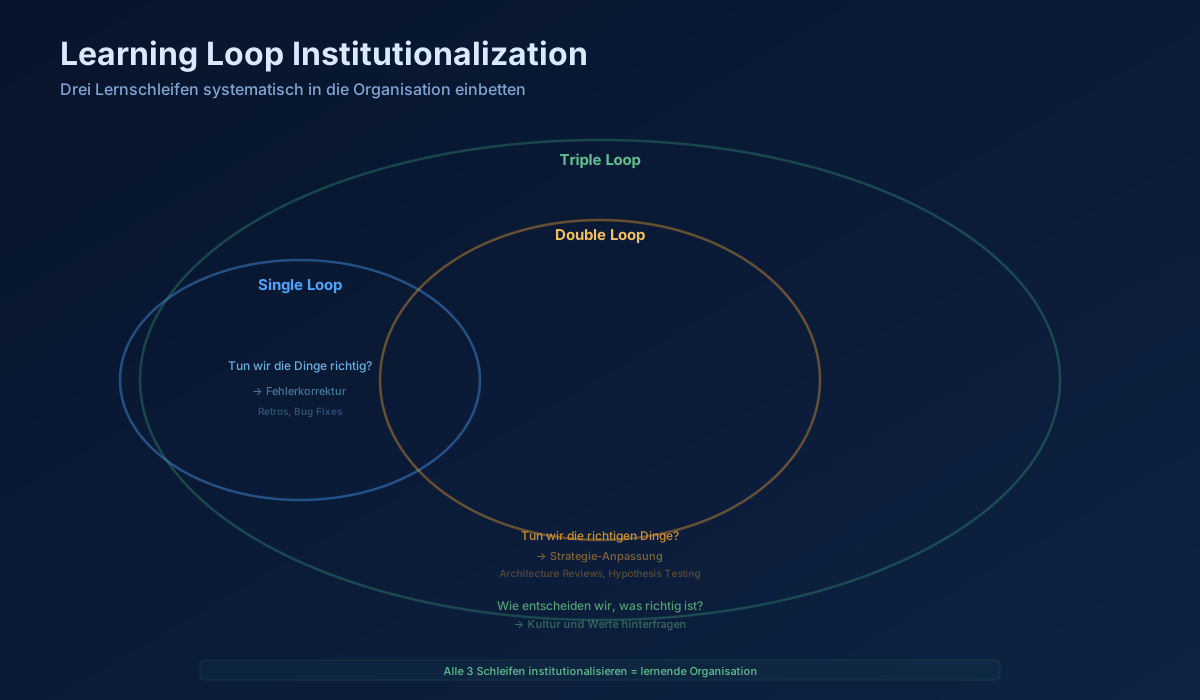
Most software teams are stuck in single-loop learning. When a server fails, someone runs a restart script and work continues. The immediate problem is gone, but the system has not learned. The same server fails again next week because nobody asked the double-loop question: why is our concept of availability so poor that rebooting a server is still considered an acceptable tool?
Intervention
"Learning Loop Institutionalization" embeds learning into the company's DNA. Formal blocks are added to architecture governance, such as mandatory blameless post-mortems after priority-one incidents. The intervention makes sure the response to an incident is not only a restart script but also a revisiting of the causal loop behind the event. The work is not considered done until the architecture has been modified so that this class of failure becomes structurally harder or impossible.
Expected Impact
Rescueric firefighting in ops begins to fade. The organization matures from a reactive bug-fix factory into a learning organization. Because recurring problems are structurally removed rather than repeatedly patched, support load can decline dramatically over time. Knowledge migrates from the heads of a few senior experts into automated pipelines, runbooks, and durable engineering structures.
Side Effects and Risks
The major risk is paralysis. If every tiny bug requires a 500-word double-loop reflection in Jira, the process suffocates itself. Developers start hiding issues because the learning overhead becomes too painful. Smart organizations reserve this intervention for structural bottlenecks and recurring failure patterns, not for every trivial typo.
Diagram
When This Intervention Becomes Effective
Chris Argyris and Donald Schon argued that mental models are among the biggest enemies of organizational learning. Double-loop learning attacks those models directly. It is not about making the deploy script 5% faster. It is about asking whether the deploy script should even exist if the organization can move toward immutable infrastructure.
What Distinguishes This Intervention from Other Levers
Capability Building over Fixes builds stronger skills within teams. Learning Loop Institutionalization is the higher-order company framework that creates the time, governance cadence, and formal process in which such capability can actually be built.
How to Introduce the Intervention Cleanly
Make actionable follow-ups the center of every retrospective and incident review. A meeting that ends with "We should be more careful next time" has wasted everyone's energy. The review should not close until a real architectural follow-up exists and an accountable owner has been assigned.
First Implementation Steps
Draw a sharp line between error and failure. If a team explores the edge of an unfamiliar cloud behavior and triggers a fail, that may be an intelligent error worth learning from. If a database password is committed into a public repository, that is a failure of tooling and education. Use double-loop learning to burn out preventable failure while still protecting intelligent experimentation.
How to Recognize Impact
Do we have a machine-enforced governance step, such as a pipeline gate, that guarantees lessons from a severe outage are woven back into the codebase as preventive checks?
Sources
Chris Argyris & Donald Schon — Organizational Learning II (FT Press, 1996)
Authors & Books
Go to referencesRelevant references for Learning Loop Institutionalization.
Leverage indicator
Leverage level 11 · Buffer sizes
Category: Structure
Go to interventions wheelContinue reading
Explore related topics from Interventions
Boundary Design
The physical and logical redrawing of boundaries such as APIs and team structures to drastically reduce friction and handoffs across the system.
Boundary Reframing
The strategic act of showing management that it shares responsibility for the current architecture problem because it defined the observation space too narrowly.