Information Flow Design
The deliberate design of transparency: who should see which operational signals so information remains usable and overload decreases.
Why it matters
Interventions matter when they do more than ease symptoms and instead shift system behavior sustainably.
Next step
Link the intervention to tools and decision rituals so it remains effective in day-to-day work.

System Problem
In modern architecture, decisions rarely fail because information is missing. They often fail because too many signals appear equally important. A tech lead receives many Slack messages, Jira emails, alerts, and meeting invitations per day. When every signal is equally loud, nothing is a clear signal anymore. Crucial architectural warnings vanish into noise because nobody consciously designed the paths through which information should travel.
Intervention
"Information Flow Design" treats information as a structural element of architecture, not as a passive byproduct. The intervention insists on reduction and channeling. Teams build information radiators such as simplified traffic-light dashboards, while also limiting distribution sharply. If someone is not on level-one support, they may be removed from the raw server-error channel entirely.
Expected Impact
Cognitive load drops. When developers receive only the telemetry relevant to their bounded context, focus and ability to act improve. Architects, meanwhile, can work with aggregated meta-signals that show trends instead of every raw operational message. The system shifts from push communication toward pull-on-demand and self-service.
Side Effects and Risks
The main danger is hiding information in the name of focus. If companies start suppressing error data from engineers, they create isolated silos that lose the larger context. There is also a leadership risk: when executives gain access to a beautifully designed real-time dashboard for thousands of servers, they may mistake visibility for omnipotent control and fall into micromanagement.
Diagram
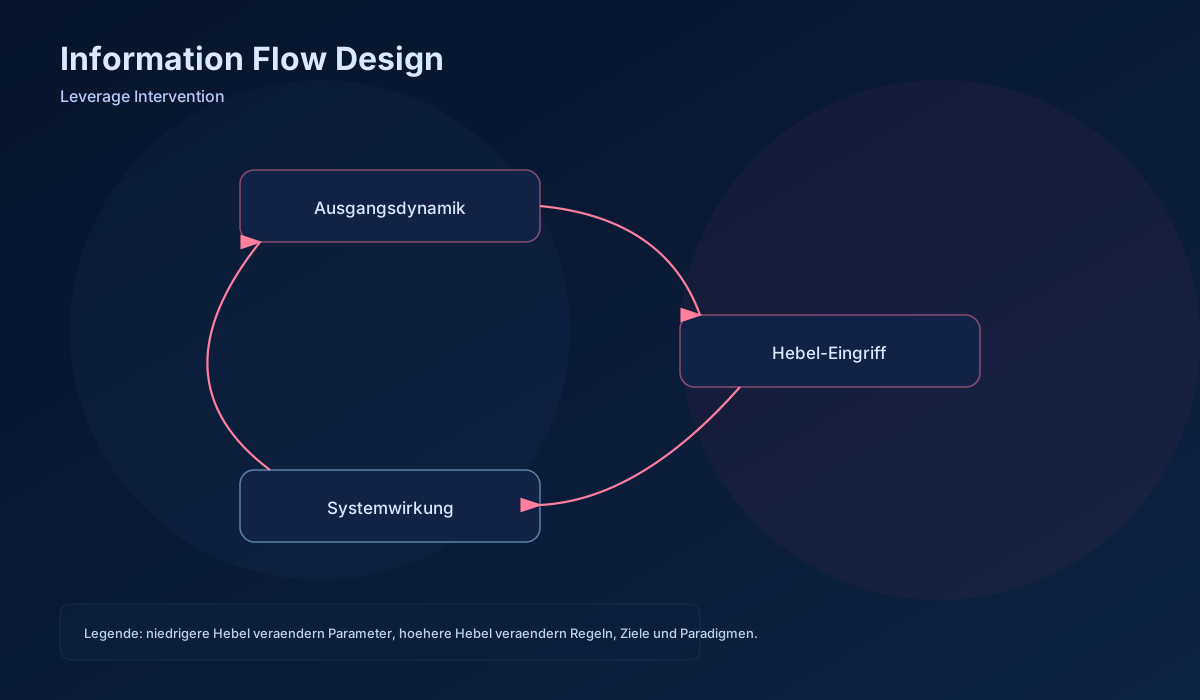
When This Intervention Becomes Effective
Meadows identifies the structure of information flows as a very strong leverage point. A classic example comes from household electricity meters: when the same meter is visible near the front door instead of hidden in the basement, usage patterns change. The presence and placement of information alters behavior. In software systems, visibility works the same way.
What Distinguishes This Intervention from Other Levers
Feedback Loop Redesign sharpens action and consequence. Information Flow Design is more foundational. It is the act of moving the meter from the basement into the hallway, or of showing developers the cloud cost of a request directly in the place where they work.
How to Introduce the Intervention Cleanly
Build information radiators, not information refrigerators. A dashboard that requires several clicks, filters, and a login before it becomes useful is a refrigerator: cold and hidden. A large screen in the team space that continuously displays the five most critical errors is a radiator: warm, visible, and impossible to ignore.
First Implementation Steps
Clean out Slack and Teams channels strictly. Add a signal-to-noise metric to retrospectives. If an ops channel received 200 automated messages last week and not a single one triggered action, delete that automation immediately. Information without action is cybernetic waste.
How to Recognize Impact
Do we have a fixed review point in our architecture governance, perhaps every six months, where we deliberately retire dashboards, cron emails, and reports that no longer influence decisions?
Sources
Donella Meadows — Leverage Points, Point 6: Information Flows
Gene Kim et al. — The DevOps Handbook, Ch. 3: Flow of Information
Authors & Books
Go to referencesRelevant references for Information Flow Design.
Leverage indicator
Leverage level 6 · Information flows
Category: Information
Go to interventions wheelContinue reading
Explore related topics from Interventions
Boundary Design
The physical and logical redrawing of boundaries such as APIs and team structures to drastically reduce friction and handoffs across the system.
Boundary Reframing
The strategic act of showing management that it shares responsibility for the current architecture problem because it defined the observation space too narrowly.