Incentive Redesign
The destruction of the cobra effect in IT by stopping the reward of failure-producing behavior and aligning incentives with system health instead.
Why it matters
Interventions matter when they do more than ease symptoms and instead shift system behavior sustainably.
Next step
Link the intervention to tools and decision rituals so it remains effective in day-to-day work.

System Problem
One of the iron laws of systems is this: a system behaves exactly as it is rewarded to behave. Many IT organizations say they want stable, low-defect software, but they pay bonuses based on the number of features shipped each quarter. The result is predictable. Developers rush broken code into production, collect the reward, and the support architecture collapses under incident load. That is not a developer problem. It is a perverse incentive problem.
Intervention
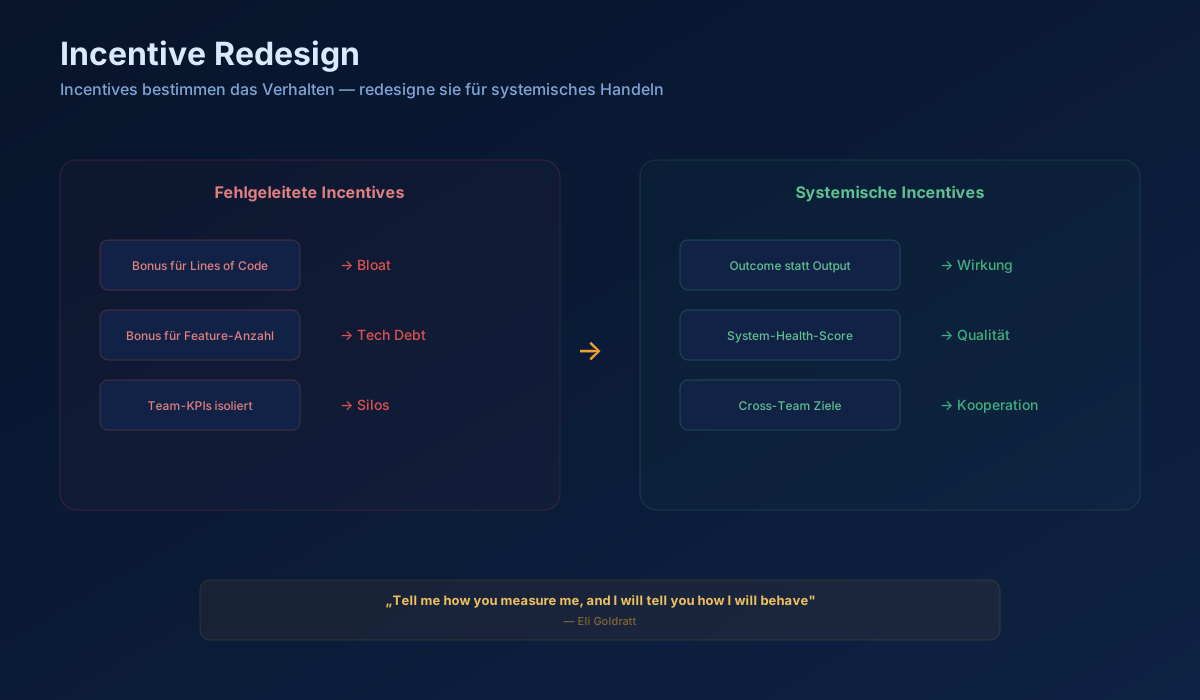
"Incentive Redesign" damages this harmful reward logic. If ops is rewarded for uptime and dev is rewarded for features, management has created two opposing incentive groups. The intervention rewires bonuses, promotions, praise, and rescuer narratives. Instead of celebrating the engineer who saved a unstable system over the weekend, the organization rewards the team whose system was so stable that nobody was called at all.
Expected Impact
When the carrot changes, the architecture changes with it. If a product owner's reward becomes partially tied to whether the ops team can sleep through the night, that product owner will suddenly support refactoring work out of self-interest. The trench war between feature speed and stability begins to dissolve because both sides are now tied to the same system-level outcome.
Side Effects and Risks
Incentives are easy to game. Reward teams for test coverage alone and they may write hundreds of tests with meaningless assertions just to hit the number. Any incentive system must be tested against the possibility of gaming. Good incentives therefore favor outcomes such as lead time, recovery speed, or customer satisfaction rather than simplistic inputs like commits or lines of code.
Diagram
When This Intervention Becomes Effective
The famous cobra effect tells the story of a government paying for dead cobra heads, which only led people to breed more cobras. The same pattern appears in IT whenever local metrics are rewarded without systemic thought. A gift card for every bug a tester finds can create a system that silently produces more bugs, not fewer.
What Distinguishes This Intervention from Other Levers
Feedback Loop Redesign changes the machine-like path of information and consequence. Incentive Redesign operates on the human layer: money, status, applause, and promotion. It reshapes what people actually want from the system.
How to Introduce the Intervention Cleanly
Tear down siloed bonuses that target one team in isolation. If frontend and backend live under competing OKRs, they will sabotage each other. Introduce shared OKRs around end-to-end lead time or reliability so both teams win only when the system as a whole improves.
First Implementation Steps
Listen carefully to leadership language in all-hands meetings. Who gets invited on stage? The team that caused a crisis and then looked reactive cleaning it up, or the team whose backend quietly handled two million requests without drama? If you want boring, healthy IT, you have to honor prevention more than spectacle.
How to Recognize Impact
Do our annual promotion guidelines explicitly recognize engineers who prevent problems, rather than mainly elevating people who become visible as reactive firefighters?
Sources
Donella Meadows — Leverage Points, Point 6: Structure of Information Flows
Steven Kerr — On the Folly of Rewarding A While Hoping for B (Academy of Management, 1975)
Authors & Books
Go to referencesRelevant references for Incentive Redesign.
Leverage indicator
Leverage level 11 · Buffer sizes
Category: Structure
Go to interventions wheelContinue reading
Explore related topics from Interventions
Boundary Design
The physical and logical redrawing of boundaries such as APIs and team structures to drastically reduce friction and handoffs across the system.
Boundary Reframing
The strategic act of showing management that it shares responsibility for the current architecture problem because it defined the observation space too narrowly.