Explicit Tradeoff Policies
The end of the architectural lie that you can have everything at once, forcing teams to declare what they are sacrificing in every system design.
Why it matters
Interventions matter when they do more than ease symptoms and instead shift system behavior sustainably.
Next step
Link the intervention to tools and decision rituals so it remains effective in day-to-day work.

System Problem
In systems thinking there are no pure solutions, only tradeoffs. When management demands maximum security, record speed, and no extra cost at the same time, it is asking for a physical fairy tale. Developers often bend under that pressure and assemble a Frankenstein system that quietly bleeds from every corner because the underlying contradictions were never made explicit. When tradeoffs stay implicit, the system fails unexpectedly in production.
Intervention
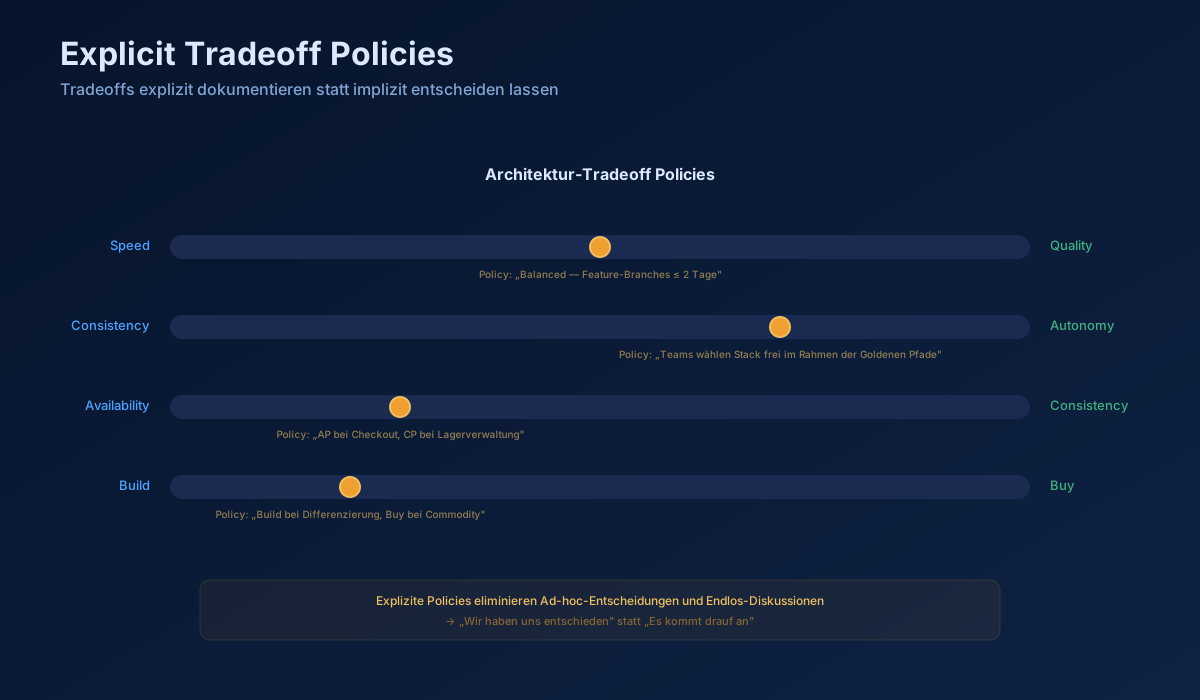
"Explicit Tradeoff Policies" impose deliberate honesty. Every architecture decision record, feature concept, and management conversation must start by naming the price. If an architect proposes microservices for better scalability, they must also state the tradeoff: for example, accepting the loss of strict ACID consistency and tolerating a few minutes of data divergence. The intervention formalizes the sacrifice instead of hiding it.
Expected Impact
The quality of strategic debate rises sharply. The endless finger-pointing between IT and business begins to fade. If the business later complains that customer data is asynchronous, engineering can point back to the signed tradeoff policy that explicitly exchanged consistency for Black Friday performance. The culture becomes more adult and more engineering-driven.
Side Effects and Risks
This intervention demands backbone from CTOs and architects. Many organizations punish people who deliver inconvenient truths. An architect who tells the board that Feature A cannot be built without endangering Stability B may be dismissed as a blocker. Explicit tradeoff work only succeeds when management accepts that software architecture is constrained by real zero-sum tensions.
Diagram
When This Intervention Becomes Effective
Mark Richards and Neal Ford describe the balancing of quality attributes such as scalability, security, and maintainability as the core profession of the architect. One simple way to make tradeoffs tangible is the slider method: give the product owner 100 points to distribute across time to market, security, and performance. Raising one slider necessarily lowers another, which makes the system's constraints visible.
What Distinguishes This Intervention from Other Levers
Boundary Reframing helps stakeholders see beyond their silo. Explicit Tradeoff Policies go a step further by forcing them to accept formally that choosing X will damage or limit Y.
How to Introduce the Intervention Cleanly
Reject Jira tickets and epic descriptions that contain only positive goals such as "Users can log in faster." Add a required field to the template named "Negative side effects we are willing to accept." If that field stays empty, the ticket author has not yet understood the cybernetic nature of the system.
First Implementation Steps
Use the CAP theorem as the perfect teaching example. Even the smartest distributed-systems researchers cannot bypass it. Teams have to choose. Once engineers internalize that they cannot have consistency, availability, and partition tolerance in an unconstrained way, tradeoff literacy becomes much easier to institutionalize.
How to Recognize Impact
Are the tradeoffs of our core architecture, such as optimizing for developer speed at the cost of higher cloud spend, documented not just in architects' heads but in onboarding material for every new engineer?
Sources
Gregor Hohpe — The Software Architect Elevator, Ch. 8: Tradeoffs (O'Reilly, 2020)
Mark Richards & Neal Ford — Fundamentals of Software Architecture (O'Reilly, 2020)
Authors & Books
Go to referencesRelevant references for Explicit Tradeoff Policies.
Leverage indicator
Leverage level 11 · Buffer sizes
Category: Structure
Go to interventions wheelContinue reading
Explore related topics from Interventions
Boundary Design
The physical and logical redrawing of boundaries such as APIs and team structures to drastically reduce friction and handoffs across the system.
Boundary Reframing
The strategic act of showing management that it shares responsibility for the current architecture problem because it defined the observation space too narrowly.