Daily Systems Thinking Practice
An organizational hack for smuggling systems thinking out of abstract books and into the deliberate 15-minute reality of agile daily stand-ups.
Why it matters
Interventions matter when they do more than ease symptoms and instead shift system behavior sustainably.
Next step
Link the intervention to tools and decision rituals so it remains effective in day-to-day work.

System Problem
Management and architects read thick books about team topologies and systems thinking. Once a year they run an inspiring workshop and declare that everyone must think more systemically. Then on Monday the production database collapses, panic spreads, executives start threatening, and everyone instantly falls back into the old linear firefighting pattern: write a bug ticket fast and punish whoever caused it. The philosophy dies because it never became muscle memory.
Intervention
"Daily Systems Thinking Practice" implants tiny cybernetic routines into the relentless cadence of Scrum or Kanban. The scrum master or lead architect enforces one short and uncomfortable systems question in every daily, sprint planning, or incident review before coding continues. The routine is intentionally small, but it is non-negotiable.
Expected Impact
The team slowly unlearns the panic response to local symptoms. A culture of pause and pattern matching emerges. When someone says in a daily, "Ticket XY is blocking us again," the team no longer defaults to "I'll just work an extra hour tonight." Instead it asks, "Let's spend two minutes looking at the boundary. Doesn't this actually belong in the platform team's bounded context?" The average developer becomes a mini-architect of the infrastructure they touch.
Side Effects and Risks
The obvious risk is academic overload. If the scrum master starts drawing elaborate causal loop diagrams on the whiteboard during a 15-minute stand-up, developers will hate the practice because they want to get back to the code. Systems thinking has to be radically slimmed down. Overemphasizing the big systemic problem can also become an excuse for avoiding small but necessary tasks.
Diagram
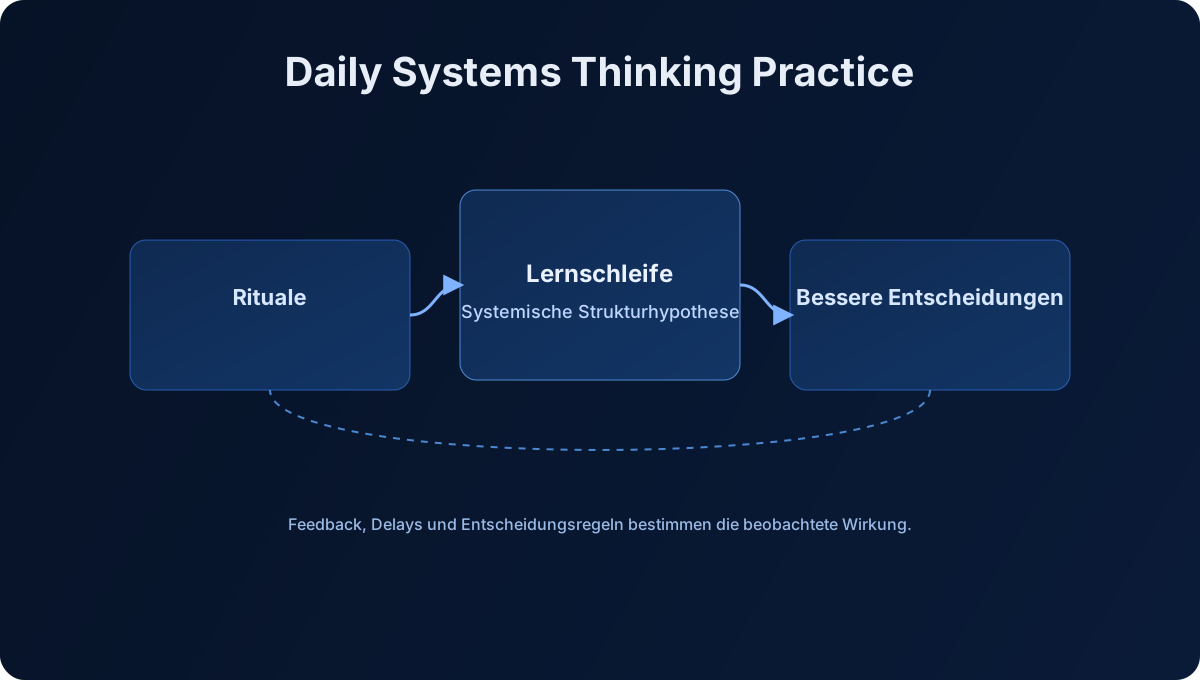
When This Intervention Becomes Effective
This intervention turns sensemaking into an operational reflex. The best technology companies encode these routines into Jira templates and pull request checklists. Rather than hoping people will think systemically, they design tools that demand it. If your post-mortem tool includes a required field asking how the system could have prevented the issue by design, you are cultivating systems thinkers every day.
What Distinguishes This Intervention from Other Levers
This practice works in direct tandem with Systems Clues in Everyday Language. First you listen to how developers speak in meetings and notice clues of faulty linear thinking. Then, in the same meeting, the daily practice interrupts that pattern with a question about delays, feedback loops, or boundaries to push the thinking back up to system level.
How to Introduce the Intervention Cleanly
Before any story-point estimate is allowed during backlog refinement, require three questions:
1.Are we attacking a local symptom or the deeper cause?
2.Which neighboring team or boundary will feel the delay if this takes longer?
3.Do we have the capacity to absorb the side effects of this feature next week, or are we only optimizing for the moment?
First Implementation Steps
Do not begin by talking about "systems thinking" as a grand theory. It sounds abstract and consultative. Instead, consistently ask about delays, second-order effects, and the mental models behind a proposal: why exactly do we believe Tool X will solve the problem?
How to Recognize Impact
Does our standard root cause analysis template for priority-one incidents require a final section that sketches the hidden systemic failure pattern, or do we still chase only surface metrics such as MTTR?
Sources
The Systems Thinker: Guidelines for Daily Systems Thinking Practice
Peter Senge — The Fifth Discipline Fieldbook (Doubleday, 1994)
Daniel Kim — Systems Thinking Tools (Pegasus Communications)
Authors & Books
Go to referencesRelevant references for Daily Systems Thinking Practice.
Leverage indicator
Leverage level 11 · Buffer sizes
Category: Structure
Go to interventions wheelContinue reading
Explore related topics from Interventions
Boundary Design
The physical and logical redrawing of boundaries such as APIs and team structures to drastically reduce friction and handoffs across the system.
Boundary Reframing
The strategic act of showing management that it shares responsibility for the current architecture problem because it defined the observation space too narrowly.