Coupling Reduction
The deliberate cutting of hard, blocking dependencies between parts of the system to buy local autonomy at the cost of some consistency.
Why it matters
Interventions matter when they do more than ease symptoms and instead shift system behavior sustainably.
Next step
Link the intervention to tools and decision rituals so it remains effective in day-to-day work.

System Problem
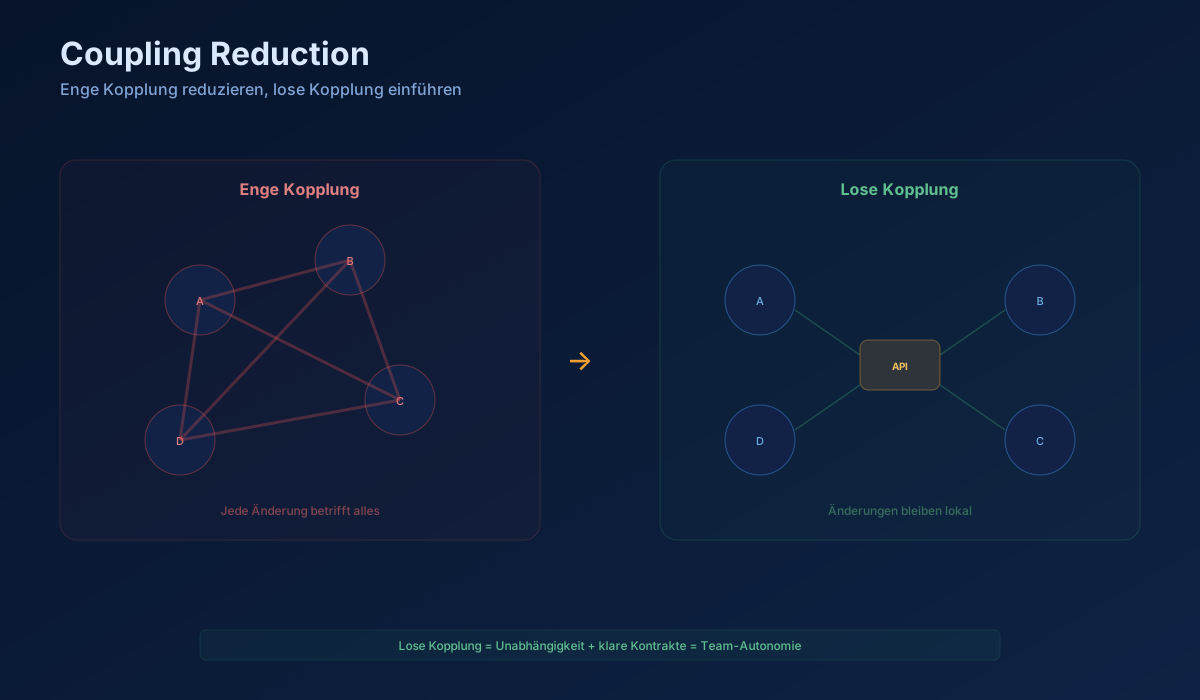
In tightly coupled systems, local pain spreads globally like a shock wave. If Team A changes its database schema, the builds of Teams B, C, and D break. Every deployment feels dangerous because someone might damage another part of the company. The system paralyzes itself through the need for permanent synchronization, and the classic release train becomes a symptom of extreme coupling.
Intervention
"Coupling Reduction" actively cuts these knots. It replaces synchronous HTTP calls with asynchronous communication such as message queues, Kafka, or event-driven patterns. It introduces anti-corruption layers so one team can use another team's data without binding itself to that team's internal model. At the organizational level it means Team A may deploy whenever it wants, without permission from Team B, as long as the API contract remains intact.
Expected Impact
The system shifts from rigidity to resilience. If Team B's service fails, Team A can continue working through queues and graceful degradation. Developer satisfaction rises because teams regain local autonomy and no longer wait days for approvals from neighboring departments.
Side Effects and Risks
What you gain in decoupling, you pay for in consistency and complexity. If you break synchronous transactions into distributed asynchronous services, you have to manage eventual consistency. Users may temporarily see incorrect balances until all systems catch up. Debugging becomes harder, which makes distributed tracing mandatory. If you cut coupling too aggressively without enough operational maturity, the architecture can collapse under its own distributed complexity.
Diagram
When This Intervention Becomes Effective
Software architecture is always a struggle with coupling. The important nuance is that there is no universal good or bad coupling. There is domain coupling, where things that belong together change together, and implementation coupling, where teams are tied together only because they share technical internals. This intervention is aimed precisely at damageing harmful implementation coupling while protecting meaningful domain relationships through clean APIs.
What Distinguishes This Intervention from Other Levers
Dependency Mapping makes harmful coupling visible on paper. Coupling Reduction is the action that follows: it is where the architect takes a knife to the knot and redesigns the interaction around contracts, asynchrony, or isolation boundaries.
How to Introduce the Intervention Cleanly
Be willing to make the hardest cut first: eliminate shared databases. As long as two microservice teams write to the same Oracle database, they remain coupled no matter how modern the org chart looks. The strongest architectural doctrine is simple: every bounded context owns its own database, and the only legitimate way to reach the data is through the service owner's API.
First Implementation Steps
Do not confuse reduced coupling with total isolation. Teams still need to align on product direction. Use mechanisms such as consumer-driven contracts to ensure that technical decoupling does not turn into silent misunderstanding between services that then fail in production.
How to Recognize Impact
Can we deploy a critical core backend service on a Wednesday morning without anyone in DevOps having to coordinate a release synchronization across three other teams?
Sources
Sam Newman — Building Microservices, Ch. 3: Splitting & Coupling (O'Reilly, 2021)
Authors & Books
Go to referencesRelevant references for Coupling Reduction.
Leverage indicator
Leverage level 10 · Stock and flow structures
Category: Structure
Go to interventions wheelContinue reading
Explore related topics from Interventions
Boundary Design
The physical and logical redrawing of boundaries such as APIs and team structures to drastically reduce friction and handoffs across the system.
Boundary Reframing
The strategic act of showing management that it shares responsibility for the current architecture problem because it defined the observation space too narrowly.