Moving from Blame to Accountability
A cultural intervention that abolishes "human error" as an excuse for production outages and holds flawed system design accountable instead.
Why it matters
Interventions matter when they do more than ease symptoms and instead shift system behavior sustainably.
Next step
Link the intervention to tools and decision rituals so it remains effective in day-to-day work.

System Problem
In 99% of traditional IT companies, the post-mortem after a major outage ends with a sentence like: "Developer X ran the wrong script. We told them to be more careful." That is blame. From a systems perspective, it is completely useless. If you punish the person, you hide the failures in the system that made it possible for that person to press the red button in the first place. The result is predictable: developers hide their mistakes out of fear, organizational learning stops, and the architecture quietly continues to decay.
Intervention
"Moving from Blame to Accountability" replaces person-centered fault-finding with systemic accountability. The mindset flips 180 degrees: "People do not simply fail in isolation. The system was designed so poorly that it misled or abandoned the developer." The intervention establishes a blameless post-mortem culture.
Expected Impact
Once developers no longer fear being fired or publicly humiliated, they start speaking honestly about near misses. Communication about failure improves dramatically. Architects suddenly receive the raw information they need about where the CI/CD pipeline truly hurts. Fixes now target structural weaknesses, such as adding an automatic syntax check, instead of moral appeals like "Please try harder next time."
Side Effects and Risks
"Blameless" is often misunderstood by junior managers as "without consequences." That is dangerous. Accountability means strong responsibility for the learning process. If a developer takes production down, they do not lose their bonus. But they do have the absolute obligation to help produce a concrete architectural change within the next 48 hours so that the same class of failure becomes impossible.
Diagram
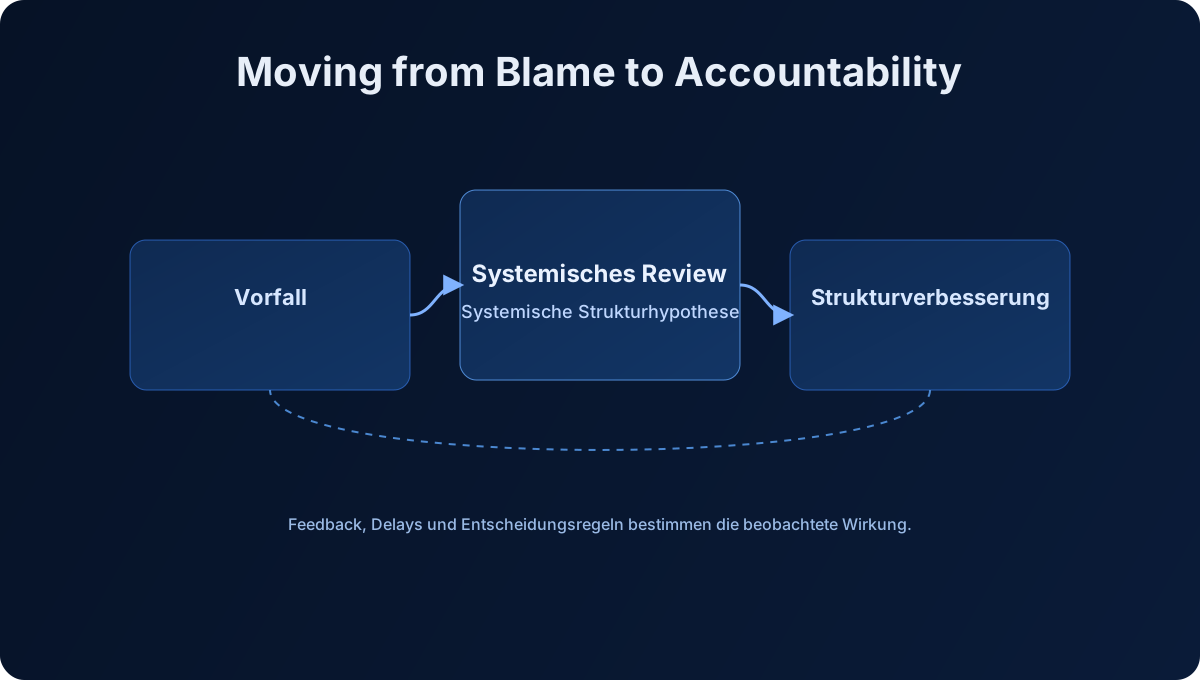
When This Intervention Becomes Effective
Systems thinkers such as Sidney Dekker, through the idea of a Just Culture, have shown that in highly complex environments like distributed microservices, a single clean root cause often does not exist. Outages are usually the result of ten small, perfectly ordinary deviations lining up at once. The search for the guilty individual is therefore not just unfair, but scientifically misleading.
What Distinguishes This Intervention from Other Levers
Causal Loop Diagrams (CLD) and the Iceberg Model can be used in a retrospective to show that the "fault" did not actually lie with the developer. But this intervention is the social and psychological contract that gives people enough safety to participate in that diagnosis at all. Without it, nobody will help draw the real loops.
How to Introduce the Intervention Cleanly
Ban the question "Who did this?" from all technical incident reviews. Replace it with "What happened here?", followed by "What information was missing at the moment of decision?" and "How did the architecture allow a local click to damage the global system?"
First Implementation Steps
This intervention must be modeled from the top down by the CIO or CTO. One of the strongest leverage points is the moment when a senior manager or lead architect stands in front of the whole engineering organization and openly explains how they themselves almost deleted the database yesterday, and how unsuitable the system design was at that point.
How to Recognize Impact
Do our HR and bonus structures actually allow a blameless culture, or do they still use individual bug counts as a basis for punishment?
Sources
The Systems Thinker: Moving from Blame to Accountability
Authors & Books
Go to referencesRelevant references for Moving from Blame to Accountability.
Leverage indicator
Leverage level 11 · Buffer sizes
Category: Structure
Go to interventions wheelContinue reading
Explore related topics from Interventions
Boundary Design
The physical and logical redrawing of boundaries such as APIs and team structures to drastically reduce friction and handoffs across the system.
Boundary Reframing
The strategic act of showing management that it shares responsibility for the current architecture problem because it defined the observation space too narrowly.