System Boundaries
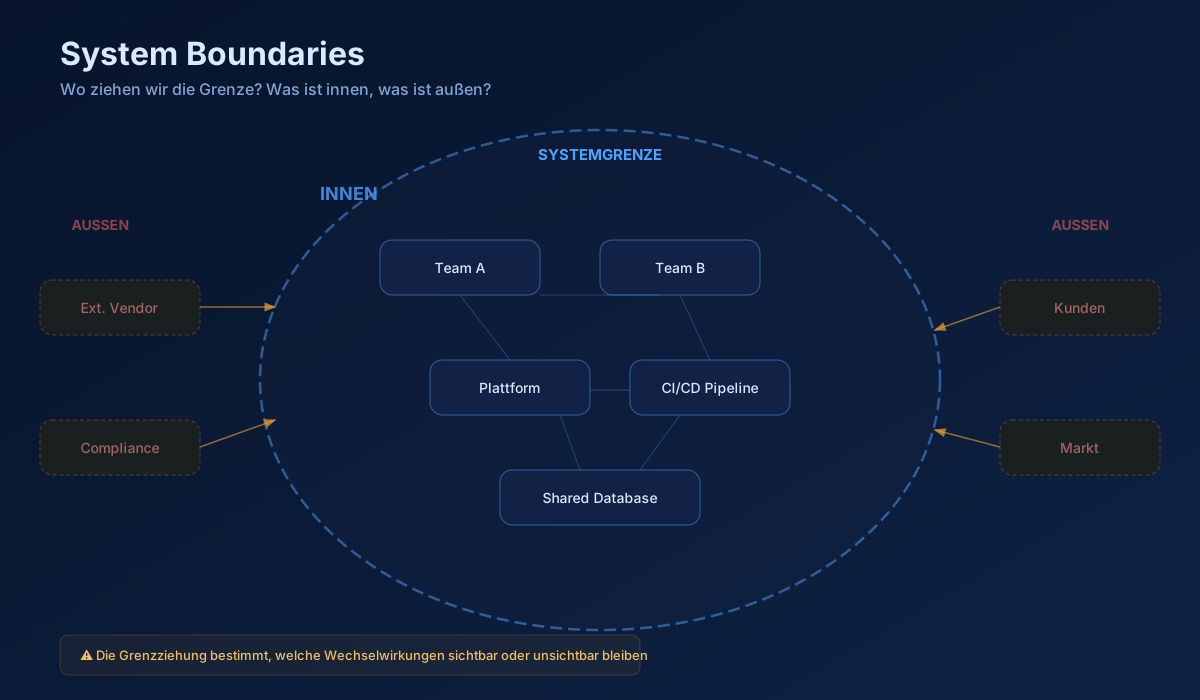
System boundaries are purely mental lines that we draw to separate what belongs to our architecture from what supposedly lies outside our control.
Why it matters
Use this concept to explain observable behavior structurally rather than merely naming it.
Next step
Next, check which archetype or diagnostic method makes the pattern visible in the concrete system.

Definition
In reality, there are no perfectly isolated systems. Everything is connected to everything else to some degree. To analyze and build software anyway, the mind has to draw boundaries. A system boundary determines what counts as internal complexity, meaning the things we want to understand, measure, and change, and what we exclude as the environment, meaning the things we treat as fixed or irrelevant. Drawing that line is one of the most powerful decisions an architect makes.
System Mechanism
If we draw the boundary too narrowly, we may optimize our local area efficiently, such as a microservice, but overlook problematic feedback effects in the surrounding environment. If we draw it too widely, we drown in complexity because every tiny feature seems to require hundreds of stakeholders and edge cases. The result is analysis paralysis.
Architecture Example
A DevOps team optimizes cloud utilization in its Kubernetes cluster and runs CPUs close to the limit. For that team, the system boundary is the namespace, where everything looks stable. What they have excluded is the frontend team outside that boundary, where small backend latency increases create terrible Core Web Vitals for real users. Because the customer sat outside the team's chosen boundary, a local optimization became problematic for company conversion rate.
Organizational Example
Product management measures itself by features delivered per sprint. Sales is measured by customer satisfaction and renewal rate. Those are different system boundaries. If the product team ships sloppy code without maintenance tooling, it may satisfy its own metric while pushing the sales organization on the other side of the fence into disaster as support calls spike. Poor boundaries inside the company can damage the end-to-end customer value stream.
Diagnostic Questions
1.In our failure analysis, have we systematically excluded external drivers by saying "that is not our code, that is Team X," even though the end product still failed?
2.Are we excluding important stakeholders or user perspectives from solution design simply because it makes the architecture decision easier?
3.In which committees are missing or badly drawn boundaries forcing us into endless administrative loops without a functional decision?
Diagram
Why This Concept Helps in Architecture
System boundaries are clouds, not stone walls. Excellent architects draw causal diagrams deliberately at different zoom levels. They start in detail, then step back and expand the cloud of the boundary to see whether balancing loops from the surrounding environment are shaping the model. Every new feature requires an explicit question: does our responsibility end at the API gateway, or do we measure value at the level of the end customer?
How to Distinguish It from Similar Topics
System boundaries interact directly with the cybernetic concept of open and closed systems. The boundary draws the line, but the design of that line determines how much variety and exchange passes across it.
How to Use the Concept in Practice
Listen carefully to the language used in architecture meetings. Sentences such as "We have no influence over that," "That must be treated as a black box," or "That ticket is out of scope" are acts of boundary setting. When dealing with stubborn incidents and fixes that fail, ask whether the real problem has been excluded from the chosen scope all along. If yes, the scope has to widen even if that is uncomfortable.
First Implementation Steps
Use practices such as Event Storming, which force business and technology to stand at the same wall and model the full causal chain of an event. Narrow departmental boundaries tend to break open automatically in that process.
How You Recognize Impact
Do our success metrics, such as DORA or uptime, measure only behavior inside our team boundary, or do we dare to be measured on complete user journeys?
Sources
Donella Meadows — Thinking in Systems, Kap. 3: Boundaries
Werner Ulrich — Critical Heuristics of Social Planning (Haupt, 1983)
Authors & Books
Go to referencesRelevant references for System Boundaries.
Concept Visual
System Boundary: Included and excluded elements shape the diagnostic quality.