Self-Organization
Self-organization is the remarkable property of complex systems to produce structures, patterns, and learning processes without central blueprints or control instances.
Why it matters
Use this concept to explain observable behavior structurally rather than merely naming it.
Next step
Next, check which archetype or diagnostic method makes the pattern visible in the concrete system.

Definition
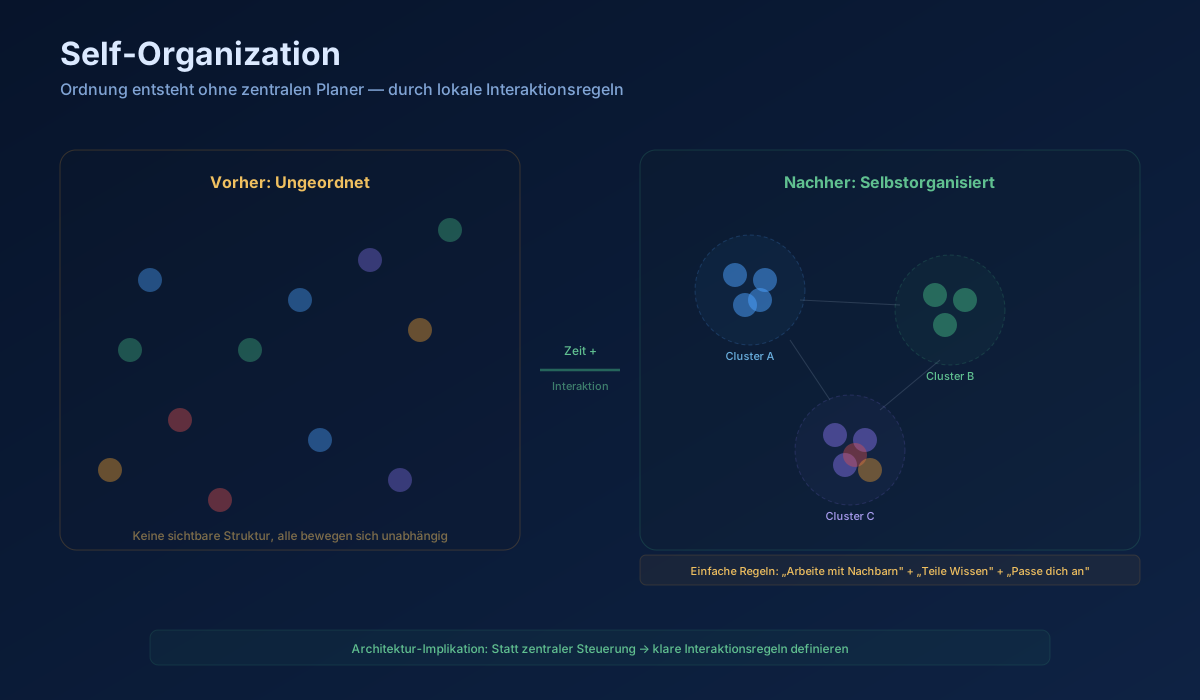
In cybernetics and complexity theory, self-organization describes how order emerges from chaos. A system organizes itself when countless small agents, such as molecules, bees, microservices, or developers, interact according to simple local rules. Even though nobody orchestrates an exact master plan, the macro level develops coordinated, stable, and adaptive behavior patterns.
System Mechanism
The strongest engine of self-organization is the system's ability to learn and change its own rules through feedback. When reinforcing and balancing loops remain intact, systems discard inefficient connections and strengthen effective ones. A central steering authority, such as management, is not required for that process and in highly complex settings may even work against it.
Architecture Example
The internet through TCP/IP and BGP is an ultimate architecture example of self-organization. No central internet administrator plans how a packet moves from Berlin to New York or supervises every router that joins the network. When a new cable is plugged in, routers exchange routes locally and the overall system seamlessly reorganizes global traffic. Without that self-organization, internet-scale growth would never have been possible.
Organizational Example
Consider an established open-source project such as Linux. There is no classic department management, no fixed office-hour model, and no central five-year release plan. Developers choose which bugs to fix. Self-organization emerges because there are clear and strict guardrails such as Git workflows, pull request reviews, and automated CI checks. Those simple but hard rules create one of the world's most stable code bases from the bottom up.
Diagnostic Questions
1.Are we, as an architecture board, desperately trying to control a highly complex platform centrally instead of creating the conditions for self-organization in engineering teams?
2.Are we robbing the organization of its learning capability by punishing failure instead of using local feedback to help teams adjust their own rules?
3.Are we confusing self-organization with anarchy and therefore refusing to define the guardrails, APIs, and coding standards that make it possible?
Diagram
Why This Concept Helps in Architecture
Self-organization does not mean laissez-faire. Genuine self-organization works only when clear boundaries and strong fitness functions exist. Architects who want to build distributed systems, whether service meshes or team structures, have to become gardeners. You do not command a plant exactly how to grow, but you provide the trellis and prepare the soil so the desired emergent behavior can appear.
How to Distinguish It from Similar Topics
Emergence is the surprising result we can observe on the surface. Self-organization is the ongoing internal process of learning, ordering, and restructuring through which a system creates that emergence. Adaptation goes one step deeper by changing how self-organization itself works in response to the environment.
How to Use the Concept in Practice
The hardest lesson for many IT leaders is that scaling beyond a certain size works only through self-organization. Stop founding more central committees. Invest instead in enabling constraints such as clear API standards, lightweight paved roads, and fully automated testing. Then let product teams orchestrate the rest as a self-organizing ecosystem.
First Implementation Steps
Do not underestimate the value of transparency and observability. Self-organization collapses when local agents cannot see real system feedback, such as hidden cloud costs. When teams can see the metrics in real time, they often steer themselves with surprising precision.
How You Recognize Impact
In post-mortems, do we trust the system, meaning our teams, to adapt new rules through self-organization, or does a controller always appear immediately with more checklists?
Sources
Stuart Kauffman — At Home in the Universe (Oxford UP, 1995)
Donella Meadows — Thinking in Systems, Kap. 3: Self-Organization
Authors & Books
Go to referencesRelevant references for Self-Organization.
Concept Visual
Self Organization: Local rules create self-reinforcing structural patterns.