Resilience
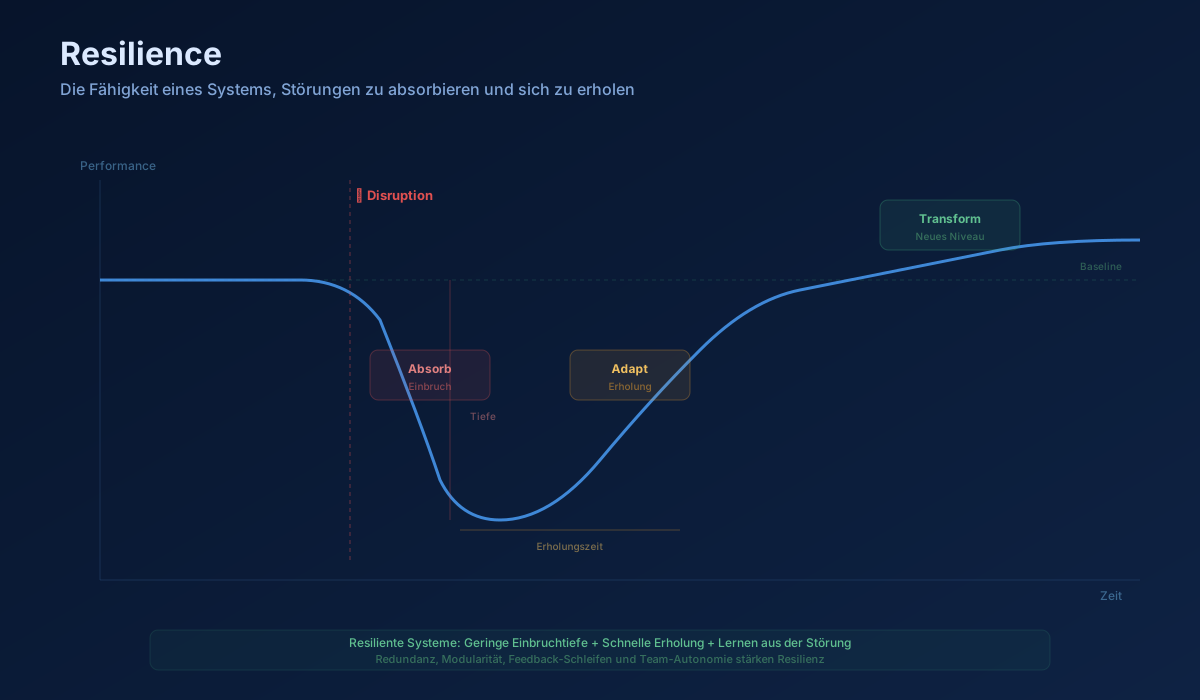
Resilience is the ability of a system not only to survive destructive shocks from outside, but to recover while preserving its structure.
Why it matters
Use this concept to explain observable behavior structurally rather than merely naming it.
Next step
Next, check which archetype or diagnostic method makes the pattern visible in the concrete system.

Definition
In systems theory, resilience describes the degree to which a system preserves its structural integrity even when it faces severe and unforeseen shocks. Resilience does not focus on efficiency or steady throughput under normal conditions. It focuses on behavior under stress. A system loses resilience when its redundant buffers are exhausted or when its balancing structures have been optimized away in the name of efficiency.
System Mechanism
Resilience emerges from a rich set of balancing feedback loops. When one part of the system fails, other parts must be able to absorb the load or function elastically through redundancy. If those mechanisms are missing because every idle reserve has been cut away for efficiency, even a small stressor can collapse the entire structure like a house of cards.
Architecture Example
A classic e-commerce architecture is designed for maximum database consistency and throughput. When the global payment provider fails for ten minutes, the database blocks all orders, resources saturate, and within minutes the whole website, including catalog and search, goes down. That system is not resilient. A resilient e-commerce architecture would isolate the failure through asynchronous messaging: checkout would store orders locally, customers could keep shopping, and payments would be replayed once the provider recovers.
Organizational Example
An engineering team has been tuned for maximum feature velocity. The bus factor is dangerously low because only Maria understands the CI/CD pipeline. Maria gets sick. Suddenly nobody can deploy, frustration rises, managers escalate, and team morale collapses. The organization had no resilience through shared knowledge or learning buffers. It was brittle.
Diagnostic Questions
1.Where have we optimized away redundant systems, slack time, or shared learning practices in the name of cost or efficiency and thereby damaged resilience?
2.If a single third-party system silently shuts down today, does the failure remain local or does it drag our entire core application into a cascading outage?
3.Which quiet resilience buffers, such as the experience of a few senior engineers, are we currently overlooking until they disappear?
Diagram
Why This Concept Helps in Architecture
Systems thinkers such as C. S. Holling point out a fundamental tension between pure output and deep resilience. If you optimize a system too aggressively for smoothness and suppress every small failure immediately, you also remove the opportunities it needs to practice adapting to shocks. That is why practices such as chaos engineering matter. They train the resilience loops of the system before the real crisis arrives.
How to Distinguish It from Similar Topics
Resilience is often confused with stability. Stability is an output measure about how few errors happen today. A system can be highly stable right now and still operate close to a cliff edge with very little resilience. Resilience asks how large tomorrow's shock can be before the structure collapses. It also differs from adaptation: resilience means absorbing shock and bouncing back, while adaptation means learning and becoming better.
How to Use the Concept in Practice
In architecture decisions, name resilience mechanisms explicitly and weigh them openly against efficiency. If a manager asks why a slower asynchronous queue is used instead of a direct database write, the honest answer may be that the team is buying resilience against main-system failures at the price of speed. Resilience nearly always looks inefficient in advance.
First Implementation Steps
Promote graceful degradation at every level of management. Good systems do not die immediately with a 500 error. They continue to provide partial functionality, such as static landing pages or disabled search, while protecting the core.
How You Recognize Impact
Can we tolerate the discomfort of active chaos engineering scripts taking down servers in the background because we trust that it strengthens long-term resilience?
Sources
C.S. Holling — Resilience and Stability of Ecological Systems (1973)
David Woods — Resilience Engineering: Concepts and Precepts (Ashgate, 2006)
Authors & Books
Go to referencesRelevant references for Resilience.
Concept Visual
Resilience: Feedback keeps the system functioning despite disruptions.