Open and Closed Systems
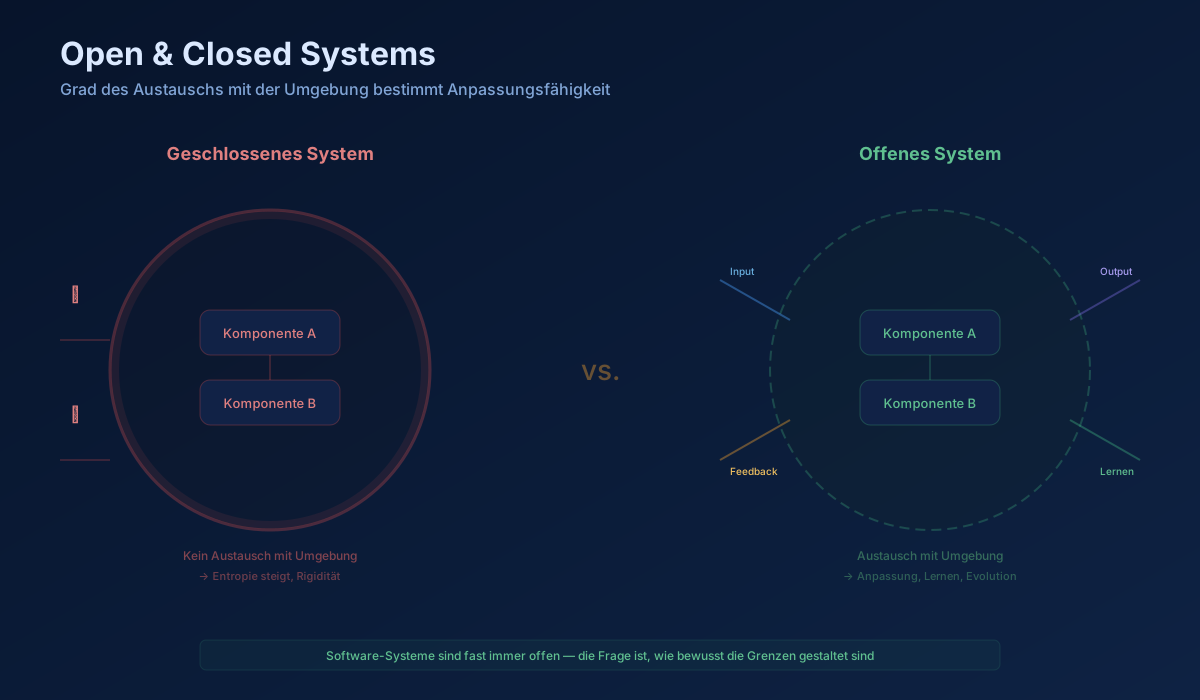
Closed systems decouple from their environment, while open systems exist in constant exchange of energy and information.
Why it matters
Use this concept to explain observable behavior structurally rather than merely naming it.
Next step
Next, check which archetype or diagnostic method makes the pattern visible in the concrete system.

Definition
The distinction between open and closed systems describes how strongly a system interacts with its environment. Closed systems are, in theory, isolated. They exchange neither energy nor signals with the outside world and tend toward disorder over time. Open systems sustain themselves, or even grow, by taking in inputs from their environment, processing them, and producing outputs. In software architecture, the exact boundary is always a modeling choice rather than an absolute fact.
System Mechanism
Open systems depend heavily on the availability, consistency, and timing of external resources such as user traffic or third-party APIs. They must be able to absorb fluctuations at those interfaces. If we mentally treat such a system as closed, we ignore outside influences and focus only on internal efficiency. The danger appears when genuinely open systems are managed as if they were closed.
Architecture Example
A core banking system is often designed like a relatively closed system: maximum internal predictability, restrictive batch processes, few external triggers, and a focus on absolute consistency. A modern e-commerce recommendation engine is a highly open system. Its value scales through constant asynchronous exchange with clickstream data, third-party inventory, and live user behavior. If you try to build the recommendation engine with the rigid architectural patterns of the banking core, you suffocate it.
Organizational Example
A classic command-and-control company often behaves mentally like a closed system. Plans are fixed for three years, and leaders act as though the market should adapt to the plan. Modern organizations behave more like open systems. Teams are expected to absorb continuous external customer feedback and adjust product strategy quarter by quarter. Open organizations survive through continuous adaptation.
Diagnostic Questions
1.Are we building components as if we were completely self-contained even though a small API change in a third-party system could bring us down?
2.How porous are our system boundaries? Do critical signals flow quickly enough from the environment into development teams?
3.Is our system becoming more disordered over time because it has sealed itself off from new technological impulses?
Diagram
Why This Concept Helps in Architecture
Good architecture deliberately manages permeability. We build anti-corruption layers to shield a subsystem and partially close it when the surrounding environment is unstable or harmful, such as legacy code. Conversely, we open architectures through APIs, webhooks, and event streaming when we want strong interoperability and external innovation.
How to Distinguish It from Similar Topics
This concept is tightly linked to system boundaries. The boundary draws the line. Open versus closed describes how much actual exchange is allowed across that line.
How to Use the Concept in Practice
For every new architectural building block, ask whether it must behave as an open system moving with the flow of its environment, which implies a focus on resilience and loose coupling, or as a highly shielded safe space focused on internal consistency and strong access control. Mixing both modes inside the same module usually creates unclear integration.
First Implementation Steps
Watch out for the Not Invented Here syndrome. It is often the expression of an organization trying to close itself artificially, which usually ends in isolation and obsolescence.
How You Recognize Impact
Were assumptions about traffic, utilization, and external data quality tested through resilience exercises instead of validating the system in isolation under lab conditions?
Sources
Ludwig von Bertalanffy — General System Theory (Braziller, 1968)
Wikipedia: Open System (Systems Theory))
Donella Meadows — Thinking in Systems, Kap. 3: System Boundaries
Authors & Books
Go to referencesRelevant references for Open and Closed Systems.
Concept Visual
Open and Closed Systems: Different boundary definitions change observation and control.