Non Linear Effects
Nonlinear effects mean that small causes can trigger significant consequences, while huge efforts often fade without visible impact.
Why it matters
Use this concept to explain observable behavior structurally rather than merely naming it.
Next step
Next, check which archetype or diagnostic method makes the pattern visible in the concrete system.

Definition
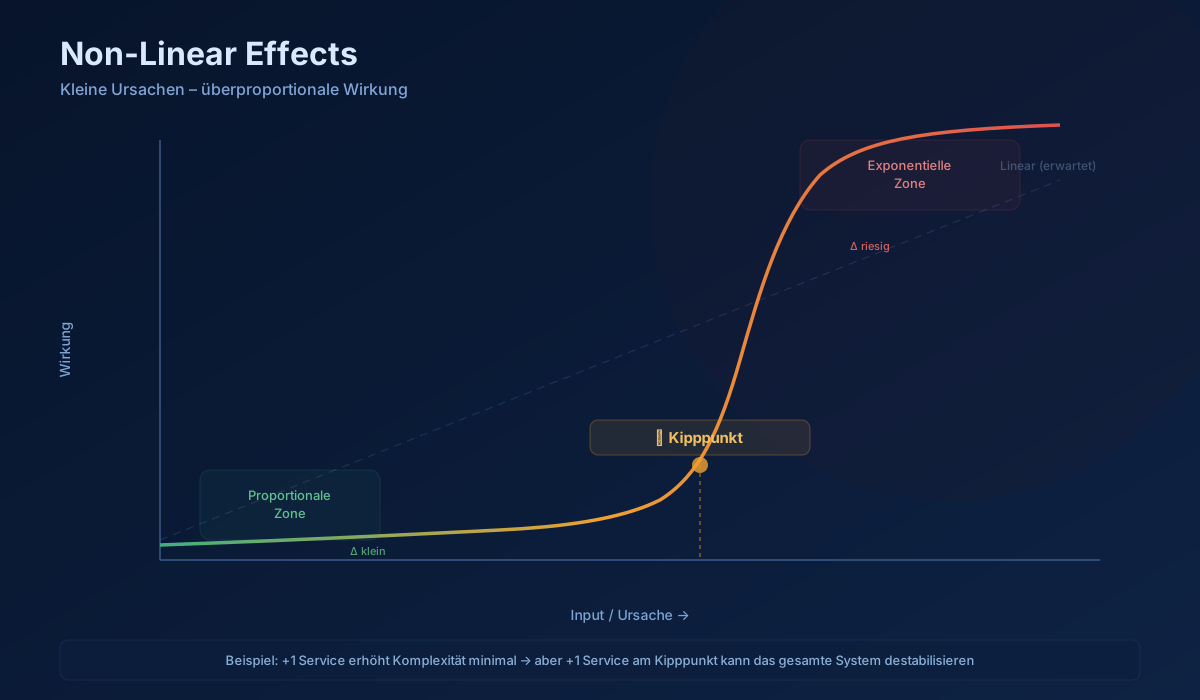
The human mind defaults to linear reasoning: if I write ten percent more code, I create ten percent more value. Complex systems do not behave that way. Nonlinearity means the input is not proportional to the output. Two extreme forms matter in practice: diminishing returns, where significant effort produces almost no visible effect, and cascade or exponential effects, where a tiny trigger pushes the system dramatically in a new direction.
System Mechanism
Nonlinear effects usually arise through thresholds, limits, and strong feedback loops. As long as a system still has reserves, it may absorb load almost linearly. But once a parameter such as memory usage or team stress reaches a hard threshold, system behavior changes abruptly. Reinforcing loops such as network effects can also bend growth curves sharply upward once the right conditions are met.
Architecture Example
A classic nonlinear tipping point appears in connection pooling or garbage collection. A database running at 90 percent load may appear stable. Add two more percent of traffic and the response time does not rise by two percent. It can rise sharply to ten times the previous value, triggering timeouts, retries, and still more load until the database locks up. A tiny input crosses an architectural threshold and tips the entire system.
Organizational Example
A new communication tool is expected to make work twenty percent more efficient. It is introduced into ten isolated teams and flops badly. Later, the management team adopts the tool by mandate. Suddenly departments across the company redesign their workflows around it, because top management now operates there. Within a few weeks, the entire organization has shifted its behavior. A small but well-connected leverage point produced a highly nonlinear adoption curve.
Diagnostic Questions
1.Where are we planning linearly, for example by assuming that doubling the project budget will make us finish twice as fast, even though the system is highly complex?
2.Which technical buffers such as memory, timeouts, or network bandwidth are approaching dangerous thresholds?
3.Where are we ignoring small failures because we assume their impact will stay proportionally small even though they could grow exponentially?
Diagram
Why This Concept Helps in Architecture
We cannot predict nonlinear effects such as sudden traffic surges or viral adoption with precision. Architects therefore have to design systems that can survive black swan events, meaning rare and extreme shocks. That requires strong isolation, strict resource limits, and degradation strategies that value survival over peak performance.
How to Distinguish It from Similar Topics
While feedback loops describe the direction of coupling, nonlinearity describes the mathematical dynamics and leverage behavior of those loops as system boundaries are approached.
How to Use the Concept in Practice
Distrust every architecture plan or scaling model that looks like a perfectly straight line. Build bulkheads into your systems. If one small component escalates nonlinearly, it must not drag the entire ship down with it. Use load tests to push systems intentionally toward their threshold so you learn not only when they break but how they break.
First Implementation Steps
Teach top management that software development is deeply nonlinear. Nine women cannot deliver a baby in one month. Adding more people to a struggling initiative often creates negative returns instead of linear acceleration.
How You Recognize Impact
Do we know the tipping points of our infrastructure and the exact utilization levels at which our system begins to behave unpredictably?
Sources
John Sterman — Business Dynamics, Kap. 3: Nonlinearity (McGraw-Hill, 2000)
Authors & Books
Go to referencesRelevant references for Non Linear Effects.
Concept Visual
Non-Linear Effects: Small causes can trigger large and amplified effects.