Interdependence
Elements in a system depend on one another; you cannot change one part in isolation without influencing the whole.
Why it matters
Use this concept to explain observable behavior structurally rather than merely naming it.
Next step
Next, check which archetype or diagnostic method makes the pattern visible in the concrete system.

Definition
Interdependence expresses that all components in a system are connected through varying degrees of coupling. The action or state change of one element inevitably influences others, and those others in turn affect the first element or additional ones. As long as strong interdependencies exist, local isolated solutions are ineffective or even harmful.
System Mechanism
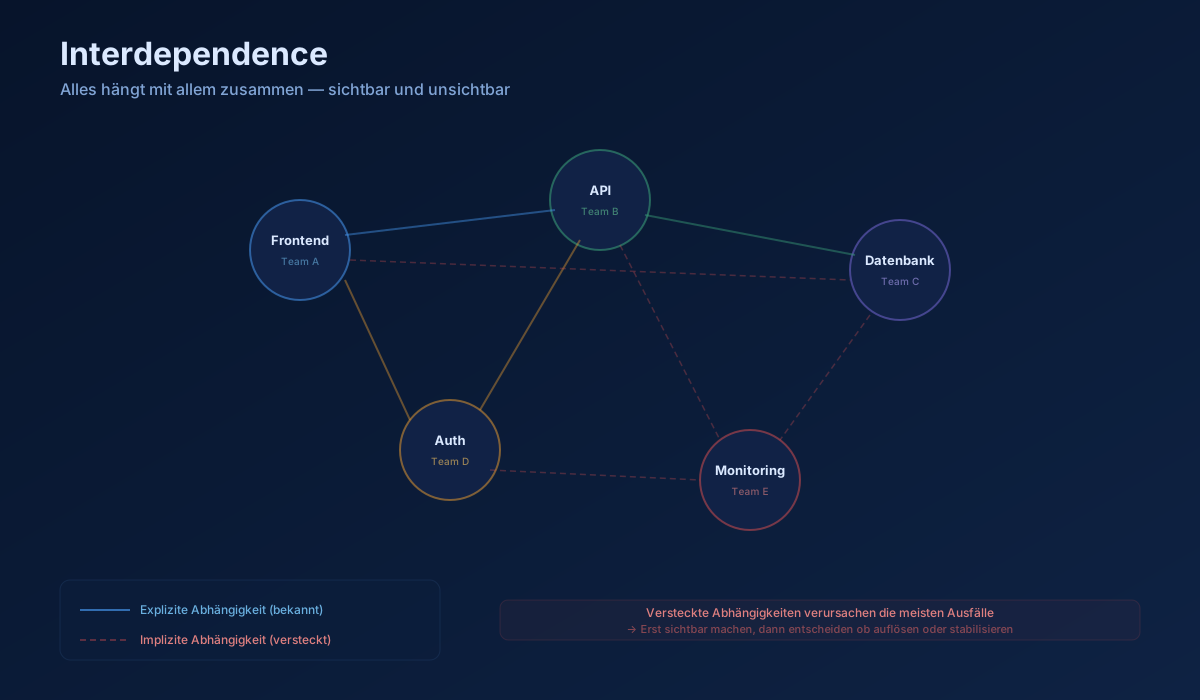
Imagine a huge spider web. If you pluck a thread at the edge, the center vibrates too. In organizations and IT systems, interdependence means that resources are shared, such as APIs or databases, information is exchanged, or goals compete. A local optimization on one side of the web almost always forces a balancing response somewhere else.
Architecture Example
In a distributed microservice architecture, Team A changes the schema of a supposedly local data object to make writes more efficient. Because of deep and unnoticed semantic interdependencies in what is really a distributed monolith, monthly reporting breaks three days later for Team B, and Team C starts producing incorrect checkout calculations. The architecture failed to manage those interdependencies through clear loosely coupled contracts such as anti-corruption layers.
Organizational Example
Too many companies still operate as vertical silos such as Dev, QA, Ops, and Security, even though their goals are strongly interdependent. Development is rewarded for speed and new features, while Security is rewarded for zero-tolerance risk reduction. That deep interdependence in the value stream, combined with conflicting goals, creates harmful conflict at every release. The answer is not better communication alone but moving toward cross-functional teams.
Diagnostic Questions
1.Where are we trying to optimize a technical component in isolation even though it is tightly coupled to several other systems and teams?
2.Where do hidden interdependencies, such as shared infrastructure or the unique knowledge of one senior engineer, become a bottleneck under stress?
3.Which organizational teams depend on each other even though their targets pull them in completely different directions?
Diagram
Why This Concept Helps in Architecture
Architects must become experts at designing boundaries to make interdependence manageable. The art is to cut the architecture so that things which need to interact closely stay together, while things with fewer touchpoints remain separated. This reduces destructive interdependence across system boundaries.
How to Distinguish It from Similar Topics
While system boundaries ask what lies inside or outside our chosen scope, interdependence looks explicitly at the degree of connectedness among the parts inside that world. The archetype Accidental Adversaries is a strong example of interdependence gone wrong.
How to Use the Concept in Practice
When making architecture decisions or reorganizing teams, focus first on dependencies and interfaces. Never optimize the state of a single part if that optimization worsens its interactions with the rest of the system. Russell Ackoff's point applies here: the performance of a system depends on how the parts interact, not on how they perform independently.
First Implementation Steps
Introduce techniques such as dependency mapping or design structure matrices to make the invisible network of interdependence between code modules or development teams visible before large programs move into solution design.
How You Recognize Impact
When a new tool or microservice was introduced, did we document who is directly upstream and downstream in technical or business terms?
Sources
Donella Meadows — Thinking in Systems, Kap. 3: System Interconnections
Russell Ackoff — Re-Creating the Corporation (Oxford UP, 1999)
Authors & Books
Go to referencesRelevant references for Interdependence.
Concept Visual
Interdependence: Subsystems continuously influence each other.