Feedback Loops
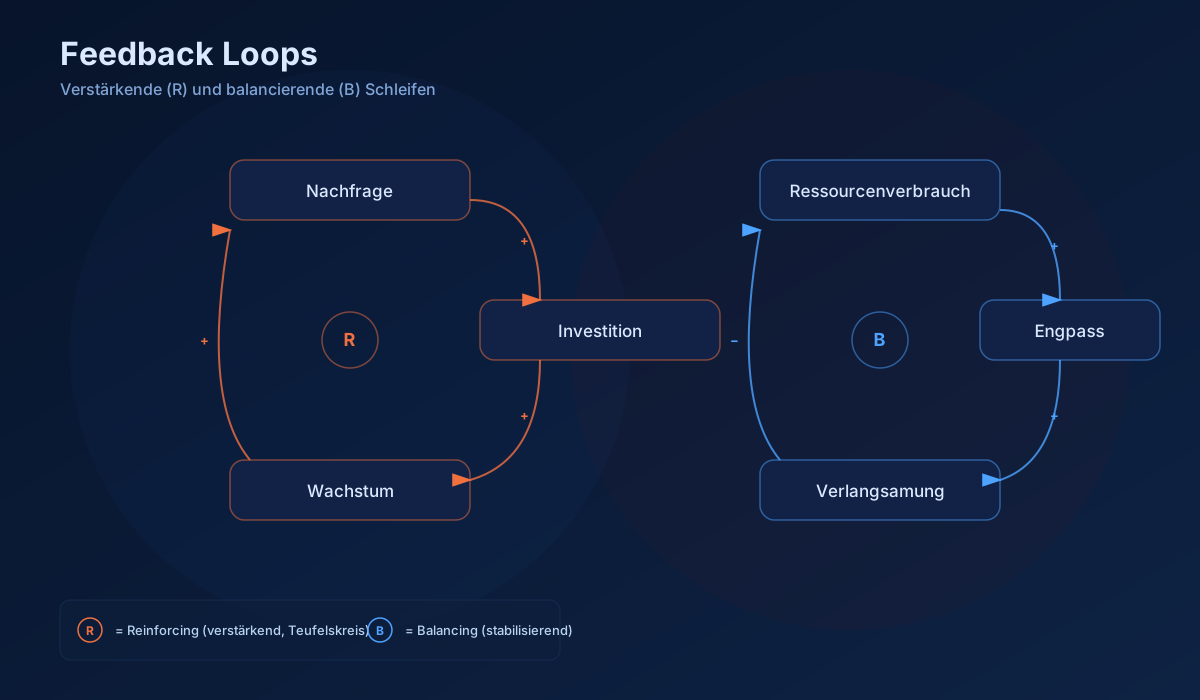
Feedback loops, whether reinforcing or balancing, are the basic building blocks that drive or stabilize system behavior over time.
Why it matters
Use this concept to explain observable behavior structurally rather than merely naming it.
Next step
Next, check which archetype or diagnostic method makes the pattern visible in the concrete system.

Definition
Feedback loops describe situations in which the effect of an action feeds back into its own cause and thereby influences future actions. They are the foundation of cyclical system behavior. Every system is driven by two primary loop types: reinforcing loops create exponential growth or drastic decline, while balancing loops stabilize a system, limit it, or align it to a target state.
System Mechanism
Reinforcing (R): The more X, the more Y. The more Y, the more X again. An example is compound interest: the more interest you receive, the more capital you have, which then generates even more interest.
Balancing (B): A system tries to close the gap between its current state and a target state. For example, the colder the room becomes, the harder the thermostat heats. As temperature approaches the target, the thermostat reduces output. Many failures in architecture and teams happen because balancing loops regulate too slowly due to delays.
Architecture Example
A classic balancing feedback loop is cloud auto-scaling. The target state is 70 percent CPU usage. When load rises, a sensor measures latency and new instances are started. Those instances reduce the load per machine, and the system stabilizes again. If the delay between measurement and boot time is too long, the system overshoots, starts too many servers, and then shuts them down frantically, creating oscillation.
Organizational Example
A destructive reinforcing loop in teams looks like this: the product team is under strong delivery pressure. To save time, it skips unit tests and quality drops. The next month, production bugs increase. Fixing them consumes more time, which further increases delivery pressure. Tests are skipped again, and the following month even more defects appear. A death spiral has formed.
Diagnostic Questions
1.Which reinforcing cycle is currently driving our growth, but also accelerating our technical debt?
2.Which balancing mechanisms, such as code reviews or auto-scaling, react too slowly and therefore create frustration or load spikes?
3.Which hidden loop keeps undoing our well-intended countermeasures?
Diagram
Why This Concept Helps in Architecture
When a system runs exponentially out of control, such as exploding cloud costs or masses of bugs, look for the driving reinforcing loop and break it. When a system stubbornly stagnates despite a lot of effort, such as a slow organization that refuses to adopt agile ways of working, you are likely pushing against a strong balancing loop. In that case, adding more pressure rarely helps. You have to change the conditions of balance.
How to Distinguish It from Similar Topics
Feedback loops are the smallest functional building blocks of causal loop diagrams. By combining reinforcing and balancing loops, we get the larger system archetypes, such as Limits to Growth or Shifting the Burden, that shape recurring patterns across organizations.
How to Use the Concept in Practice
To navigate complex architectures or organizations, draw causal loop diagrams. For each metric and dependency, determine whether it moves in the same direction or the opposite direction. Then mark identified loops with "R" for reinforcing growth or "B" for balancing stability.
First Implementation Steps
Pay close attention to factors that distort feedback, such as silos, or delay it. An architecture review board that gives feedback only after three months of development time is a balancing loop with too much delay. It will not stabilize the system. It will provoke conflict.
How You Recognize Impact
In critical architecture decisions, were balancing safety mechanisms such as rate limits, circuit breakers, and rollbacks designed as carefully as the growth-oriented parts?
Sources
Donella Meadows — Thinking in Systems, Kap. 1: Basics of Feedback
Peter Senge — The Fifth Discipline, Kap. 5: Seeing Feedback (Doubleday, 1990)
Authors & Books
Go to referencesRelevant references for Feedback Loops.
Concept Visual
Feedback Loop: Repercussions change future decisions in the system.