Emergence
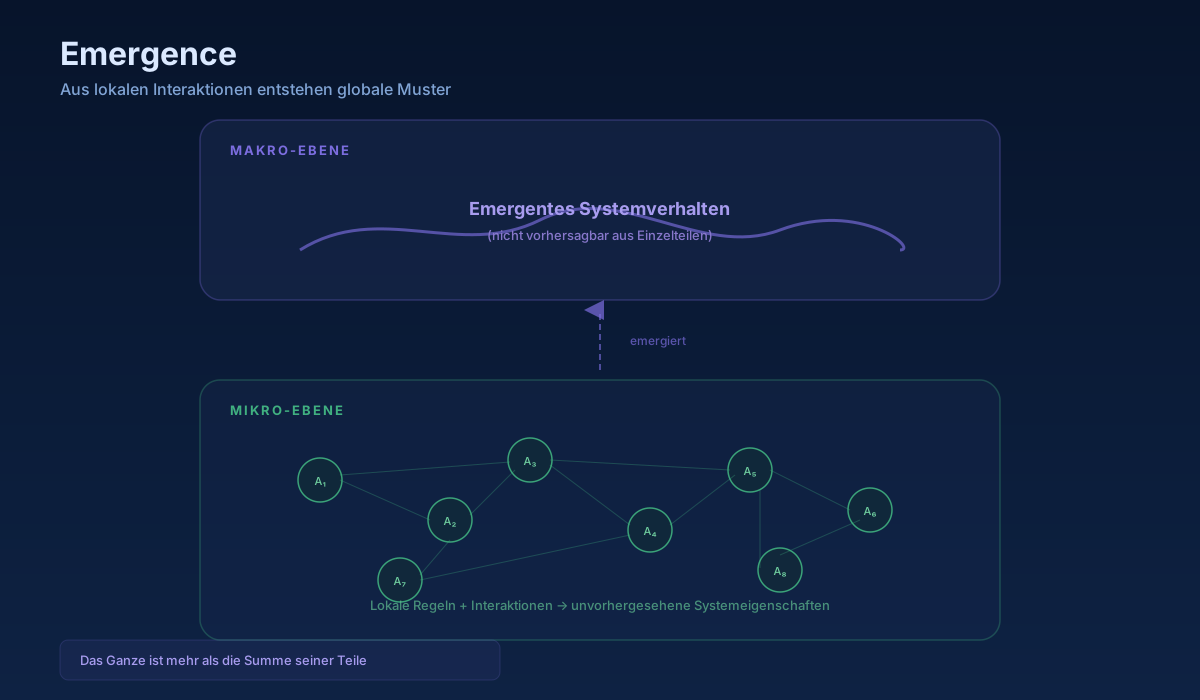
Emergence describes global system properties that arise only through the interaction of local parts and cannot be predicted from the parts alone.
Why it matters
Use this concept to explain observable behavior structurally rather than merely naming it.
Next step
Next, check which archetype or diagnostic method makes the pattern visible in the concrete system.

Definition
Emergence describes the phenomenon in which a whole system develops properties and behaviors that none of its individual parts possess on their own. Systems theory captures this with the maxim that the whole is more than, or at least different from, the sum of its parts. Emergent behavior arises from the way components interact. You cannot understand it by reducing the system to isolated pieces.
System Mechanism
Simple local rules followed by individual agents can, through continuous interaction, create a complex global pattern. A classic example from nature is a flock of birds. No bird holds the full blueprint of the flock. Each bird follows only a few local spacing rules relative to its neighbors. The graceful movement of the flock is the emergent result of those local interactions.
Architecture Example
Consider a microservice ecosystem. No single service is designed to fail the entire platform every two minutes. But if Service A fires three retries on every timeout to Service B, and Service B flushes caches and calls Service C under load, then a tiny network disturbance can produce a significant retry storm. The outage is an unwanted emergent property that appears only when the services interact under stress.
Organizational Example
A company introduces the goal of maximizing feature velocity per team. Each team locally optimizes its workflow, which seems sensible in isolation. The emergent global result is a fragmented architecture, mounting technical debt at handoff points, and a terrible overall user experience because nobody owns the product holistically. Silo thinking is emergent behavior produced by local incentives.
Diagnostic Questions
1.Which unwanted macro-level behavior are we stubbornly trying to solve by repairing individual agents?
2.Which simple local rules, KPIs, or architecture directives are unintentionally producing exactly that behavior?
3.Do we understand the interfaces and interactions between services and teams as well as we understand the services and teams themselves?
Diagram
Why This Concept Helps in Architecture
Because emergent behavior such as system stability or company culture cannot be programmed directly, architects must learn to steer through conditions rather than commands. Instead of prescribing everything each service should do, define protective mechanisms at interaction points, such as bulkheads, circuit breakers, and rate limits, so harmful emergence is contained and useful emergence remains possible.
How to Distinguish It from Similar Topics
Emergence is the result of interaction inside complex adaptive systems. While CAS describes the underlying system model, emergence focuses specifically on the macro-level properties that rise out of that model and cannot simply be commanded from above.
How to Use the Concept in Practice
Accept that in large sociotechnical systems you cannot foresee every edge case. Shift your focus away from perfect upfront planning and toward observability plus fast safety mechanisms. When harmful emergence appears, do not punish the agents. Change the interaction rules.
First Implementation Steps
Train yourself to read architecture not only as a collection of boxes but as a network of lines. Most emergence happens on the lines.
Introduce game days or chaos engineering to provoke and observe emergent system behavior in a controlled environment.
How You Recognize Impact
Are our architecture reviews too focused on the internal quality of individual components while neglecting the interaction patterns of the system as a whole?
Sources
Santa Fe Institute — Emergence in Complex Systems (Complexity Explorer)
Authors & Books
Go to referencesRelevant references for Emergence.
Concept Visual
Emergence: Interactions create new patterns that can reinforce themselves.