Delays
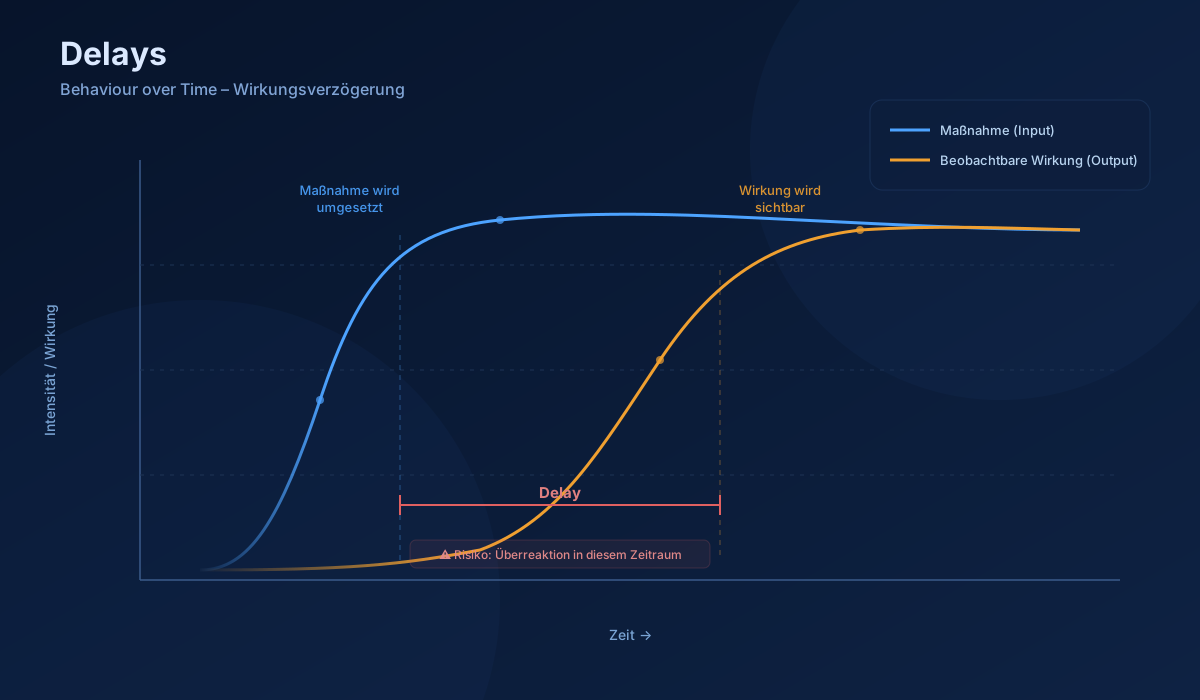
Delays exist in every system. They distort our perception of cause and effect and push us toward drastic overreactions.
Why it matters
Use this concept to explain observable behavior structurally rather than merely naming it.
Next step
Next, check which archetype or diagnostic method makes the pattern visible in the concrete system.
Definition
Delays describe the time gap between an action we put into a system and the visible feedback the system returns to us. Delays are treacrescuerus because our brains expect immediate feedback, as with a light switch. When feedback arrives late, as with adjusting shower temperature, we keep steering blindly and overreact because we assume the first action had no effect. The result is strong and chaotic oscillation.
System Mechanism
In balancing loops that are meant to provide stability, delays can become dangerous. When a system moves away from its target state and someone intervenes, there are usually three kinds of delay:
1.Perception delay: How long does it take before we even notice the problem?
2.Decision delay: How long do we take to decide on a response?
3.Execution delay: How long does it take until the response becomes physically effective in the system?
If the combined delay becomes too long, the system overshoots the target and begins to swing back and forth.
Architecture Example
A classic example is horizontal auto-scaling in Kubernetes. A traffic spike hits. It takes 30 seconds for the metric to be read, 10 seconds for the scaling decision, and 3 minutes until the new pod has started and is ready. During those three minutes, the cluster still sees no improvement, so it keeps scaling upward in panic. Once the spike is gone, fifty useless pods sit idle and burn budget before the system overcorrects in the other direction.
Organizational Example
An established company realizes that it lacks enough DevOps specialists. HR starts a major recruiting campaign, but it takes six months from first interview to onboarding. Since no new colleagues are visible during those six months, management increases recruiting budgets and adds headhunters. After a year, a flood of new DevOps engineers arrives, budgets rise sharply, and radical hiring freezes follow. It is the classic boom-and-bust cycle caused by delay.
Diagnostic Questions
1.For which KPIs or dashboards are we really looking in the rear-view mirror and taking frantic action today based on old data?
2.What is the exact execution delay from architecture decision to effective code change in production?
3.Where do we regularly overshoot during incidents because monitoring feedback arrives too slowly?
Diagram
Why This Concept Helps in Architecture
Systems thinkers dislike unobserved delays because they make prediction much harder. The most effective way to handle delays is not always to eliminate them completely, since build times or onboarding cannot be reduced to zero. Often the better response is to slow your own reaction speed artificially. If the system adapts slowly, your countermeasures must also slow down through cooldown periods to avoid overcontrol.
How to Distinguish It from Similar Topics
Delays are the most critical add-on to feedback loops. Without delays, balancing loops would not oscillate, and archetypes such as Fixes that Fail would lose much of their destructive force.
How to Use the Concept in Practice
When designing new processes or architectures, focus first on the information feedback curve. If the feedback loop is slower than the rhythm at which management orders adjustments, you are in trouble. Use forecast models or dense proxy metrics as early indicators to shorten the practical delay at the steering wheel.
First Implementation Steps
Use cooldown periods in automated systems such as infrastructure scaling so the system is forced to wait and reveal the impact of a change before additional interventions are triggered.
How You Recognize Impact
Have we measured the delay precisely between committing defective code and seeing our monitoring metrics fire in production?
Sources
Donella Meadows — Thinking in Systems, Kap. 2: Delays
John Sterman — Business Dynamics, Kap. 4: Delays (McGraw-Hill, 2000)
Authors & Books
Go to referencesRelevant references for Delays.
Concept Visual
Delay Loop: The effect occurs with a time delay and generates late countermeasures.