Conway's Law
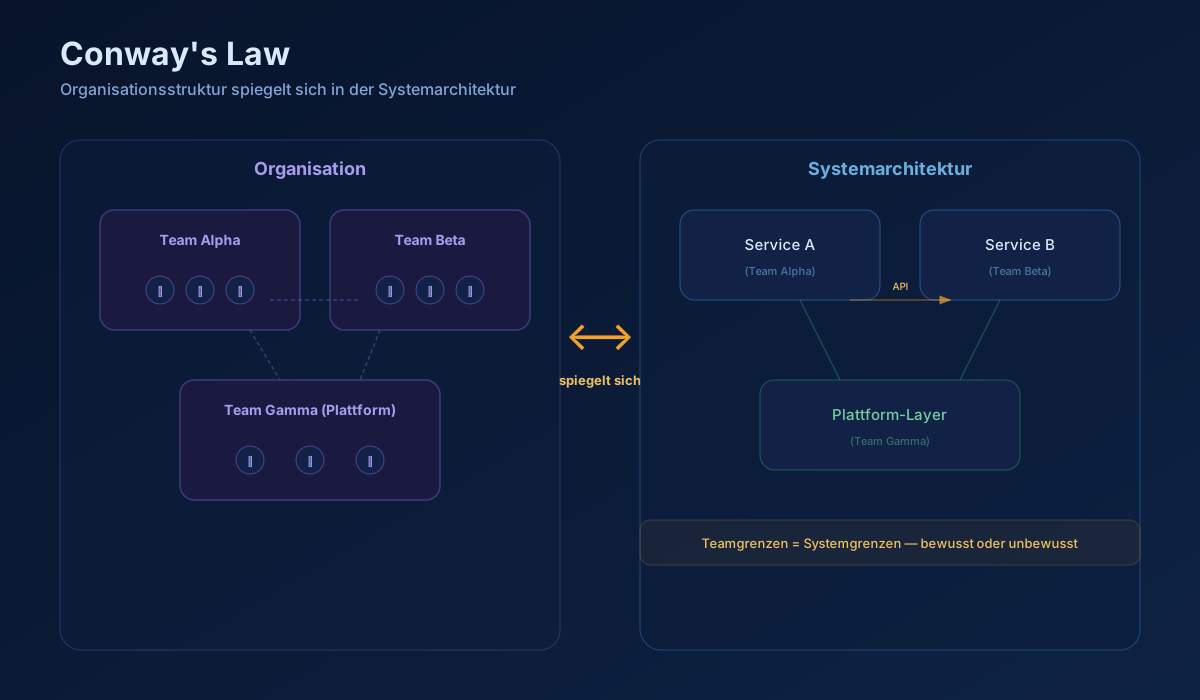
Organizations that design systems are forced to create designs that mirror the communication structures of those organizations.
Why it matters
Use this concept to explain observable behavior structurally rather than merely naming it.
Next step
Next, check which archetype or diagnostic method makes the pattern visible in the concrete system.

Definition
Conway's Law states that the technical architecture of a system always mirrors the social communication structure of the organization that built it. Melvin Conway wrote in 1968, "Organizations which design systems ... are constrained to produce designs which are copies of the communication structures of these organizations." If four separate development departments work on a compiler, the result will almost certainly be a four-pass compiler, regardless of whether that is the technically best solution.
System Mechanism
Software interfaces such as APIs and modules require human coordination through meetings, chat, and negotiation. When developers sit in the same team, the communication surface is smooth and they tend to build tightly coupled code. When two teams sit in different time zones and struggle to collaborate, they protect their modules behind rigid, asynchronous interfaces. In other words, the architecture behaves just like the social structure.
Architecture Example
A company wants to migrate to a modern microservice architecture in order to enable more independent deployments. But the developers remain in their old functional silos: a dedicated frontend team, a backend team, and a database team. The result is that the supposed microservice architecture turns into a highly coupled distributed monolith. Every feature still requires coordination across all three teams because the code is sliced by technical layers rather than by business domains. Conway's Law wins.
Organizational Example
To use Conway's Law to your advantage, apply the inverse Conway maneuver. The company wants the checkout system and the recommendations system to scale independently. Instead of issuing architecture directives alone, management changes the organization: it forms two fully autonomous cross-functional teams with their own product managers, backend engineers, and frontend engineers, each working in separate repositories. The team boundary enforces the desired API boundary in the system.
Diagnostic Questions
1.Are we trying to force a technical architecture that cuts directly across our existing team and department structures?
2.Where does the code contain messy dependencies that exist mainly because Team A and Team B lack a clean escalation or collaboration channel?
3.Do the cognitive boundaries of a team, meaning how much business logic it can keep in its head, still match the hard boundaries of its code modules?
Diagram
Why This Concept Helps in Architecture
Software architecture is never just technology. It is sociotechnical design. If an architecture board draws plans that do not fit the reality of team communication, the plan is worthless. Modern approaches such as Team Topologies treat Conway's Law not as an obstacle but as a powerful design tool: shape team interaction patterns, such as stream-aligned teams or platform teams, so that they generate the architecture you actually want.
How to Distinguish It from Similar Topics
Conway's Law is closely related to interdependence, but it goes one step further by explicitly linking human and organizational dependencies to code dependencies in the technical system.
How to Use the Concept in Practice
Never fight Conway. When the code structure and the organization structure are in conflict, the organization wins in the end. If the business demands fast, independent feature releases through microservices, break down the organizational silos first and form fully domain-centered vertical product teams. The architecture will follow the new communication structure automatically.
First Implementation Steps
Watch for implicit communication paths. If all developers share the same database or discuss every issue ad hoc in the same Slack channel, unplanned coupling will emerge in the code even if the org chart suggests a clean separation.
How You Recognize Impact
When the company adopted the new architectural paradigm, such as data mesh or micro-frontends, did it also re-examine the organization chart?
Sources
Melvin Conway — How Do Committees Invent? (1968)
Matthew Skelton & Manuel Pais — Team Topologies (IT Revolution, 2019)
Authors & Books
Go to referencesRelevant references for Conway's Law.
Concept Visual
Conway's Law: Team boundaries are reflected in architectural boundaries.