Complex Adaptive Systems
Complex adaptive systems change their behavior through local adaptation and feedback among many components.
Why it matters
Use this concept to explain observable behavior structurally rather than merely naming it.
Next step
Next, check which archetype or diagnostic method makes the pattern visible in the concrete system.

Definition
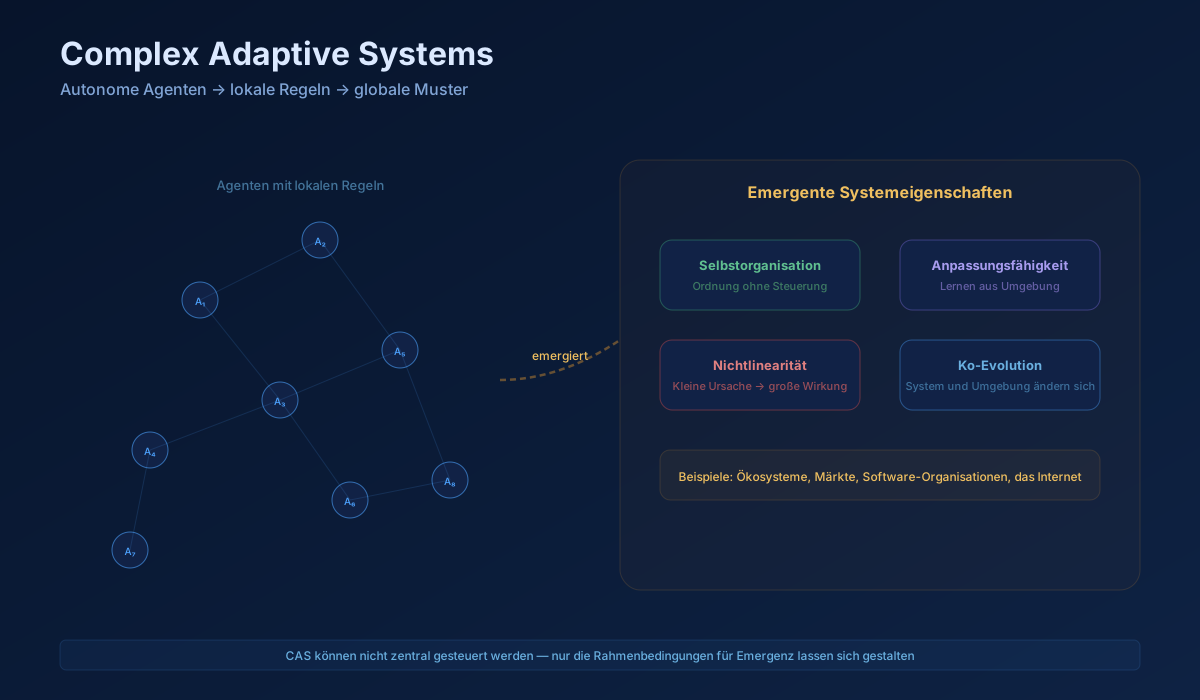
Complex adaptive systems, or CAS, consist of many interconnected agents such as components, teams, or individuals that act and interact according to local rules. Their defining quality is that continuous interaction and learning by individual agents produce emergent and often unpredictable properties at the level of the whole. The system adapts to its environment almost like a living organism.
System Mechanism
In a CAS, there is no central control instance that steers the overall behavior in detail. Order emerges from the bottom up. Agents communicate through interfaces, react to one another, and continuously adapt their local strategies. Because small changes in local rules can create large global effects through nonlinearity, complex adaptive systems are hard to predict.
Architecture Example
A large event-driven architecture with hundreds of autonomous microservices behaves like a CAS. Service A emits events, Services B and C react according to their own local logic, and in turn emit new events. Without central orchestration, a vast web of distributed behavior emerges. A local update in Service B can suddenly trigger cascading effects across the system that no architecture diagram made obvious in advance.
Organizational Example
Think of Spotify-style agile models or strongly decentralized engineering organizations. When fifty squads independently build features, choose tools, and adjust processes according to their own rhythms, no one orchestrates every interface. The organization adapts organically to market needs, but cultural and technical challenges such as shadow IT also emerge and can only be managed by understanding the whole network of interactions.
Diagnostic Questions
1.Are we trying to control the system centrally even though it consists of dozens of decentralized actors?
2.Which unexpected behavior patterns have emerged from the simple interactions of local teams?
3.Do our conditions encourage adaptability, or do they inhibit natural evolution?
Diagram
Why This Concept Helps in Architecture
Software architecture in large enterprises is never only about technology. It is always a sociotechnical system and therefore behaves like a CAS. Architects in such environments must constantly balance two questions: which constraints should we impose top-down to contain chaos, and how much freedom should we leave bottom-up so the system can respond and adapt?
How to Distinguish It from Similar Topics
A CAS stands in sharp contrast to complicated mechanical systems such as a clockwork or an aircraft turbine. A complicated system can be fully decomposed, analyzed, and calculated in advance. A complex adaptive system is alive, changes its rules in motion, and can never be fully predicted on paper.
How to Use the Concept in Practice
The key lesson for architects is that you cannot instruct a CAS in every detail. You can only cultivate it and shape its boundaries. Focus on strong, loosely coupled contracts such as interfaces, APIs, and team boundaries, plus a few simple global rules such as governance and fitness functions. Let local agents handle the details.
First Implementation Steps
Stop searching for the perfect all-encompassing master plan. Instead, strengthen fast feedback loops, local autonomy, and excellent observability so emerging chaos can be steered early.
How You Recognize Impact
Do we have observability metrics that show actual system behavior in real time instead of forcing us to rely on outdated architecture diagrams?
Sources
Melanie Mitchell — Complexity: A Guided Tour (Oxford UP, 2009)
Authors & Books
Go to referencesRelevant references for Complex Adaptive Systems.
Concept Visual
Complex Adaptive Systems: Local adaptation leads to emergent stabilization.