Success to the Successful
Competition for limited resources can further favor teams with a slight head start while others receive fewer development opportunities despite their potential.
Why it matters
An archetype helps you recognize recurring dynamics behind local symptoms.
Next step
Next, move into a diagnostic method to test the suspected structure against observations.

Description
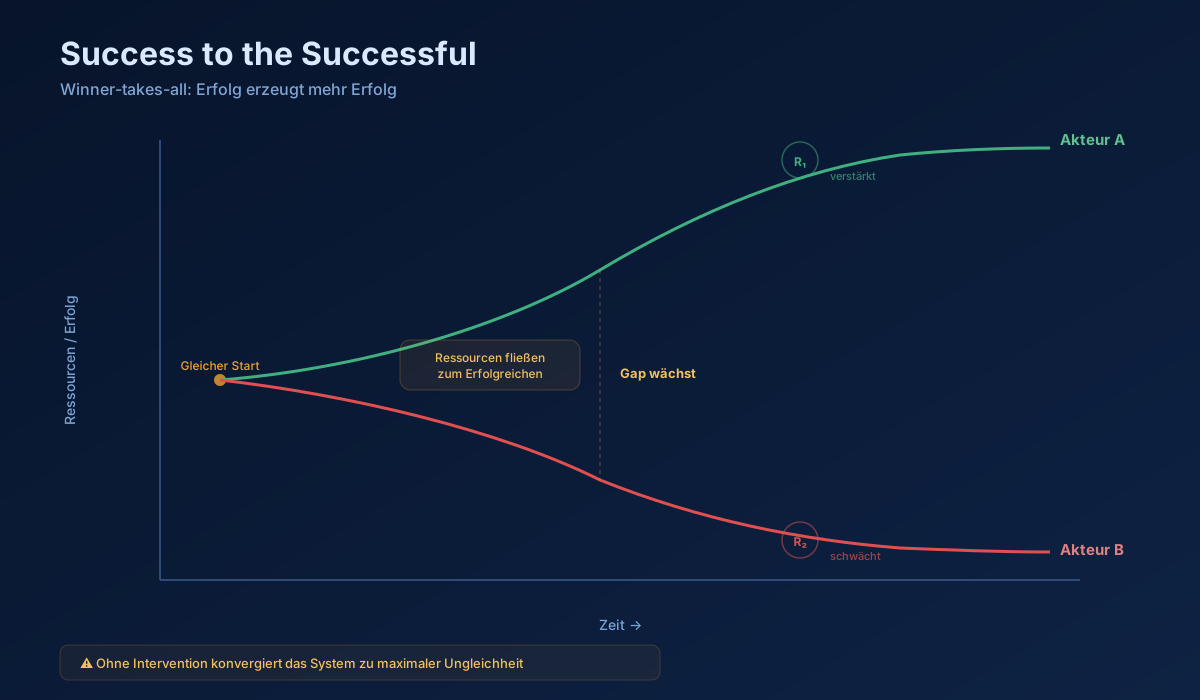
The archetype "Success to the Successful", known in sociology as the Matthew effect, describes a dynamic in closed environments such as companies. Two parties, such as tools, teams, or projects, compete for a limited pool of resources. Party A receives slightly more success at the beginning through chance, visibility, or a small starting advantage. If management interprets these early metrics as clear proof of superior performance, more resources flow to A. A then grows further, while B receives fewer opportunities to demonstrate its potential.
Feedback Loops
The engine consists of two competing reinforcing loops coupled in the shape of an inverted figure eight, effectively a zero-sum game.
Upper loop, the winner: Team A ships a feature slightly faster. It receives the success bonus of more budget and more freedom in allocating resources. More budget improves developer experience, which lets Team A ship even faster.
Lower loop, the disadvantaged alternative: Because both loops draw from the same limited source, Team A's gain reduces Team B's options. Team B receives less budget, developer experience deteriorates, output drops, and the next review appears to confirm the original allocation decision.
Architecture Example
Inside a large company, two cloud migration approaches compete: classic lift and shift and cloud-native serverless architecture. The lift-and-shift model wins the first small proof of concept because it is faster to implement for a simple application. As a result, more cloud budget, training, and onboarding effort flow into that approach. The cloud-native team receives less room for experimentation and cannot complete more demanding proofs of concept. From management's perspective it appears slower, even though its approach might be architecturally more valuable in the long term.
Organizational Example
Consider a visible "star" developer who regularly receives the most interesting tasks because earlier results were perceived positively. Other developers increasingly take on maintenance, bug fixing, and less visible work. This reduces their chances to produce similarly visible success. Management then confirms its original assessment and further reinforces the resource distribution. Over time the team loses breadth, learning capability, and motivation.
Diagnostic Questions
1.Do we have internal star projects, such as a GenAI pilot, that bind many resources while essential system hygiene receives too little financial attention?
2.Are we evaluating competing architecture approaches by their structural value, or simply by which one management historically watered with more money at the beginning?
3.Are we unintentionally breeding rockstar programmers by shielding them from bug fixing and support tickets, turning them into the winners of a dysfunctional culture?
Diagram
How to Recognize the Pattern in Daily Work
The key cybernetic rule for architects in this pattern is simple: never confuse structural success with system-coupled starting advantage. When managers launch internal competitions and say "let the best ideas win," an unmanaged system usually rewards not the best ideas but the ones with the fastest feedback rhythm. Real design work means decoupling strategic goals from competitive survival-of-the-fittest dynamics whenever promising options require a longer incubation delay.
What Distinguishes the Pattern from Similar Dynamics
Success to the Successful is fundamentally a zero-sum pattern. What one side gains, the other side loses in real resources. That makes it very different from Escalation, where both actors keep investing in their own buildup and drift toward a dangerous balance of terror.
How to Move from Pattern to Response
Break the direct connection between short-term success and future resource allocation. If innovation, feature delivery, refactoring, and technical debt compete for the same budget, the organization should not allocate only by short-term output. Fixed capacity shares, protected budgets, or longer evaluation periods can prevent the more visible short-term topic from being favored permanently.
First Next Steps
An architecture approach that starts more slowly but has higher long-term potential needs protected space, a guaranteed baseline budget, and a longer evaluation period before it is judged against an established short-term approach.
How to Recognize the Pattern with Confidence
Do we critically examine in retrospectives whether the so-called high-performing teams in release-train metrics truly excel because of craftsmanship, or whether they are still surfing on a wave of historical budget and resource preference from 2021?
Sources
The Systems Thinker: Success to the Successful
Authors & Books
Go to referencesRelevant references for Success to the Successful.
Continue reading
Explore related topics from Archetypes
Accidental Adversaries
Teams that actually want to collaborate drive each other into ruin through selfish local optimizations.
Attractiveness Principle
A rising product or team attracts so much demand that quality collapses and the very source of its attractiveness gets damaged.