Shifting the Burden to the Intervenor
Teams become dependent on an external helper, which causes their own ability to solve architectural problems to atrophy.
Why it matters
An archetype helps you recognize recurring dynamics behind local symptoms.
Next step
Next, move into a diagnostic method to test the suspected structure against observations.

Description
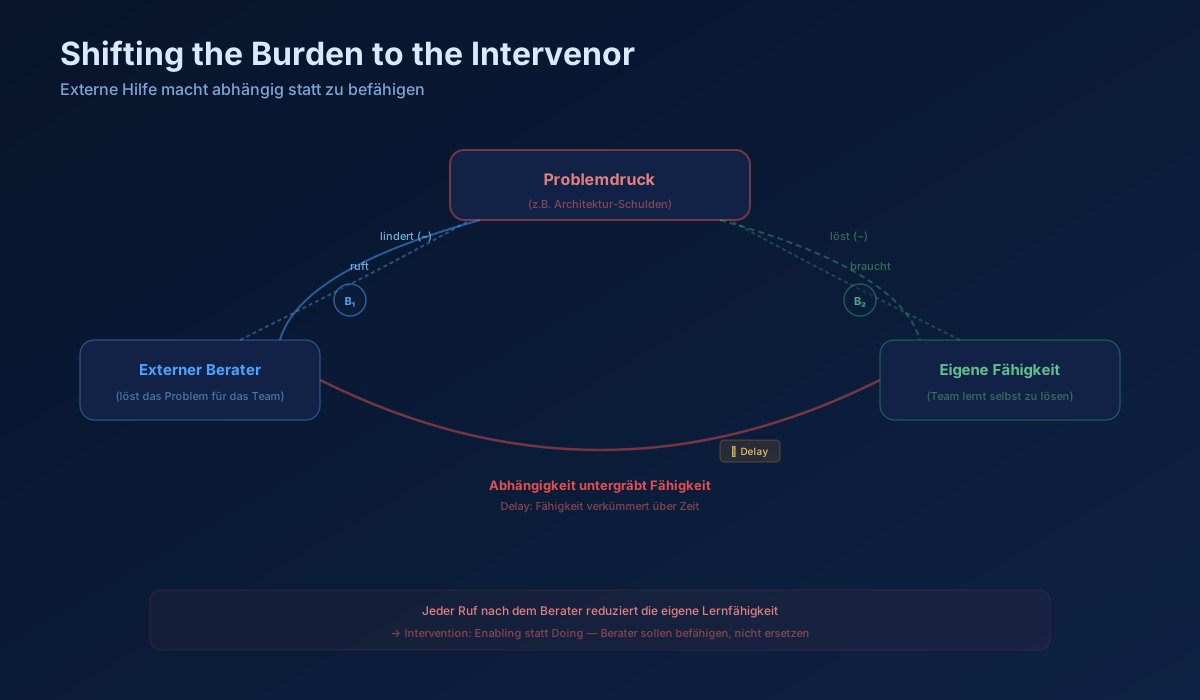
This variation of Shifting the Burden puts external help at the center of the dependency. An IT system has a structural problem. An external team, a platform team, or a consultant solves the acute problem quickly. That helps in the short term. If the solution is permanently performed for the internal team, however, that team does not build the necessary capability itself. At the next similar problem, external help is needed again.
Feedback Loops
Two balancing loops compete to solve the problem:
1.The team solves it itself through clear, slower buildup of its own skills.
2.The intervenor solves it for the team through a fast symptomatic fix.
The central reinforcing loop forms at the capability level: the more often a team uses external help, the less it practices its own problem solving. Declining capability increases the likelihood that help will be requested again for the next similar problem. A stable dependency emerges.
Architecture Example
A feature team has trouble with a complex Kubernetes deployment and asks the platform engineering team for help. An experienced platform engineer corrects the Helm charts. Three weeks later the deployment breaks again after a library update. Because the feature team did not understand the solution itself, it creates another ticket. A supporting platform team gradually becomes an operational execution team for other teams.
Organizational Example
A similar pattern can arise with external agile coaches. A company has leadership problems, but relies on permanent external facilitation. When conflicts arise, the coach takes over instead of internal leaders building conflict capability. The organization becomes dependent on the intervention even though the original problem lies in internal leadership capability.
Diagnostic Questions
1.Do we have support teams that primarily execute tasks for others instead of providing self-service tools and enablement?
2.Where do we tolerate senior-developer dependency? When a server fails, does everyone call the same person instead of building debugging knowledge in the team?
3.Which departments need continuous support from vendors or specialist teams for every larger release?
Diagram
How to Recognize the Pattern in Daily Work
This dependency can also be stabilized by the helper role itself. Someone who is permanently needed often has little incentive to make the role unnecessary. Good help therefore builds self-help capability: documentation, pairing, self-service, training, and clear handovers. Any service that permanently replaces internal capability creates a structural dependency.
What Distinguishes the Pattern from Similar Dynamics
Shifting the Burden describes the shift toward a symptomatic solution, such as additional hardware. Shifting the Burden to the Intervenor describes the shift toward a human actor or external team, which reduces institutional learning capability.
How to Move from Pattern to Response
When a DevOps team, security team, or external consultant provides support, success should not only be measured by solved tickets. The more important metric is capability building in the host team. A security team is more successful in the long run when it provides a self-service portal and developers can safely apply configurations themselves, instead of the security team manually configuring every firewall.
First Next Steps
Plan the transition deliberately. When external help is reduced, performance may temporarily decline because the team first has to rebuild missing capability. This period should be supported through pairing, clear learning goals, bounded support, and explicit success criteria for independence.
How to Recognize the Pattern with Confidence
Does the role of the platform enablement team clearly state that enablement, self-service, and capability building matter more than permanent execution for feature teams?
Sources
The Systems Thinker: Shifting the Burden to the Intervenor
Authors & Books
Go to referencesRelevant references for Shifting the Burden to the Intervenor.
Continue reading
Explore related topics from Archetypes
Accidental Adversaries
Teams that actually want to collaborate drive each other into ruin through selfish local optimizations.
Attractiveness Principle
A rising product or team attracts so much demand that quality collapses and the very source of its attractiveness gets damaged.