Limits to Growth
Growth in real systems eventually meets limiting resources. The important work is to recognize that limit early and either expand capacity or adjust ambition.
Why it matters
An archetype helps you recognize recurring dynamics behind local symptoms.
Next step
Next, move into a diagnostic method to test the suspected structure against observations.

Description
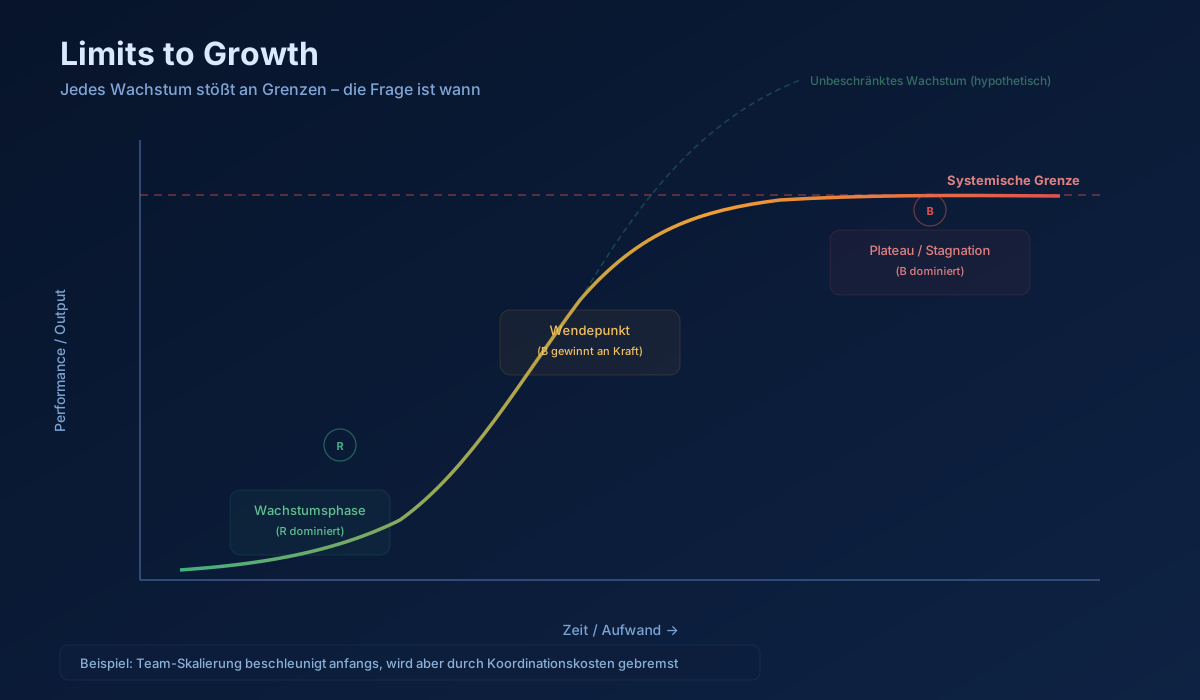
The archetype "Limits to Growth" describes a dynamic in which initially successful growth is slowed by a limiting resource. As long as the limit has not been reached, growth can reinforce itself: more users, more teams, more features, or more infrastructure initially create additional value. As load increases, however, a balancing feedback loop becomes active. Capacity, coordination ability, attention, or technical resources are no longer sufficient, and performance flattens or declines.
Feedback Loops
The structure consists of two loops. A reinforcing loop drives growth: success leads to more usage, more investment, or more demand. In parallel, a balancing loop emerges from a limited resource. That resource may be technical capacity, such as network bandwidth or build time, but it may also be cognitive capacity, such as the amount of code a team can still understand and maintain reliably.
Architecture Example
A new microservices architecture with a message bus is introduced. At first productivity increases: teams can develop, deploy, and scale services independently. As the number of services grows, however, operational effort also increases. Network latency, distributed tracing, versioning, CI/CD dependencies, and coordinated deployments become limiting factors. A small interface change may affect several teams and services. Architectural growth no longer automatically creates more delivery capability; it creates additional coordination work.
Organizational Example
Scaled agile can create a similar dynamic. A company expands its agile organization from a few squads to many teams, roles, and coordination formats. At first visible output increases because more people work in parallel. At some point, however, communication load becomes the limiting factor. Planning events, dependencies, committees, and role clarification consume so much attention that the organization becomes slower, even though more people are involved.
Diagnostic Questions
1.Which growth variable is increasing: users, teams, services, features, data volume, or coordination demand?
2.Which resource is not growing at the same pace: capacity, attention, maintainability, budget, governance, or technical infrastructure?
3.Where do we see early signs that more effort no longer produces proportional impact?
Diagram
How to Recognize the Pattern in Daily Work
In daily work, the pattern often appears when familiar recipes for success become weaker. More teams, more servers, more meetings, or more process discipline no longer solve the problem and may increase the load. The useful question is not "How do we push harder on growth?" but "Which balancing loop is currently limiting the effect?" Once the limiting resource is understood, it can be expanded, protected, or consciously accepted.
What Distinguishes the Pattern from Similar Dynamics
Limits to Growth describes growth that flattens because of a limiting resource. The Attractiveness Principle describes situations where several attractiveness factors compete with each other, such as speed, price, and quality. Growth and Underinvestment adds a management decision: the limit is visible, but the necessary investment in capacity arrives too late or is too weak.
How to Move from Pattern to Response
An effective response starts with scenarios. Take the central growth variable, for example transactions per second, number of services, number of teams, or amount of customer data, and scale it up significantly in a thought experiment. Then ask: which technical, organizational, or cognitive limit becomes relevant first? That leads to concrete architecture decisions: decoupling, automation, capacity planning, clearer team boundaries, or explicit WIP limits.
First Next Steps
Sketch the expected S-curve: what grows quickly at first, and what later limits that growth?
Name the limiting resource explicitly before adding more teams, features, or infrastructure.
Regularly check whether the system is currently constrained by demand, capacity, or coordination.
How to Recognize the Pattern with Confidence
Can we name the technical or organizational limits that our most important growth variables will reach first?
Sources
Donella Meadows - Thinking in Systems, ch. 3: Limits to Growth
Authors & Books
Go to referencesRelevant references for Limits to Growth.
Continue reading
Explore related topics from Archetypes
Accidental Adversaries
Teams that actually want to collaborate drive each other into ruin through selfish local optimizations.
Attractiveness Principle
A rising product or team attracts so much demand that quality collapses and the very source of its attractiveness gets damaged.