Growth and Underinvestment
A growing environment withers because investment in core capacity is delayed until it is too late.
Why it matters
An archetype helps you recognize recurring dynamics behind local symptoms.
Next step
Next, move into a diagnostic method to test the suspected structure against observations.

Description
The archetype "Growth and Underinvestment" is a company killer in the cloud age. A product or system grows rapidly. At some point that growth hits capacity limits, the system slows down and bugs pile up. The logical cybernetic response would be to invest heavily in capacity through refactoring, stronger infrastructure, or deep onboarding. But management avoids the cost, waits, or invests too late. Because performance remains poor, customers leave, growth stalls, and then declines. Management sees the declining numbers and feels vindicated after the fact: good thing we did not invest so much, growth went down anyway. It is a suicidal misreading of the system.
Feedback Loops
The engine follows the classic Limits to Growth pattern. A reinforcing loop drives success. That soon activates a balancing loop as performance limits slow the success down. The distinctive third branch is another delay loop that should actually expand the physical limit through investments in hardware or architecture. But because management misreads the signals, or because the delay of the upgrade is too large, such as nine months to carve up a monolith, that third loop does not act in time. Declining performance then kills the growth engine.
Architecture Example
A company builds a huge data warehouse for ML training. The architecture is simple and grows phenomenally. The more departments use the warehouse, the worse query latency becomes. Instead of approving a major re-architecture budget, such as a migration to a true streaming architecture or data mesh, management orders the team to patch only what is necessary. Latency remains poor. Frustrated departments move to their own Excel sheets and local SQL mirrors. Usage of the warehouse falls. The warehouse team loses budget because the platform is now "used less anyway."
Organizational Example
A rising startup significantly scales its feature teams. More developers should mean a stronger feature factory. What it fails to invest in is developer experience and CI/CD pipelines, the invisible capacity of the organization. Management wants budgets only for visible features, not for invisible platform hygiene. Eventually build times rise sharply, pull requests sit for weeks, and developers either work around the system or leave. Growth collapses. Management blames poor work ethic, while arguments like "we must not neglect the platform" are laughed off because the metrics are already in free fall.
Diagnostic Questions
1.Are we misreading a drop in usage metrics as lower market demand even though poor performance and terrible stability are what drove customers away?
2.Do we have severe delays in approving budget for foundational infrastructure changes?
3.Are we telling ourselves that we will refactor the architecture once we are big and profitable, while ignoring that we can never become big and profitable without that refactoring?
Diagram
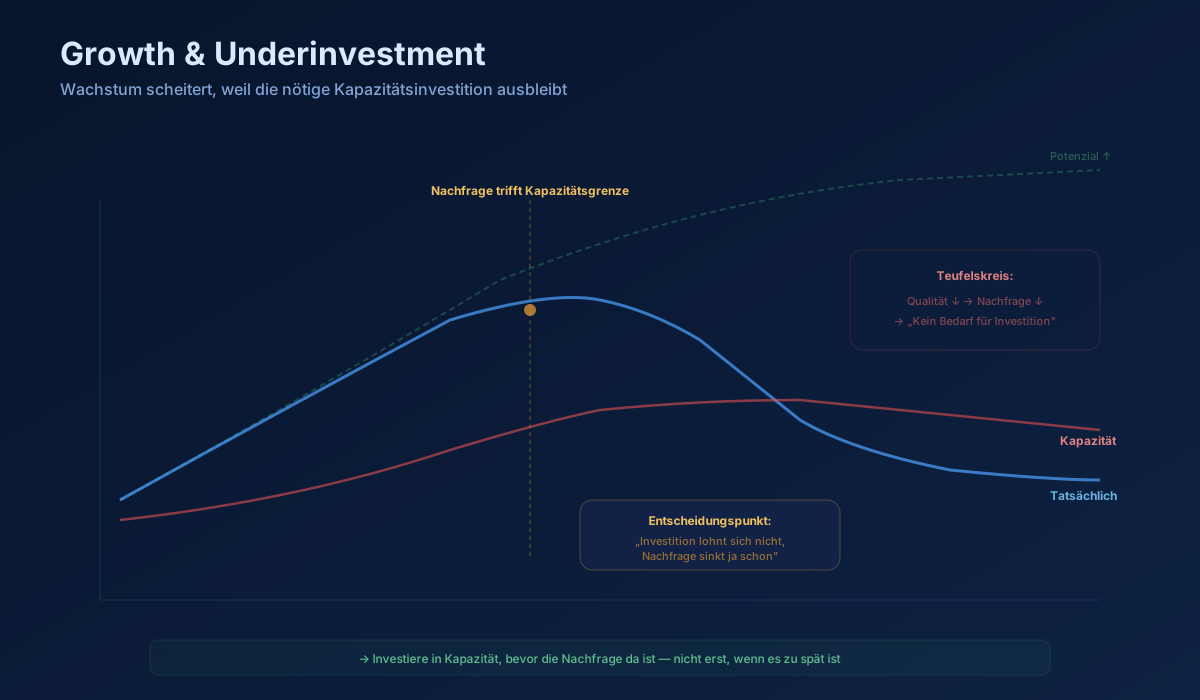
How to Recognize the Pattern in Daily Work
This dysfunction shows consistently that vision alone will not save a system. Growth requires anticipatory investment in core capacity long before the operating system starts to smoke. In IT projects, the classic underinvestment mistake is failing to invest early in automation, observability, and decoupling. Once architecture crisis has arrived, the organization no longer has the bandwidth to pull the lever.
What Distinguishes the Pattern from Similar Dynamics
Growth and Underinvestment is essentially the more detailed and economically painful extension of the pure Limits to Growth archetype. It shines a harsh light on the human reflex of avoiding the realization that you actually have to invest your way out of the hole.
How to Move from Pattern to Response
When the warning signs appear, quality declines, metrics start to soften, frustration rises, there is only one legitimate response. Establish excellent warning metrics and invest in the structure proactively, even when the curve is already flattening. For architects this means defending platform engineering budget with everything you have. Platform work is not a luxury byproduct. It is the only real capacity expansion that makes future growth possible.
First Next Steps
Tie capacity indicators rigidly to business signals. When the number of users exceeds threshold M, the architecture board should automatically block feature X in the master review until architecture investment Y has been secured.
How to Recognize the Pattern with Confidence
Are we falling into the trap of explaining the failure of a poorly maintained internal tool by saying "nobody wanted it anyway," instead of admitting that our underinvestment simply made it unusably slow?
Sources
The Systems Thinker: Growth and Underinvestment
Authors & Books
Go to referencesRelevant references for Growth and Underinvestment.
Continue reading
Explore related topics from Archetypes
Accidental Adversaries
Teams that actually want to collaborate drive each other into ruin through selfish local optimizations.
Attractiveness Principle
A rising product or team attracts so much demand that quality collapses and the very source of its attractiveness gets damaged.