Balancing Process with Delay
Ignorance about delayed feedback causes actors to overcorrect wildly and destabilize the system.
Why it matters
An archetype helps you recognize recurring dynamics behind local symptoms.
Next step
Next, move into a diagnostic method to test the suspected structure against observations.

Description
The archetype "Balancing Process with Delay" highlights the treacrescuerus oscillations that arise when systems react sluggishly to our steering interventions. If an actor such as an architect or manager tries to correct a problem in IT but sees the effect of the measure only after a significant delay in monitoring, people almost inevitably tend to overreact. We wrongly assume the correction has had no effect, increase it again, and overshoot the target completely in the opposite direction.
Feedback Loops
The core structure is a single, seemingly harmless balancing loop that aims at a target state. The problem sits on the feedback line in the form of a hard delay. The system reads the gap between actual and desired state, makes an intervention, but the feedback saying "we are now close to the target" arrives much later. During that blind waiting period, the loop repeats the action several times and produces a zigzag roller coaster.
Architecture Example
In a message queue, backlog rises rapidly. An autoscaler reacts by adding workers. But it takes four minutes of boot time and cache warming before a new worker handles real traffic. After two minutes the autoscaler sees that the queue is still not shrinking and concludes that it needs more servers. It launches many more workers. At minute five all of the newly started machines become active at once. The queue is drained within seconds, the metric collapses far below target, and the cluster panics and kills dozens of workers. Five minutes later the wild ride starts again.
Organizational Example
This is the classic hiring-and-firing problem. A tech company notices that delivery speed is too low. To handle the pressure it hires aggressively. It takes six months to find senior engineers, onboard them, and bring them into a complex system. Because velocity has not improved after three months, management pushes recruiting even harder. One year later the hallways are full of expensive new developers, the system is more complex than ever, the budget breaks, and a mass layoff follows.
Diagnostic Questions
1.Have we observed IT phenomena that constantly swing between far too little and far too much?
2.When a measure shows no effect after two weeks, do we immediately believe it has failed and launch the next reorganization in panic?
3.Is the delay between triggering a CI/CD pipeline and receiving true end-to-end test feedback so long that developers keep piling new faulty commits on top?
Diagram
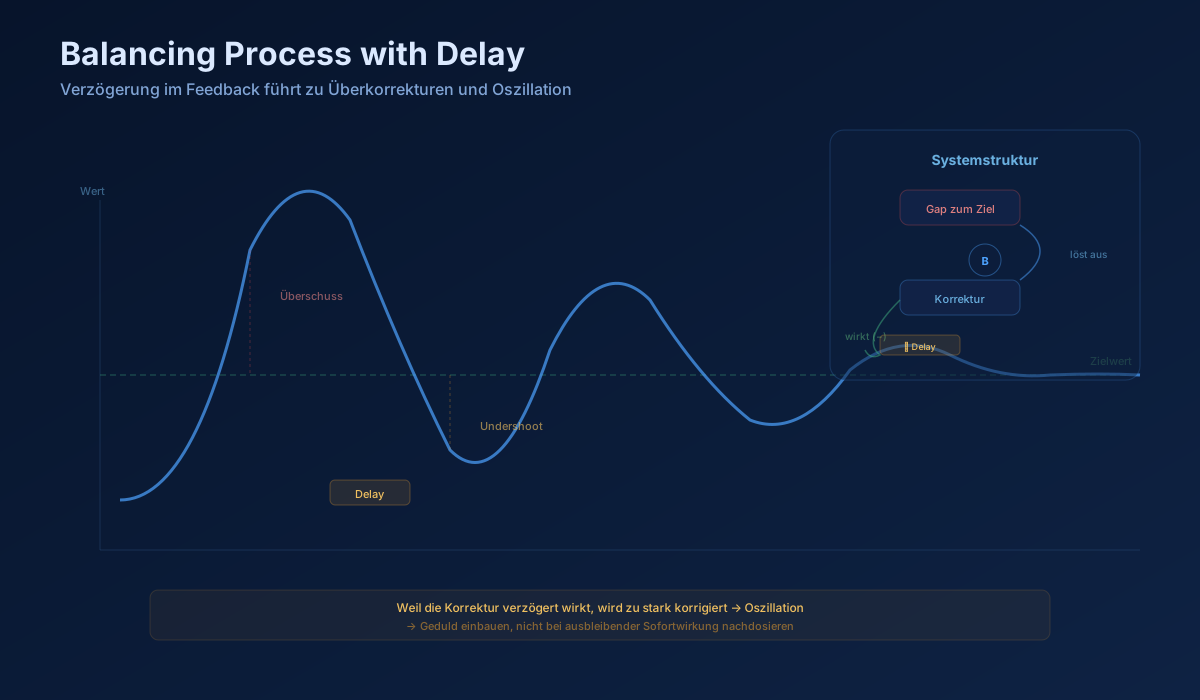
How to Recognize the Pattern in Daily Work
The classical engineering answer, make it real time, does not work everywhere. In machine systems we can often shorten delays through better technology. In human systems such as knowledge transfer, team building, or hiring, delays cannot be compressed past a certain physical point. The most effective medicine is therefore often paradoxical: slow down. If you cannot shorten the delay, you must radically reduce the frequency of your interventions. Let the system settle before yanking the wheel again.
What Distinguishes the Pattern from Similar Dynamics
This concept connects the general idea of delays with an archetype. In extreme form it can turn into Drifting Goals if the participants become so discouraged by constant overshoots and delays that they eventually give up and lower their original goals.
How to Move from Pattern to Response
Force delays to become explicitly visible through information radiators. An autoscaler needs a cooldown setting. A management board needs an iron rule such as: we completed a major reorganization, and for the next six months we will not touch the organizational structure again, no matter how painful the short term feels. We wait until the delay has fully played out.
First Next Steps
Make it explicit that short-term quick fixes in distributed systems are often neutralized by delays. Use chaos engineering to measure the real response time of your production cluster during a crisis.
How to Recognize the Pattern with Confidence
Was the autoscaler prevented from triggering multiple times before the first wave of instances had any physical effect on the load metric?
Sources
Donella Meadows - Thinking in Systems, ch. 2: Delays in Balancing Loops
Authors & Books
Go to referencesRelevant references for Balancing Process with Delay.
Continue reading
Explore related topics from Archetypes
Accidental Adversaries
Teams that actually want to collaborate drive each other into ruin through selfish local optimizations.
Attractiveness Principle
A rising product or team attracts so much demand that quality collapses and the very source of its attractiveness gets damaged.