Systems Mapping Canvas Tools
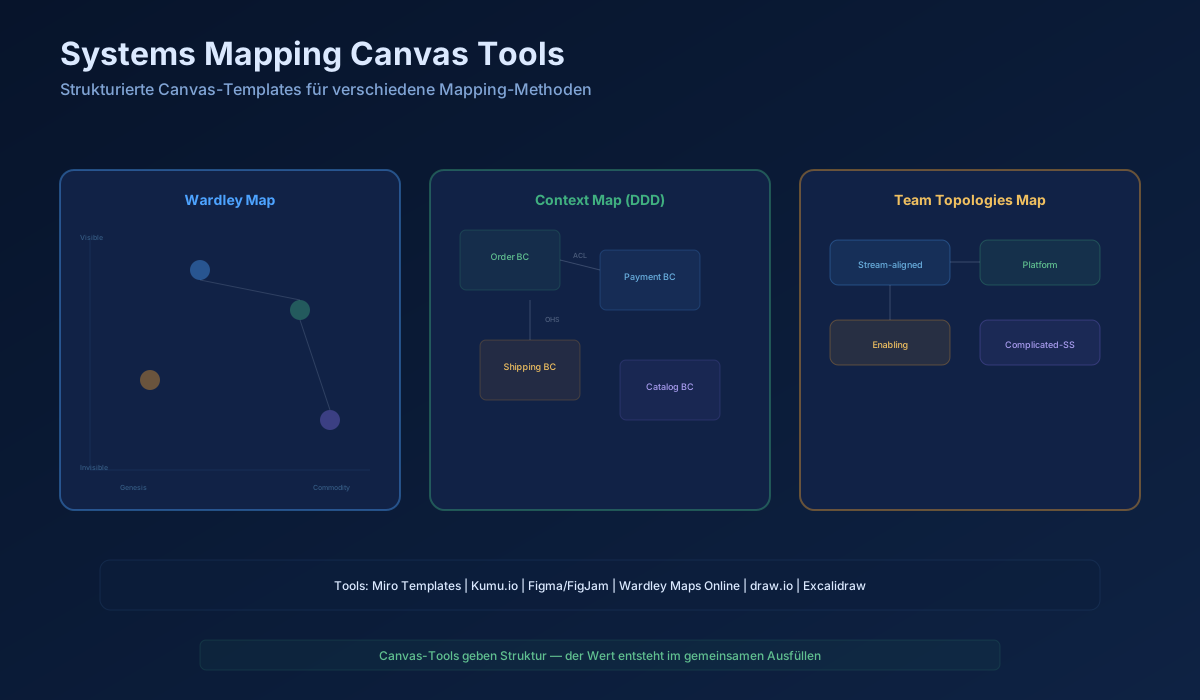
Pre-structured canvases such as Wardley Maps or Team API canvases that give architecture workshops a clear thinking frame.
Why it matters
Tools help make systems thinking practical in analysis, communication, and implementation.
Next step
Always combine the tool with a diagnostic or intervention logic instead of using it in isolation.

System Purpose
The most notorious moment in every architecture design meeting is the empty whiteboard, the blank-canvas syndrome. When architects start drawing without structure, the meeting ends with 50 disconnected boxes, endless debate about database indexes, and zero strategic decisions. Systems Mapping Canvas Tools are pre-drawn templates that force thinking into a strategic frame. They stop the meeting from collapsing into operational tactics and force hard conversations about value creation.
Tool Mechanics
A canvas such as a Wardley Map or a Team Topologies blueprint is not just an image. It is a value matrix.
Wardley Map canvas: It has two axes. The Y-axis is value, how close something is to the user. The X-axis is evolution, whether it is novel innovation or a commodity you should buy. If a tech team places its Kubernetes cluster in the lower-left genesis corner, the matrix should scream: "Do not build this yourself, buy Amazon EKS."
Event Storming canvas: A large linear timeline on a wall that forces the team to design asynchronous systems from left, origin, to right, resulting state.
Architecture Use
Canvases are wrecking balls for silo thinking. If a frontend team works in isolation, it may not care at all about the payment team. Put them together in an event-storming canvas and suddenly they discover huge overlaps in their domains and bounded contexts. The canvas becomes a boundary object. Engineers and sales specialists stop arguing against one another and start arguing together against the template on the wall: "Why doesn't our payment process fit this box?"
Limits and Risks
Canvas ping-pong without execution. There is a dangerous agile subculture that does nothing but fill out colorful canvases. "We still need the empathy-map canvas and the value-proposition canvas." If a canvas workshop, often consuming three hours of extremely expensive time from ten senior people, does not end with a clearly assigned architecture task in Jira or GitHub and a clear decision such as "kill Project X," it was consulting theater.
Diagram
Differentiation
Causal Loop Tools investigate failures and causality over time. Architecture Observability watches the living patient. Systems Mapping Canvas Tools such as Wardley Maps are pure strategy. They map the company's evolutionary position and answer the highest architectural question of all: make versus buy.
Decision and Practice Guide
Never use two different canvases in the same meeting. Make the chosen canvas a non-negotiable rule of the architecture review board: "We do not discuss budget approval for a new microservice until the team can defend its position on this quarter's Wardley Map." The canvas tool must not remain an optional creativity exercise. It needs to sit in the center of IT governance.
Sources
Simon Wardley — Wardley Maps (Online Book)
Matthew Skelton & Manuel Pais — Team Topologies, Ch. 7: Team API (IT Revolution, 2019)
Alberto Brandolini — Introducing EventStorming (Leanpub, 2021)
Authors & Books
Go to referencesRelevant references for Systems Mapping Canvas Tools.
Continue reading
Explore related topics from Tooling
Agent-Based Modeling Tools
Tools that simulate the behavior of many autonomous actors — for example how teams respond to new architecture rules — to surface emergent effects before rollout.
Architecture Observability Tooling
Traces, metrics, and logs as architecture diagnostics: they make gradual structural decay visible before it turns into incidents.