System Mapping Tools
A decision aid for choosing system mapping tools: when to use Miro, Kumu, Backstage, or Vensim — criteria instead of tooling dogmatism.
Why it matters
Tools help make systems thinking practical in analysis, communication, and implementation.
Next step
Always combine the tool with a diagnostic or intervention logic instead of using it in isolation.

System Purpose
One of the biggest traps in cybernetics is the golden-hammer syndrome: if the only tool you have is a hammer, every problem starts looking like a nail. Architects who just learned System Dynamics often want to force even a tiny bug-fix discussion into a four-week mathematical simulation. A pragmatic architecture practice needs a hard tooling matrix that determines which system-mapping tool is allowed for which level of urgency or complexity. That saves weeks of unnecessary analysis paralysis.
Tool Mechanics
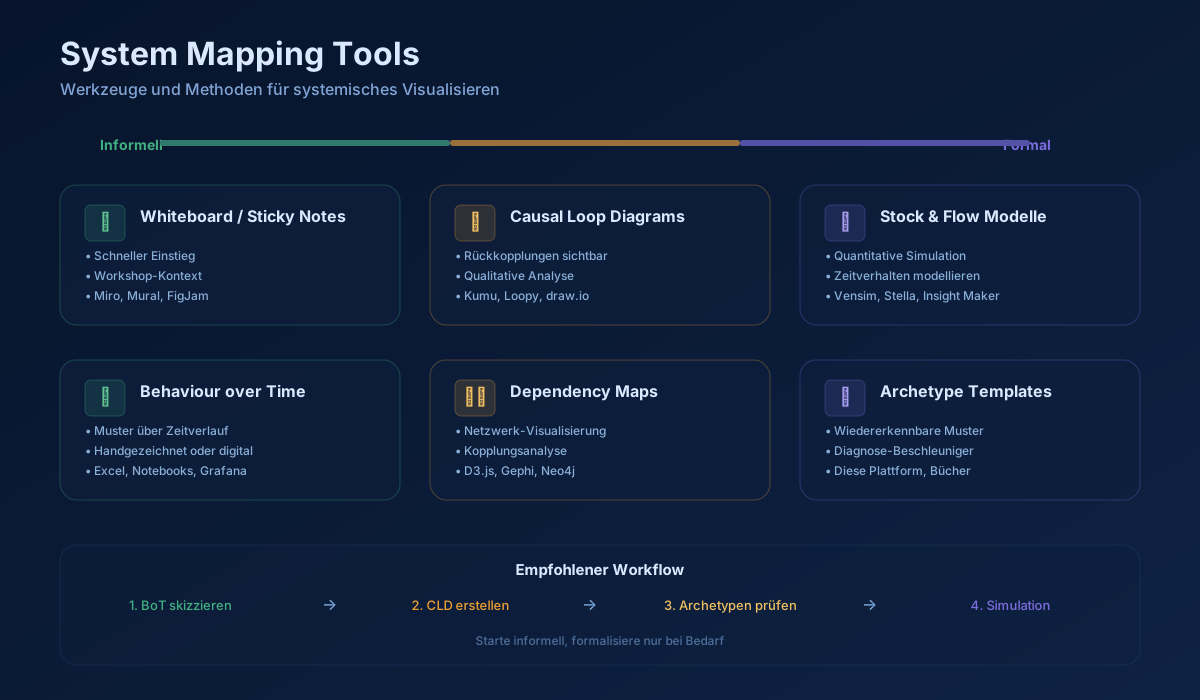
A mature tool stack operates across exactly three escalation levels:
1.Low fidelity (collaboration): The digital whiteboard, such as Miro, FigJam, or Excalidraw. No syntax, pure speed. Ideal for the first event-storming session when nobody yet understands where the system boundaries actually are.
2.Mid fidelity (topology and causal loops): Graph modelers, such as Loopy, Kumu, or Kivy. Fixed syntax with plus, minus, and delay semantics. Best for postmortems where stakeholders must map the real feedback structures behind the chaos.
3.High fidelity (dependency and simulation): Machine truth, such as Backstage, Neo4j, Stella, or Datadog. Code scanners and physics simulators. This is where personal opinion stops and staff engineers do deeper data-driven causality work.
Architecture Use
Mapping tools are the shared vocabulary between management and engineering. Engineers tend to see the system as code and services, management sees it as budgets and value flow. On the map, these realities collide and force the company to establish a universal language. A clean, versioned architecture map in the wiki can become a genuine single source of truth against which every new feature idea must be tested.
Limits and Risks
Map decay. If an architect builds a majestic Kumu causal-loop diagram, exports it as a PNG, and buries it on a Confluence page called "Architecture V1," the map is worthless the next morning. Systems are alive. Any mapping tool that is not tied continuously into Git or automated documentation workflows becomes a victim of drift. The map must breathe. A system graph older than two quarters actively misleads newcomers.
Diagram
Differentiation
Transparency by Design focuses on internal sensors such as logs and traces inside running code. System Mapping Tools are the external cartographers. They look down like satellites from the meta level onto the combined construct of technology, people, and process without worrying about individual lines of code.
Decision and Practice Guide
The iron rule of mapping is simple: do not build maps for eternity, build them for tomorrow's decision. An architect needs to know when to close the mapping tool again. Use Loopy especially when you need to explain to a non-technical executive why a fixed-budget project will turn into a high maintenance burden over time. There are few more effective tools than animated feedback loops on a tablet in the boardroom.
Sources
Kumu.io — Systems Mapping Platform
Authors & Books
Go to referencesRelevant references for System Mapping Tools.
Continue reading
Explore related topics from Tooling
Agent-Based Modeling Tools
Tools that simulate the behavior of many autonomous actors — for example how teams respond to new architecture rules — to surface emergent effects before rollout.
Architecture Observability Tooling
Traces, metrics, and logs as architecture diagnostics: they make gradual structural decay visible before it turns into incidents.