System Dynamics Simulation
The step from sketch to quantitative model: testing hidden delays in the architecture numerically before they cause damage in production.
Why it matters
Tools help make systems thinking practical in analysis, communication, and implementation.
Next step
Always combine the tool with a diagnostic or intervention logic instead of using it in isolation.

System Purpose
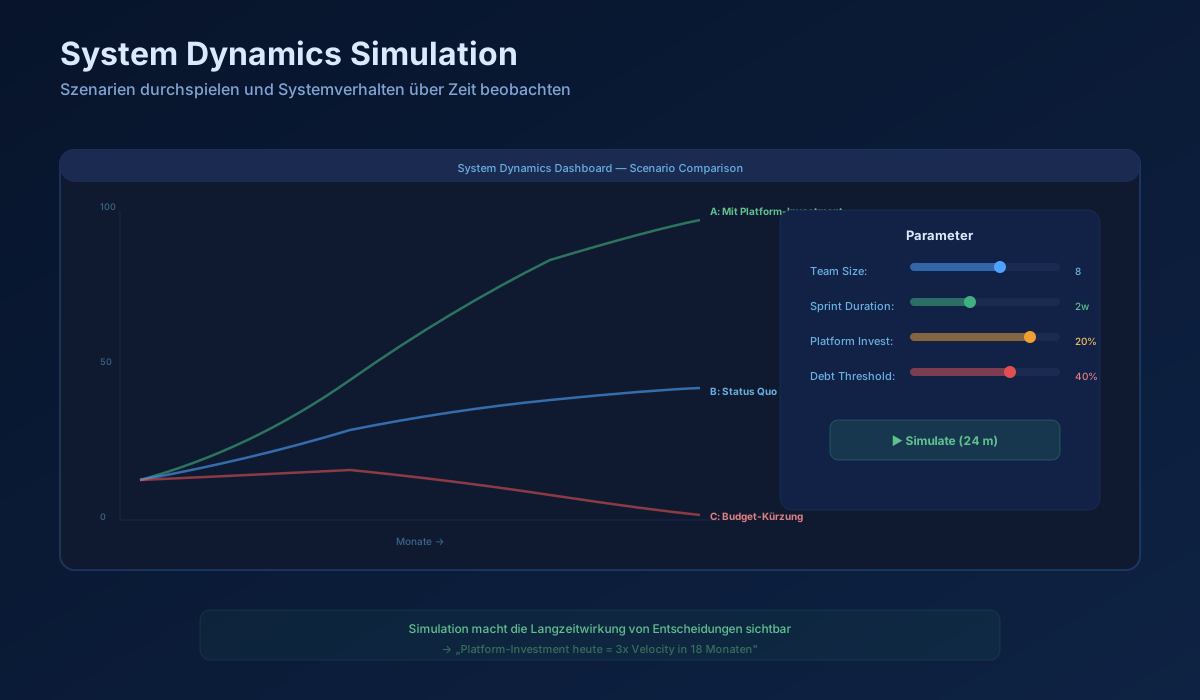
In highly complex systems, interventions often deliver the exact opposite of their long-term goal in the short term, the classic "worse before better" pattern. If an architect orders a significant refactoring freeze, feature velocity may rise today, but in 18 months support tickets rise sharply and feature velocity collapses. System Dynamics Simulation exists to make that dangerous delay visible. It protects architects from decisions that save the current quarter while physically wrecking the company in the one after next.
Tool Mechanics
Simulation strips intuition of its power. You define the system as a mathematical network and inject shocks into it:
1.Input shock: "What happens if we suddenly double the number of junior developers on the team?"
2.Nonlinear calculation: The simulation computes Brooks's Law: juniors tie up seniors for training, bugs rise, and review times increase nonlinearly.
3.Plot: The tool outputs a curve in which team productivity falls for the next nine months before returning to its old level, the classic J-curve effect.
Architecture Use
Imagine management demands the construction of a significant enterprise service bus (ESB) to integrate every application. The lead architect doubts it and suspects a central bottleneck. They build a system-dynamics model: 100 autonomous microservices send requests to the ESB node. The simulation shows immediately that above a system size of N=30, the central ESB team chokes on integration tickets. The architect walks into the CIO meeting not with opinions but with a mathematical image of unavoidable causal collapse.
Limits and Risks
The illusion of omnipotence. If an architect builds a 400-node model, they eventually start confusing the model with reality. An excellent system-dynamics model contains perhaps ten core variables. The moment you start factoring employee coffee consumption, Berlin weather, and the AWS stock price into "service stability," the model loses its value. Models are not there for fortune-telling. They are there to damage problematic thinking errors in architecture design.
Diagram
Differentiation
Simulation Sandboxes such as Chaos Monkey inject physical failures into real running servers. System Dynamics Simulation is a dry run on the abstract level, a kind of bathtub mathematics. It happens before the first line of code and tests the dynamics of organizational and delivery economics rather than Java code.
Decision and Practice Guide
Simulation is a weapon for high-risk, multimillion-euro one-way-door decisions, for example whether to split a monolith or not. Never use simulation for trivial choices such as React versus Vue. Do not hire outside consultants to build a model you cannot understand mathematically yourself. If the model is a black box to you, you cannot use it to defend your architecture to the CEO.
Sources
John Sterman — Business Dynamics (McGraw-Hill, 2000)
Authors & Books
Go to referencesRelevant references for System Dynamics Simulation.
Continue reading
Explore related topics from Tooling
Agent-Based Modeling Tools
Tools that simulate the behavior of many autonomous actors — for example how teams respond to new architecture rules — to surface emergent effects before rollout.
Architecture Observability Tooling
Traces, metrics, and logs as architecture diagnostics: they make gradual structural decay visible before it turns into incidents.