Simulation Sandboxes
Tools that deliberately inject load or failure into production-like systems to test architectural resilience under controlled conditions.
Why it matters
Tools help make systems thinking practical in analysis, communication, and implementation.
Next step
Always combine the tool with a diagnostic or intervention logic instead of using it in isolation.

System Purpose
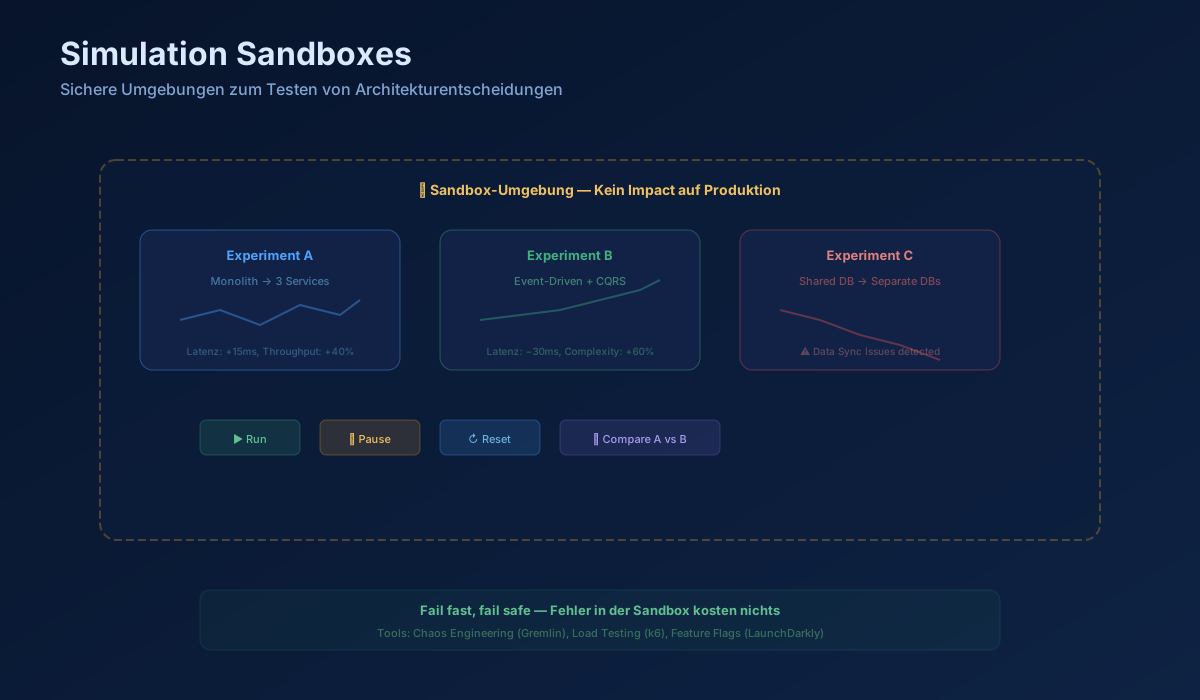
Architects draw beautiful fallback lines in their diagrams. In theory, if the main database fails, the load balancer switches seamlessly to the cache. In practice, when the database actually fails at 3 a.m., that exact fallback mechanism fails and drags the entire cloud with it. Simulation Sandboxes, including chaos engineering and load testing, put an end to hope-based architecture. They are the virtual wind tunnel. Instead of waiting for disasters, the cybernetics team triggers them on purpose, but inside a tightly controlled blast radius.
Tool Mechanics
There are two main categories of physical simulation in running systems:
1.Load and stress testing: Tools such as k6 or Gatling. They do not simulate user empathy, they simulate raw physics. "What happens if 100,000 users click the purchase button in the same second?" The tool crushes your servers artificially to expose the real limits of your services.
2.Chaos engineering: Tools such as Gremlin or Netflix's Chaos Monkey. They interfere directly with infrastructure by killing Kubernetes pods, injecting network latency, or stripping RAM from servers.
Architecture Use
Sandboxes close one of the longest and deadliest feedback loops in IT: the disaster-recovery loop. Normally a team receives feedback on its emergency design maybe once every three years, when everything is already on fire. With simulations, the architect forces the organization into a weekly problem loop. Management can approve "game days" where developers and DevOps engineers gather, pull the plug live, and observe in real time whether and how quickly the cybernetic system heals itself.
Limits and Risks
Chaos in the wild. Chaos engineering in production is the highest discipline, but if the company has not even mastered basic observability, it is pure recklessness. If you start a chaos test and cannot see within five seconds on the dashboard that you are blocking real customer checkout, you did not run a test, you committed sabotage. Sandboxes require maturity, automatic kill switches, and excellent dashboards.
Diagram
Differentiation
Agent-Based Modeling simulates human herd behavior. System Dynamics models abstract mathematical patterns. Simulation Sandboxes are different because they are not abstract at all. They inject unforgiving physical pressure directly into real RAM, real CPU, and real networks.
Decision and Practice Guide
Do not start with chaos engineering in production. Begin in a dedicated staging environment isolated from customers, the actual sandbox. Always write down a steady-state hypothesis first, for example: "Even if Service B fails, 99% of logins must stay under one second." Only after that hypothesis is explicit should the chaos monkey be activated. Force the architecture to prove resilience physically instead of preaching theology in Confluence.
Sources
Gremlin — Chaos Engineering Platform
Authors & Books
Go to referencesRelevant references for Simulation Sandboxes.
Continue reading
Explore related topics from Tooling
Agent-Based Modeling Tools
Tools that simulate the behavior of many autonomous actors — for example how teams respond to new architecture rules — to surface emergent effects before rollout.
Architecture Observability Tooling
Traces, metrics, and logs as architecture diagnostics: they make gradual structural decay visible before it turns into incidents.