Dependency Graph Analysis
Tools that extract dependency graphs from real systems and show which couplings make changes risky.
Why it matters
Tools help make systems thinking practical in analysis, communication, and implementation.
Next step
Always combine the tool with a diagnostic or intervention logic instead of using it in isolation.

System Purpose
Once a company leaves the monolithic phase and moves into distributed systems, the human eye loses the ability to spot tight coupling at a glance. The system starts behaving chaotically. One team updates an apparently harmless LogHelper library and suddenly 40 other microservices fail, even though no one realized they depended on it. Dependency Graph Analysis through tools such as Backstage, Neo4j, or code analyzers like SonarQube is the machine-based rescue from that blindness. It scans code or network calls and generates an unforgiving physical network of dependencies.
Tool Mechanics
Dependency tools operate both microscopically in the code and macroscopically across the cloud architecture:
1.Static analysis: Tools read package.json or pom.xml across repositories and build graphs such as "who uses which React version?" This helps contain dependency issues and third-party security risks.
2.Service catalogs: Developer portals such as Spotify's Backstage.io register every microservice in the system. Developers can ask, "Show me the graph of all teams and databases that depend on this payment service upstream." The machine reveals the blast radius of your planned change.
Architecture Use
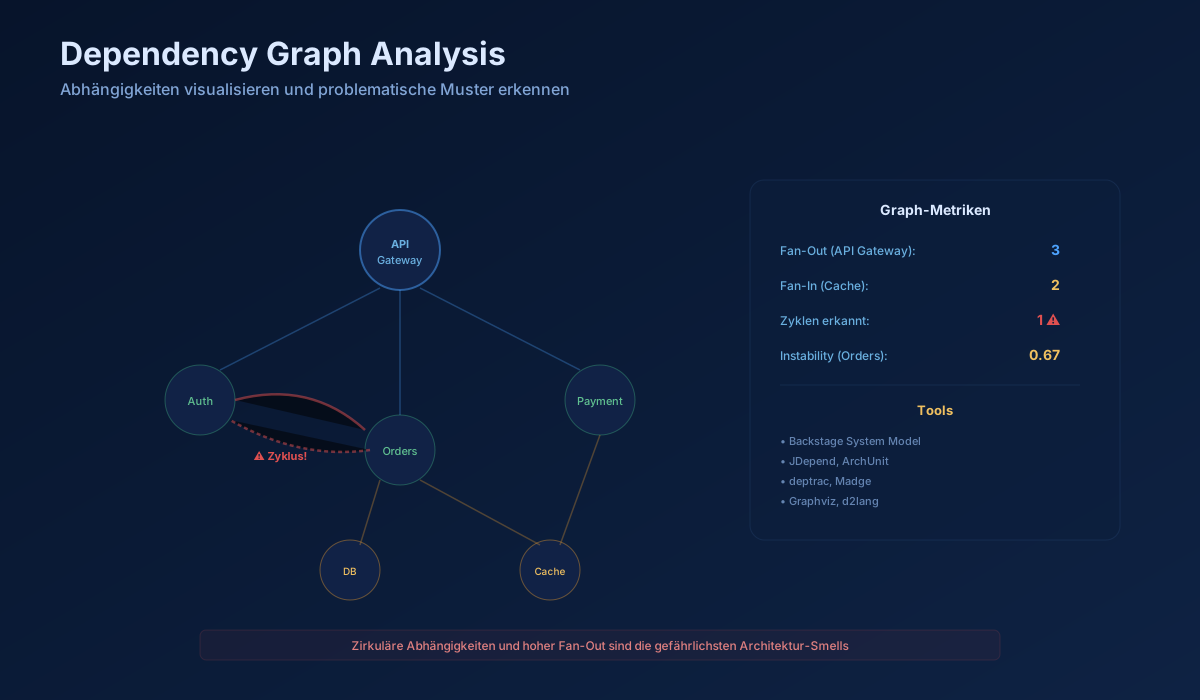
These tools are essential for structural coupling adjustment. Before you can separate two teams in Conway's Law terms, you must prove where they are bleeding together. Feed the code into a dependency analysis tool and search for the big ball of mud, the Gordian knot where hundreds of red lines from every corner of the system converge into one central utils.js file. That node is the cybernetic bottleneck of the entire company.
Limits and Risks
The deceptive comfort of static graphs. If you measure dependencies only by scanning source code, compile-time dependency, you remain blind to the most dangerous coupling of all: runtime dependency. Team A may never call Team B directly in code, yet Team A silently writes data into an S3 bucket at night that Team B reads the next morning. If Team A changes the file format, Team B dies in production while the static graph still looks green. To reach actual truth, dependency tooling must be cross-checked with observability tooling.
Diagram
Differentiation
Causal Loop Tools capture the humanly imagined model of system problems. Architecture Observability records the active signals of living servers. Dependency Graph Analysis scans the skeleton of the existing architecture, who calls whom, who includes whom, in a value-neutral and simple objective way.
Decision and Practice Guide
Destroy the possibility of cyclic dependencies. Configure build pipelines, for example with ArchUnit in Java or Madge in JavaScript, so that they fail the build as soon as a developer even hints at introducing A-needs-B and B-needs-A into the code. Preventing structural cycles protects team autonomy.
Sources
Sam Newman — Building Microservices, Ch. 3: Coupling (O'Reilly, 2021)
Authors & Books
Go to referencesRelevant references for Dependency Graph Analysis.
Continue reading
Explore related topics from Tooling
Agent-Based Modeling Tools
Tools that simulate the behavior of many autonomous actors — for example how teams respond to new architecture rules — to surface emergent effects before rollout.
Architecture Observability Tooling
Traces, metrics, and logs as architecture diagnostics: they make gradual structural decay visible before it turns into incidents.