Viable System Model
A masterpiece of organizational cybernetics that describes the mathematical and fractal structure every software company needs in order to stay alive under intense market pressure.
Why it matters
Diagnostics turn assumptions into grounded structural hypotheses for architecture and organization.
Next step
After that, derive interventions that specifically change rules, boundaries, or feedback loops.

Purpose
Created by Stafford Beer in the 1970s and inspired by the human nervous system, the Viable System Model remains one of the most radical tools for understanding scale in IT. It argues that org charts lie and often condemn companies to inefficiency. VSM states that an organization must contain exactly five fundamental subsystems. If even one is missing, or if feedback between them breaks, the organization either dies from rigidity or rises sharply into chaos. VSM is the blueprint for scaling teams and software architecture in a fractal way.
Context of Use
VSM is one of the philosophical foundations beneath ideas such as Conway's Law and Team Topologies. When a company forces a transition from a monolith to distributed service-oriented architecture, it is really transferring the burden of complexity management onto teams. VSM is used when the CTO level is losing visibility over a growing fleet of autonomous services and needs a way to restore coherent information flow.
Step by Step
A viable system is fractal. A single product team can reflect the same structure as a department, and a department can reflect the same structure as the enterprise.
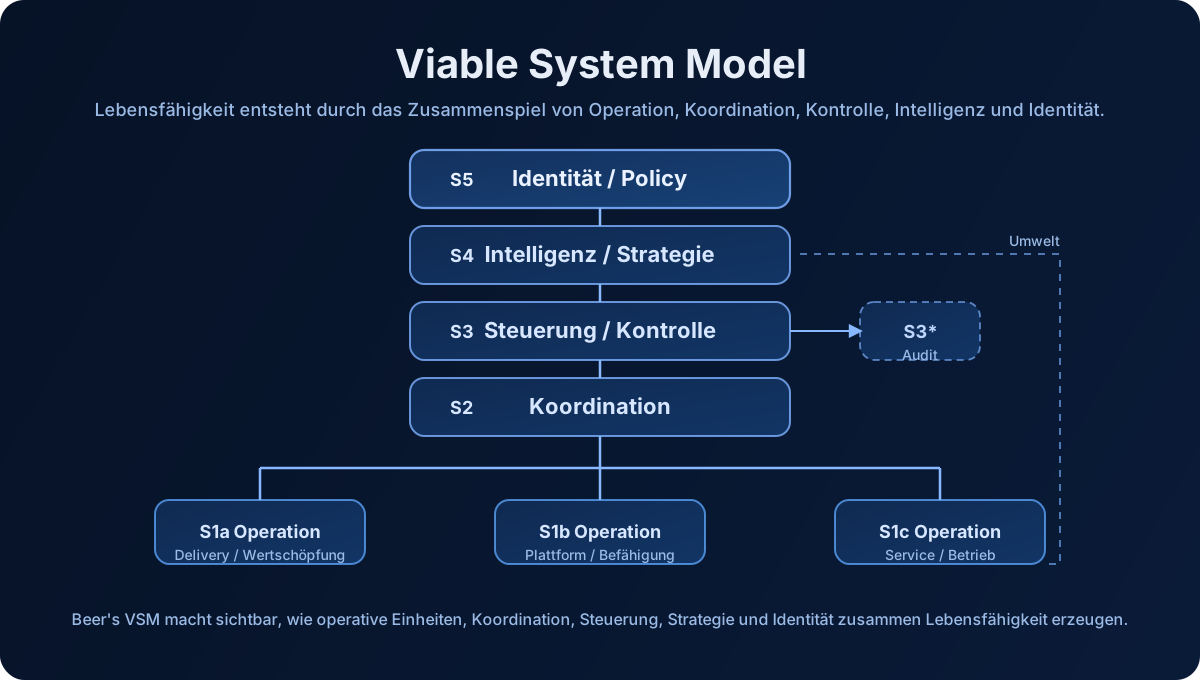
System 1 (Operations): The muscles. The actual work. The delivery teams writing and shipping code. These units need strong autonomy.
System 2 (Coordination): The parasympathetic nervous system. It stops the muscles from cramping. Shared design systems, API gateways, and scrum-of-scrums belong here. System 2 synchronizes the units without commanding them.
System 3 (Control and delivery): The lower brain. It allocates resources, budgets, and focuses on the inside and now.
System 4 (Intelligence and future): The cortex. It looks outward and forward. Which technologies are emerging? What options must we create for tomorrow?
System 5 (Identity and policy): The super-ego of the organization. This is where identity, purpose, and the balance between present survival and future adaptation are decided.
Example
A fast-growing ecommerce platform starts to fail. A VSM diagnosis reveals a fractal break in complexity damping. Engineers in checkout send every small deploy error directly into the CIO office. The top of the organization is overwhelmed by noise from low-level operational detail. VSM demands an intervention: strengthen System 2 through paved roads and reliable CI/CD, and strengthen System 3 through dedicated platform engineering and operational control. Those layers must absorb and filter noise before it burns out System 5.
Diagram
How Diagnosis Turns into Action
In VSM, communication, especially the algedonic signal, is everything. When teams say they are building autonomous microservices, they often really mean they are cutting communication arteries. VSM warns strongly against that. An autonomous unit must be able to send pain signals upward quickly and without distortion. If middle management sanitizes incident reports, the alarm channel is blocked, leadership feels safe, and the body of the organization can burn quietly.
When This Method Fits Best
Domain-Driven Design defines domain boundaries. The Viable System Model tells you how the cybernetics between those boundaries must be wired so that the organization does not drown in communication overhead. It provides the theoretical foundation for the more operational Viability Audit.
How to Use the Diagnosis in Everyday Work
As an architect, obsess over the balance between System 3 and System 4. A typical legacy silo has a huge System 3 devoted to daily operations, incidents, and bug fixing, while System 4 is handled by one developer on Friday evening after regular work. Rescue System 4. If System 3 rules the company alone, you have optimized yourself straight into technological obsolescence.
First Analysis Steps
It is useless to use VSM as a slide template only. Its real force appears when you take Ashby's Law of Requisite Variety seriously. The number of control states available to management has to exceed the variety of the system it governs. That is impossible if the organization relies on manual oversight of highly complex services. Architecture therefore has to attenuate variety upward through automation while amplifying capability downward through tooling and cloud scale.
How You Recognize a Useful Diagnosis
Does each cross-functional team at the lowest level have its own small version of System 4, real time and capacity to think about the future of its domain and upcoming refactorings, or is all future thinking still dictated centrally by the architecture board?
Sources
Stafford Beer — The Brain of the Firm (John Wiley, 1972)
Stafford Beer — Diagnosing the System for Organizations (John Wiley, 1985)
Authors & Books
Go to referencesRelevant references for Viable System Model.
Example analysis artifact
VSM structure map with operational units, coordination and governance.
Continue reading
Explore related topics from Diagnostics
Assumption Mapping
A diagnostic tool for strictly exposing, categorizing, and deliberately testing unspoken assumptions in architecture design.
Behaviour over Time Charts
A visualization tool that reveals how system variables such as metrics, debt, or productivity change over time.