Viability Audit with VSM
An audit tool that strictly tests whether software teams and architectures are biologically viable or structurally destined to collapse.
Why it matters
Diagnostics turn assumptions into grounded structural hypotheses for architecture and organization.
Next step
After that, derive interventions that specifically change rules, boundaries, or feedback loops.

Purpose
The Viability Audit is the operational checklist of Stafford Beer's Viable System Model. Tech companies often scale from ten to five hundred developers simply by adding more tribes or more microservices. That usually leads to loss of control. The Viability Audit checks whether an organization or software service actually contains the five cybernetic organs required for autonomous survival in a hostile environment of markets, outages, and attacks.
Context of Use
Use the audit as an emergency brake before hypergrowth phases, carve-outs, or radical autonomy programs such as "you build it, you run it." If the CEO declares that squads are now fully autonomous and middle management can be removed, the architect should use this audit to verify whether those teams can actually govern that autonomy.
Step by Step
The auditor checks for the existence and health of the five systems at every relevant scale:
1.System 1 (Operations): Does the unit perform core work such as building and shipping features, or does it mostly manage itself?
2.System 2 (Coordination): Are there mechanisms, such as API contracts or CI/CD pipelines, that prevent operating units from damaging each other through oscillation and conflict?
3.System 3 (Control): Is there a real-time dashboard, management process, and resource-allocation mechanism for the here and now? Is there also a sporadic audit function, System 3*, that tests whether the dashboard reflects reality?
4.System 4 (Development): Are enough organizational brain cells looking outward and forward, through tech radar work, research, or architecture hygiene?
5.System 5 (Identity and policy): Is there a final decision authority that can resolve tension between present-day control and future adaptation?
Example
A viability audit is applied to a one-hundred-person feature tribe that ships large amounts of code but has an exploding defect rate. The result is immediate. System 1 is running at 150 percent. System 2 is practically absent because there are no automated end-to-end tests between services. At the same time, System 3, daily sales pressure, dominates the unit completely, while System 4, architecture research and preparation for the next platform shift, has zero dedicated capacity. The result is binary: the tribe is not viable. It will damage itself because it has no future-sensing capability.
Diagram
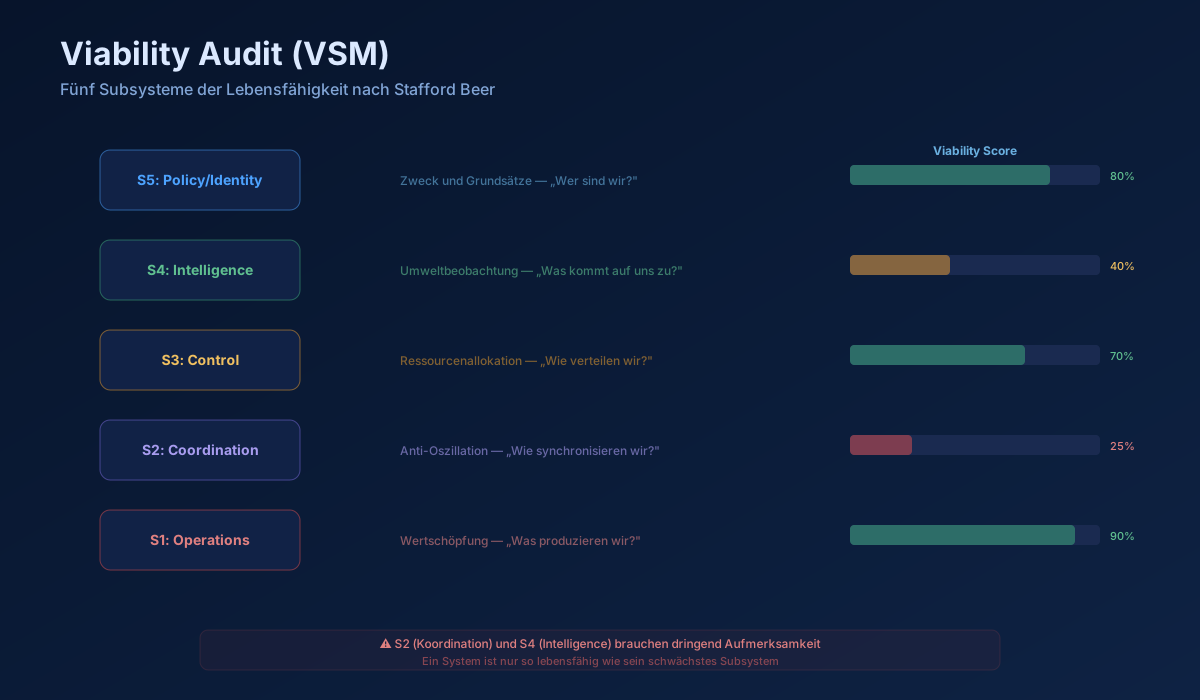
How Diagnosis Turns into Action
One of the most painful points in a VSM audit is the conflict between System 3, the inside-and-now, and System 4, the outside-and-then. Architects should largely operate in System 4, but in many companies they spend ninety percent of their time trapped in System 3 firefighting and micromanagement. If the audit shows System 4 is under-supported, systems thinking predicts that the market offering will age rapidly or be damaged by disruptive competitors.
When This Method Fits Best
Dependency Mapping and Stock and Flow ask whether the code flows. The Viability Audit asks a higher-order question: does this code, this cloud service, and the team around it even possess the cybernetic brain needed to stay alive without constant intervention from above?
How to Use the Diagnosis in Everyday Work
Challenge management templates that equate lean with good and management with overhead. The autonomy of elite teams at companies such as Amazon works only because huge sums are invested in coordination and control through APIs, automation, and alarms. You cannot simply remove governance layers without building the technological equivalents. Removing them without replacement does not produce agility — it removes the system's ability to steer itself.
First Analysis Steps
Audit the communication channels, especially algedonic channels, with deliberate honesty. In a viable system, a severe failure in System 1 must be able to send an unfiltered pain signal upward past middle management to System 5. If your culture dilutes errors in the management chain, the audit should raise a serious alarm.
How You Recognize a Useful Diagnosis
Is an independent bounded context accepted as complete only when the responsible squad can prove that the service includes not just System 1 functionality but also automatic observability for System 3 and a clear lifecycle plan for System 4?
Sources
Stafford Beer — The Brain of the Firm (John Wiley, 1972)
Stafford Beer — Diagnosing the System for Organizations (John Wiley, 1985)
Authors & Books
Go to referencesRelevant references for Viability Audit with VSM.
Example analysis artifact
VSM audit structure to check whether operational, coordinating and controlling functions work together sustainably.
Continue reading
Explore related topics from Diagnostics
Assumption Mapping
A diagnostic tool for strictly exposing, categorizing, and deliberately testing unspoken assumptions in architecture design.
Behaviour over Time Charts
A visualization tool that reveals how system variables such as metrics, debt, or productivity change over time.