Systems Clues in Everyday Language
A forensic tool for analyzing stock phrases, excuses, and us-versus-them language in IT meetings in order to uncover hidden architectural sins.
Why it matters
Diagnostics turn assumptions into grounded structural hypotheses for architecture and organization.
Next step
After that, derive interventions that specifically change rules, boundaries, or feedback loops.

Purpose
In most cases, the causes of severe software architecture do not first appear in the source code but in the unconscious language patterns of daily stand-ups. Systems Clues in Everyday Language trains you to listen with unusual precision. People often use words as shields around broken feedback loops. Before a system collapses, it frequently announces itself for weeks through a semantic shift in the rhetoric of the people maintaining it.
Context of Use
This diagnostic should run as a constant background process in the mind of every capable principal engineer or scrum master, but it is especially powerful in retrospectives and incident post-mortems. Instead of searching only for technical bugs, the architect analyzes the team's transcript and language to expose the deeper systemic rot.
Step by Step
Pay close attention to four recurring linguistic signals and practice translating them:
1.Built-in delay, symptom: oscillation: "We are always one sprint behind. First everything runs well, then chaos breaks out." Translation: the system lacks real-time metrics and is steering itself blind.
2.Us-versus-them split, symptom: silo boundaries: "The testers have no idea what they are doing." Translation: the architecture is cut badly, and the handoff to QA is a structural gap rather than a shared domain goal.
3.Frog in hot water, symptom: eroding goals: "There was a bit of latency this morning, that happens." Translation: service-level objectives are slipping gradually and the team is normalizing deviance.
4.Blame assignment, symptom: linear thinking: "We are overloaded because product keeps throwing too many tickets at us." Translation: the team overlooks circular causality and fails to see how its own bugs create the panic that drives micromanagement.
Example
A lead architect sits in a status meeting. The backend lead says under pressure: "To save API response time, we have to crank up the cache significantly right now, even if that creates stale data. There is no alternative." The architect hears the key system signal: must, or no alternative. In cybernetics there is never only one option. This is a classic sign of symptomatic fixing. The language proves that the team is fighting the symptom, latency, with a panic move instead of redesigning the underlying cause, too many synchronous database queries.
Diagram
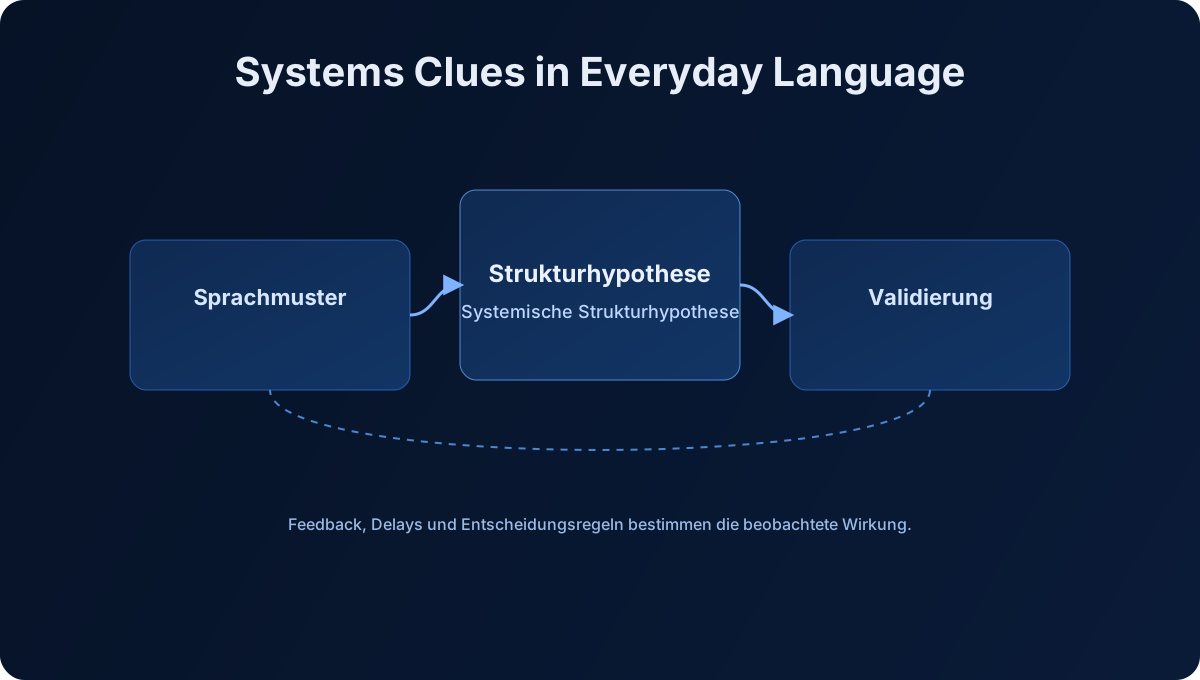
How Diagnosis Turns into Action
Systems thinkers dislike passive voice in architecture documentation. Phrases like "The server became slow" or "Technical debt accumulated" erase agency. Debt does not accumulate by magic. People create debt. Push the team back into active language. Who took on the debt? For what rational reason? Passive constructions are often the system's attempt to hide responsibility and outsource pain to uncontrollable external forces.
When This Method Fits Best
Where Root Definition Analysis actively formulates cleaner new statements, Systems Clues in Everyday Language is passive and observational. It is a radar screen that watches the dirty everyday language of chats and meetings and raises the alarm long before Jira metrics deteriorate.
How to Use the Diagnosis in Everyday Work
In architecture decision sessions, listen for the word "actually" followed by "but." When someone says, "We actually wanted to do event sourcing properly, but ...", the sentence after the but identifies the leverage point of the organization. It tells you which system limits, budget, team skill, or deadline, are strong enough to crush even the supposedly best design. Fight that limit, not the fantasy before it.
First Analysis Steps
Run a kind of dysfunction buzzword bingo as an architect or agile coach. When the team says things like "That is not our problem," write it down. It is evidence that the bounded context in your Domain-Driven Design strategy is socially broken.
How You Recognize a Useful Diagnosis
Do you actively interrupt meetings when developers shift blame onto management, "the system," or external providers, and refuse to continue until circular co-responsibility is acknowledged?
Sources
The Systems Thinker: Systems Clues in Everyday Language
Peter Senge — The Fifth Discipline, Chapter 9: Team Learning
Virginia Anderson & Lauren Johnson — Systems Thinking Basics (Pegasus, 1997)
Authors & Books
Go to referencesRelevant references for Systems Clues in Everyday Language.
Example analysis artifact
Language pattern map that makes evidence of blame, boundaries and implicit control logic visible.
Continue reading
Explore related topics from Diagnostics
Assumption Mapping
A diagnostic tool for strictly exposing, categorizing, and deliberately testing unspoken assumptions in architecture design.
Behaviour over Time Charts
A visualization tool that reveals how system variables such as metrics, debt, or productivity change over time.