Stock and Flow Mapping
The precise quantitative map of systems thinking. It visualizes architecture as a network of stocks that fill and drain through rates.
Why it matters
Diagnostics turn assumptions into grounded structural hypotheses for architecture and organization.
Next step
After that, derive interventions that specifically change rules, boundaries, or feedback loops.

Purpose
Stock and Flow Mapping is one of the highest disciplines of system diagnosis, rooted in the work of Jay Wright Forrester. While Causal Loop Diagrams sketch blurred directional logic such as "more features create more bugs," stock-and-flow models translate architecture into hard quantitative dynamics. They expose the consistent truth that a clogged system, such as a full backlog of Jira tickets, cannot always be emptied just by adding more developers to the outflow. In many cases it is cheaper to turn down the inflow from product.
Context of Use
Use this method whenever management asks, "Why does everything take so long?" or "Where are our server resources disappearing?" Stock and Flow Mapping is the right diagnosis for anything that accumulates: technical debt, ticket backlogs, memory leaks, burnout, or employee churn caused by overload.
Step by Step
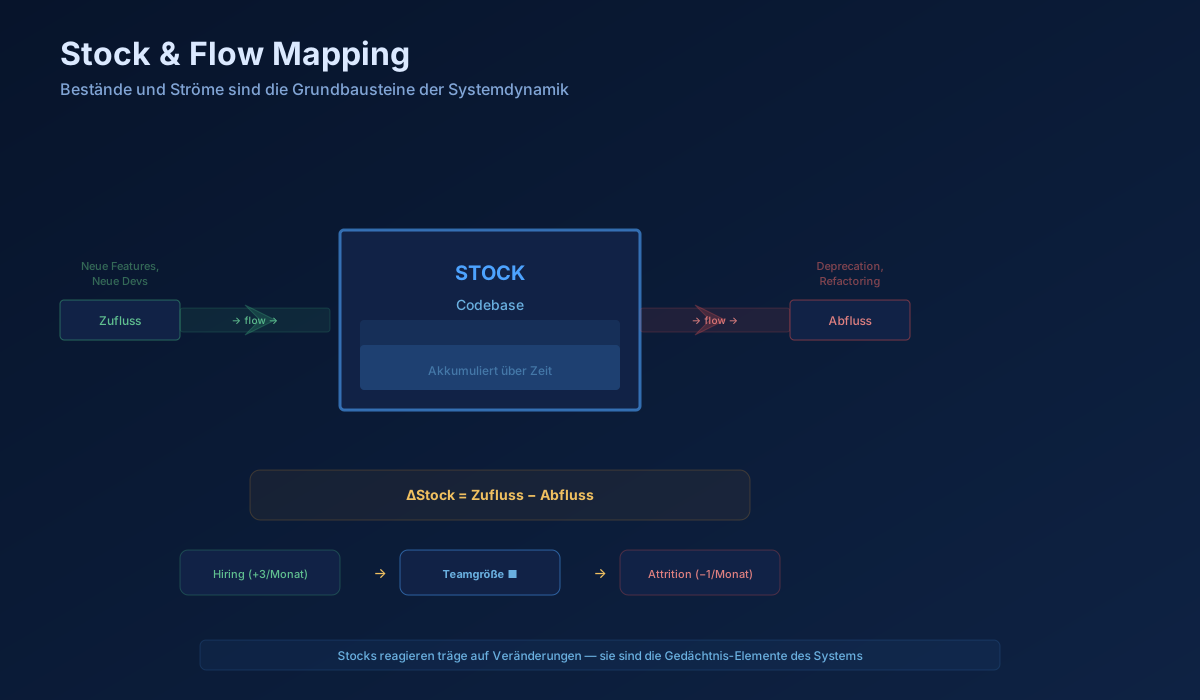
1.Identify the stock: This is the bathtub. It is a quantity that exists even if time stopped, such as the number of unresolved production bugs. In diagrams it is shown as a rectangle.
2.Draw the inflow: This is the pipe feeding the bathtub. It is a rate measured over time, such as twenty new bugs per week. It is usually drawn as a thick arrow with a valve.
3.Draw the outflow: This is the pipe draining the bathtub, such as ten bug fixes per week.
4.Calculate accumulation: The stock level is the integral of inflow minus outflow over time. If inflow is twenty and outflow is ten, the bathtub fills by ten bugs per week. Overload is mathematically guaranteed.
Example
A VP of Engineering complains that platform documentation is always outdated. A stock-and-flow diagram is drawn. The inflow, new architecture changes per sprint, is fifty units per week. The outflow, developer time actually spent on documentation, is five units per week. The documentation debt grows by forty-five units every week. The diagnosis is simple and unforgiving: as long as development speed keeps feeding the inflow at that level, the documentation debt problem cannot be solved.
Diagram
How Diagnosis Turns into Action
One of the human mind's biggest blind spots is the failure to understand accumulation. Architects often say, "We are fixing more errors than ever," because they look only at the outflow. But if inflow is even slightly larger than outflow, the system is still deteriorating. Stock and Flow Mapping brings the concept of carrying capacity into IT scaling discussions. Your Kubernetes cluster is a stock. If customer logins flow in faster than capacity expands, the bathtub spills into an incident unless auto-scaling reacts in time.
When This Method Fits Best
Behaviour over Time charts show history. Causal Loop Diagrams show relationships. Stock and Flow Mapping is the bridge to executable simulation models of your system, including queueing theory, Little's Law, or other operational forecasting tools.
How to Use the Diagnosis in Everyday Work
Treat the product backlog not as an abstract planning space where everything can be prioritized at once, but as a concrete stock. A backlog behaves like a bathtub: if more features flow in at the top than get implemented at the bottom, the stock overflows — tickets go stale before anyone touches them. Learn to throttle the inflow valve through prioritization so the ratio of inflow to outflow on your board stays stable. WIP limits are applied stock-and-flow thinking.
First Analysis Steps
Distinguish clearly between physical stocks, such as the number of containers or lines of code, and informational or intangible stocks, such as team exhaustion, architectural knowledge, or trust. Invisible stocks behave just as physically as RAM. When trust in the backend reaches zero, releases stop because nobody dares to deploy.
How You Recognize a Useful Diagnosis
When you face major delivery bottlenecks, are you only trying to squeeze more developer speed out of the outflow, or are you also strategically constraining the inflow of new requirements?
Sources
Jay Forrester — Industrial Dynamics (MIT Press, 1961)
John Sterman — Business Dynamics, Chapter 6: Stocks and Flows (McGraw-Hill, 2000)
Authors & Books
Go to referencesRelevant references for Stock and Flow Mapping.
Example analysis artifact
Stock-and-flow model for measuring accumulation and throughput.
Continue reading
Explore related topics from Diagnostics
Assumption Mapping
A diagnostic tool for strictly exposing, categorizing, and deliberately testing unspoken assumptions in architecture design.
Behaviour over Time Charts
A visualization tool that reveals how system variables such as metrics, debt, or productivity change over time.