Soft Systems Methodology
A seven-stage framework for structuring highly soft, ambiguous architecture problems where nobody even agrees on what the problem is.
Why it matters
Diagnostics turn assumptions into grounded structural hypotheses for architecture and organization.
Next step
After that, derive interventions that specifically change rules, boundaries, or feedback loops.

Purpose
Software development often teaches only hard systems thinking: a server is broken, we debug it, and it runs again. Soft Systems Methodology, developed by Peter Checkland, is designed for the places where that hard logic fails completely. It addresses wicked problems where the sentence "We need to fix the system" is impossible because fifteen senior managers in the room hold fifteen incompatible definitions of what the system even is.
Context of Use
SSM belongs in phase zero of major digital transformations. The business says IT is too slow, IT says the business does not know what it wants, and if you try to solve that immediately with new microservices, you will fail. As an architect, you first have to turn the swamp of competing viewpoints into formal, discussable system statements before a single ticket is created.
Step by Step
The seven-stage SSM process moves back and forth between the messy real world and the cleaner world of systems thinking:
1.Enter the swamp: Acknowledge the unstructured problem situation. Nobody fully understands what is happening.
2.Create the rich picture: Draw the problem subjectively and visually. Capture feelings and political enemies.
3.Write root definitions: For each important perspective, formulate a purposeful system statement using Root Definition Analysis and CATWOE.
4.Build conceptual models: Draw the logical activity model. Which verbs must the system perform for the root definition to be true?
5.Compare with reality: Hold the conceptual model against the messy situation. Where do they collide?
6.Decide: Find changes that are both culturally feasible and systemically desirable.
7.Act: Implement the change.
Example
The C-level says, "Frontend performance is too poor." SSM begins with a Rich Picture that shows performance is not the real issue. The CEO believes the competitor feels faster. Root Definition A from the development team says, "We must reduce bundle size." Root Definition B from sales says, "We need more glittering features, performance is secondary." Step 5 reveals that a pure code optimization, such as switching from Webpack to Vite, does not resolve the deeper conflict between sales and engineering. The culturally feasible change is not a framework swap but a weekly performance budget that sales and developers must negotiate together.
Diagram
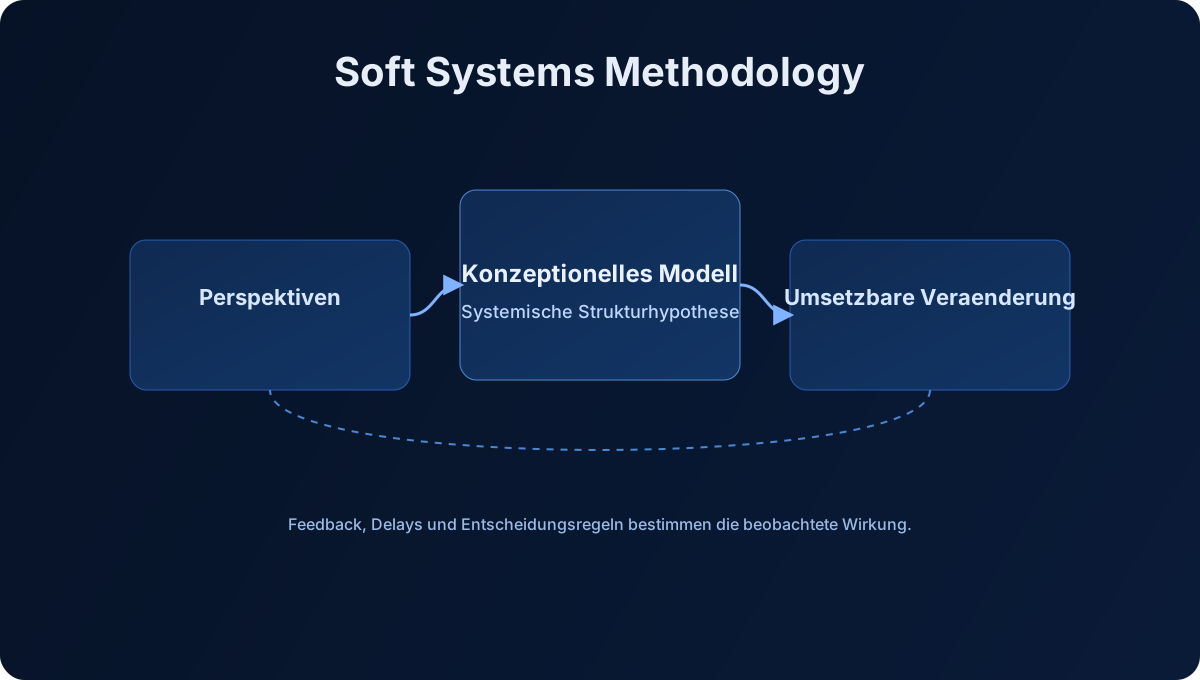
How Diagnosis Turns into Action
The genius of SSM is its separation of spheres. Architects love to flee into formal system thinking too early by drawing architecture diagrams. If they do that without first understanding the cultural dirt, they build the perfect container cluster for the wrong problem in a company that actually has a product-discovery issue rather than a hosting issue.
When This Method Fits Best
SSM is the umbrella method under which Rich Picture Mapping, Root Definition Analysis, and CATWOE operate as supporting tools. It is the philosophical counterpart to systems engineering methods such as system dynamics, which assume that goals are already measurable and mathematically clear.
How to Use the Diagnosis in Everyday Work
As a senior architect, maintain the discipline of refusing to sign off on a solution architecture until it is documented which competing worldviews created the actual problem. One of the strongest moves a tech lead can make is to tell stakeholders: "Good news, our architecture problem is not really an architecture problem. We have a business strategy conflict. Solve that first before I create a new backend repository."
First Analysis Steps
At stage six, pay close attention to the phrase "systemically desirable and culturally feasible." A design may be the cleanest and most elegant solution in the world, but if the developer culture rejects it outright, the diagnosis has failed. Architecture has to be acceptable to the people who will live inside it.
How You Recognize a Useful Diagnosis
When introducing a new company-wide architecture standard, was the method first tested against the lived culture of the messiest development tribe before it was imposed top-down?
Sources
Peter Checkland — Systems Thinking, Systems Practice (Wiley, 1981)
Peter Checkland & John Poulter — Learning for Action (Wiley, 2006)
Authors & Books
Go to referencesRelevant references for Soft Systems Methodology.
Example analysis artifact
SSM overview with problem space, learning loop and iterative comparison between world view and action.
Continue reading
Explore related topics from Diagnostics
Assumption Mapping
A diagnostic tool for strictly exposing, categorizing, and deliberately testing unspoken assumptions in architecture design.
Behaviour over Time Charts
A visualization tool that reveals how system variables such as metrics, debt, or productivity change over time.