Scenario Analysis
A stress test for architectures in which the system design must survive radically different but still plausible future worlds.
Why it matters
Diagnostics turn assumptions into grounded structural hypotheses for architecture and organization.
Next step
After that, derive interventions that specifically change rules, boundaries, or feedback loops.

Purpose
In IT there is a persistent illusion that an architecture only needs to be optimized for the one path currently visible on the product roadmap. Scenario Analysis splits that path into several plausible future branches. The goal is not to predict the future accurately. That is impossible. The goal is to design the architecture so that it remains robust and remains usable no matter which future world arrives.
Context of Use
This method belongs in major enterprise architecture discussions before large hardware purchases, cloud vendor lock-in, or strategic rewrites. You do not bet the resources of an entire tech tribe on a single point of failure such as "AWS will stay cheap forever."
Step by Step
Scenario planning often follows the Shell method or the principles of Peter Schwartz:
1.Choose the focal question: For example, "What should our infrastructure roadmap look like in 2030?"
2.Map drivers and uncertainties: Which two external and uncontrollable variables matter most, such as EU regulation on one axis and AI talent availability on the other?
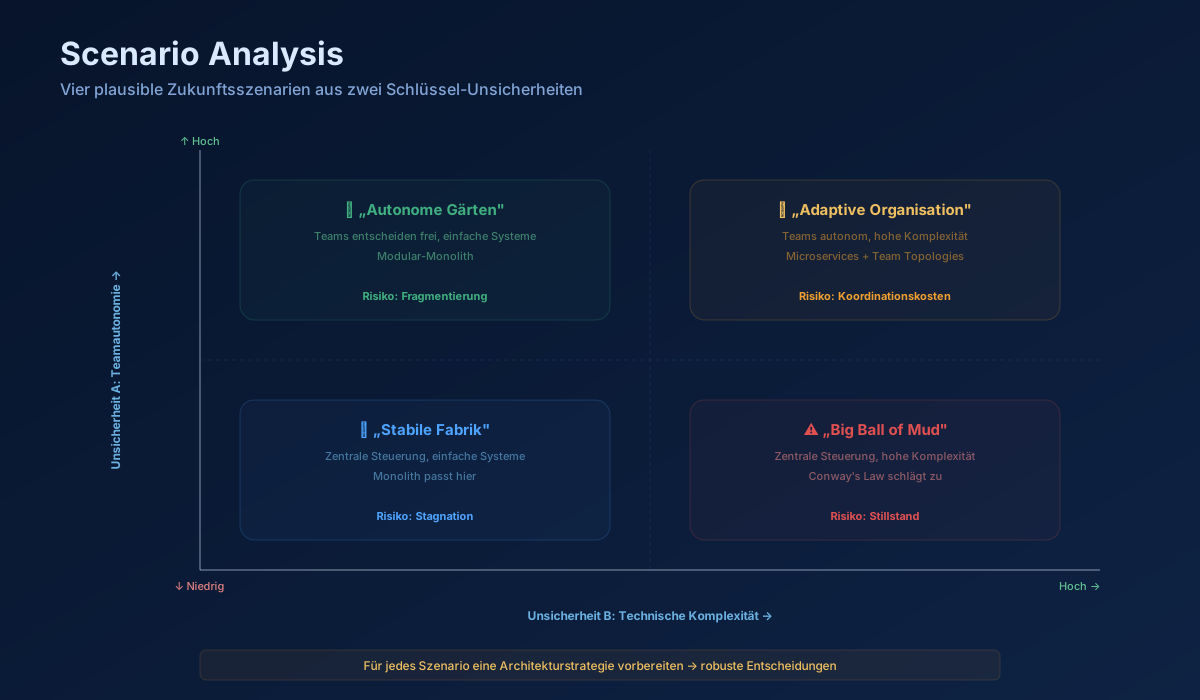
3.Create the four worlds: Build a 2x2 matrix and write short science-fiction narratives for the four quadrants.
4.Wind-tunnel the plan: Hold your current architecture against each world. In which world does it fail particularly likely?
Example
A startup builds a huge data warehouse on Google Cloud and couples it deeply to closed AI APIs. An architecture scenario workshop creates the world "AI Winter and Privacy Clampdown." In that scenario, EU regulators prohibit data transfer to the United States and OpenAI prices increase tenfold. The wind-tunnel result is deliberate: the current plan becomes infeasible in scenario B within a short time. The team responds by building an abstraction gateway so it can switch to weaker but local models running in its own data centers if necessary.
Diagram
How Diagnosis Turns into Action
Software is soft, but architecture decisions often behave like concrete. Architects sometimes hide behind YAGNI to avoid overengineering, but they also use it as an excuse not to think about the future at all. Scenario Analysis helps teams find the balance between "we do not build dead features" and "we do not make the system so fragile that one market shift undermines it."
When This Method Fits Best
Behaviour over Time charts look backward and extrapolate trends into the present. Scenario Analysis deliberately breaks extrapolation. It asks what happens if a trend ends tomorrow because of political, physical, or economic shocks.
How to Use the Diagnosis in Everyday Work
Use a pre-mortem mode in strategy sessions. Say to the room: "It is the year 2029. Our Kubernetes rollout failed clearly. The company is under severe pressure. You each have five minutes to write down the environment event that caused the collapse." Those notes become the raw material for the architecture scenarios you test against.
First Analysis Steps
Do not confuse scenario planning with risk management spreadsheets. Risk management tries to assign probabilities, such as an X percent chance that AWS goes down. In complex adaptive systems, probabilities for black swans are often impossible to calculate. Do not build simple best-case and worst-case scenarios. Build qualitatively different worlds.
How You Recognize a Useful Diagnosis
Has the current three-year cloud-migration plan been tested not only against the slide that says everything goes smoothly and savings arrive, but also against the story where your strongest provider suddenly doubles ingress prices and drops compatibility guarantees?
Sources
Peter Schwartz — The Art of the Long View (Doubleday, 1991)
Authors & Books
Go to referencesRelevant references for Scenario Analysis.
Example analysis artifact
Scenario canvas for comparing robust architectural assumptions under different future situations.
Continue reading
Explore related topics from Diagnostics
Assumption Mapping
A diagnostic tool for strictly exposing, categorizing, and deliberately testing unspoken assumptions in architecture design.
Behaviour over Time Charts
A visualization tool that reveals how system variables such as metrics, debt, or productivity change over time.