Root Definition Analysis
An SSM tool for turning extremely vague IT project mission statements into measurable, precise transformation statements.
Why it matters
Diagnostics turn assumptions into grounded structural hypotheses for architecture and organization.
Next step
After that, derive interventions that specifically change rules, boundaries, or feedback loops.

Purpose
Hundreds of IT projects begin with disastrous mission statements such as, "We want a more agile backend." But what does more agile actually mean? What is the system for? Root Definition Analysis is a core practice inside Soft Systems Methodology. It forces analysts and architects to turn the swamp of the problem situation into one radically precise sentence that declares exactly how the system does what it does, and why.
Context of Use
Use this when a team is fighting over what should be built in the current sprint, or when the architecture has become so diluted that it tries to satisfy fifteen stakeholders at once. A strong root definition cuts away the noise and fixes the fundamental reason a subsystem exists.
Step by Step
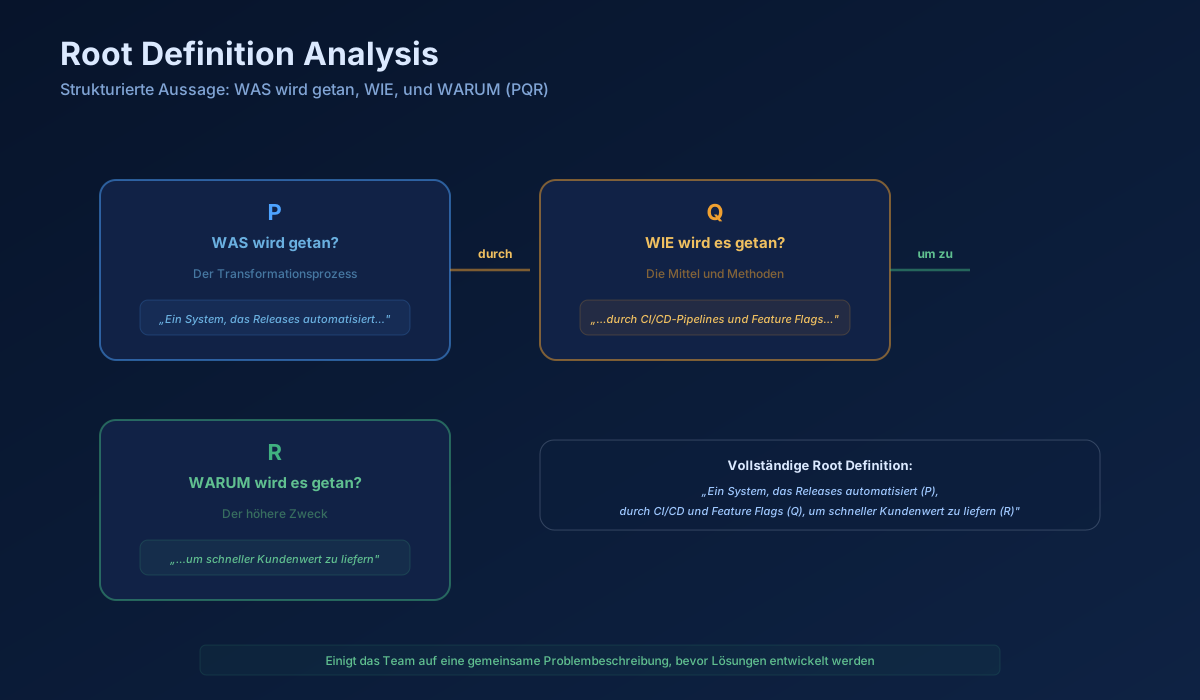
A clean root definition usually follows this structure: "A system that does X by applying Y in order to achieve Z."
1.The what (X): What is the exact input and output? This is the transformation.
2.The how (Y): What technological or process method is used?
3.The why (Z): What larger meaning justifies this transformation, usually grounded in the CATWOE worldview?
These sentences are then tested in loops against the six dimensions of CATWOE: Customers, Actors, Transformation, Worldview, Owner, and Environment.
Example
A team is asked to build a user analytics portal.
Bad definition: "We are building a system for product metrics so we can be more data-driven."
First iteration: "A system that turns clicks into graphs through a Kafka data pipeline in order to help product owners make faster decisions."
Then CATWOE exposes missing context: the real owners are bank auditors, and GDPR compliance is mandatory.
Final root definition: "A GDPR-compliant system that transforms anonymized raw end-user traffic data through aggregated Redshift views, operated by the data-engineering team, into compliance-safe reports in order to ensure the legally required auditability of our traffic on behalf of the legal department."
At that point the architecture shifts completely. The system is no longer about real-time graphs for product owners but about reliable batch reporting for auditors. Huge misinvestment is prevented.
Diagram
How Diagnosis Turns into Action
Architecture is the art of saying no. A sharp root definition is the sword used to fight feature creep at the system level. If a stakeholder suddenly wants to bolt credit-card billing onto the new reporting application, the domain architect can point to the root definition and say: that is outside our transformation, we are not the payment context.
When This Method Fits Best
Rich Pictures celebrate chaos. Root Definitions hate chaos. They are the grammatical transition from the swamp of the problem situation into a formal system description. While Domain-Driven Design marks boundaries in code, the root definition acts as the semantic boundary marker for that space.
How to Use the Diagnosis in Everyday Work
Do not accept Jira epics, system-context proposals, or new cloud repositories unless they contain a precise root definition in the README. Push architects to remove buzzwords such as synergy, platform, and agility from these statements. Force the sentence back to verbs: what is transformed into what?
First Analysis Steps
For complex systems there is never only one root definition. Marketing has one definition of your app, operations has another, and customers may have a third. A strong route to clarity is to create three competing root-definition sentences for the same software and discuss where they conflict and who gets priority.
How You Recognize a Useful Diagnosis
Could five developers from your backend team, without preparation, all recite the same sentence of the form "System X does Y in order to achieve Z" about the architecture they spend forty hours a week building?
Sources
Peter Checkland — Systems Thinking, Systems Practice (Wiley, 1981)
Peter Checkland & John Poulter — Learning for Action (Wiley, 2006)
Authors & Books
Go to referencesRelevant references for Root Definition Analysis.
Example analysis artifact
Root Definition Canvas to clarify transformation, purpose and responsibility framework.
Continue reading
Explore related topics from Diagnostics
Assumption Mapping
A diagnostic tool for strictly exposing, categorizing, and deliberately testing unspoken assumptions in architecture design.
Behaviour over Time Charts
A visualization tool that reveals how system variables such as metrics, debt, or productivity change over time.