Dependency Mapping
A visualization of technical and organizational entanglements that exposes bottlenecks and dangerous coupling.
Why it matters
Diagnostics turn assumptions into grounded structural hypotheses for architecture and organization.
Next step
After that, derive interventions that specifically change rules, boundaries, or feedback loops.

Purpose
Dependency Mapping is the surgical diagnostic of distributed architecture. It reveals that microservices are often just distributed monolithic knots in disguise. Teams think in boxes, "This is my service." Dependency Mapping forces them to think in arrows: "I cannot ship if service B is down." It measures the true degree of systemic freedom and autonomy in an organization.
Context of Use
If the company repeats, "We are agile," while every release requires four weeks of release-train synchronization and a trivial frontend field change forces updates across three backend services, then problematic coupling is already in place. Dependency Mapping should happen before teams are scaled so you can check whether the architecture can survive that scaling.
Step by Step
1.Start the inventory: List the core components or squads.
2.Hard dependencies: Draw red arrows for synchronous blockers. For example, service A fails if service B does not answer in 100 milliseconds.
3.Soft dependencies: Draw blue arrows for asynchronous connections. For example, service A publishes a Kafka message for service B.
4.Organizational dependencies: Add an overlay, such as "Team A cannot deploy until Ops team C manually approves the firewall rule."
5.Count the edges: Count incoming and outgoing arrows per squad. The node with the highest incoming dependency count is your organizational bottleneck.
Example
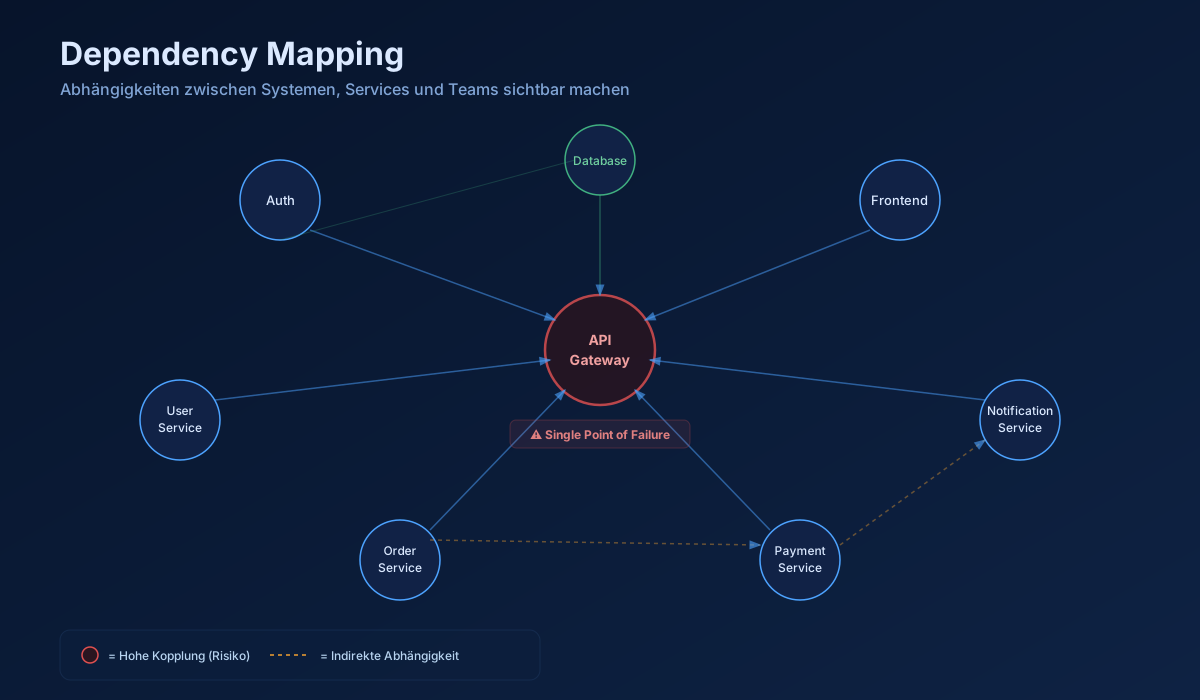
Product velocity is highly uneven. Squad A ships weekly while Squad C needs months. A dependency map is drawn from checkout down to the database. The map reveals a large dependency knot around Team B, the authentication backend. Nearly all twenty feature teams have organizational and technical hard links to this team. Team B is is overloaded by the cognitive load of hundreds of pull requests. Squad C is slow because it sits in Team B's queue.
Diagram
How Diagnosis Turns into Action
As Sam Newman emphasizes, every synchronous dependency in a distributed system is a potential weapon against availability. The arithmetic is deliberate: 99.9 percent uptime for service A multiplied by 99.9 percent uptime for service B becomes 99.8 percent uptime for the combined path. Every extra crossing on a dependency map costs the organization real money in coordination meetings. The diagnostic exposes how often organizational charts lie about autonomy.
When This Method Fits Best
Unlike very broad causal loop diagrams that allow abstract sociological variables such as pressure or motivation, Dependency Mapping is hard and concrete: API calls, package dependencies, and ticket handoff silos between teams.
How to Use the Diagnosis in Everyday Work
Architects have to make trade-offs. The goal is never zero dependencies. That would be absurdly inefficient. The goal is asynchronous causality. If node A goes down, system B should not block the user. In architecture sessions, actively cut arrows on the diagram and ask, "How do we redesign this synchronous arrow into asynchronous event publishing so we do not have to wait anymore?"
First Analysis Steps
Use the Team Topologies lens. Any dependency that is not defined as a crystal-clear X-as-a-Service relationship with full automation is, by definition, a blocking collaboration or facilitation dependency that consumes large amounts of human bandwidth.
How You Recognize a Useful Diagnosis
When reviewing a proposed architecture change, do you inspect not only the new container or service but also whether it creates three new hard dependencies that multiply overall system risk?
Sources
Matthew Skelton & Manuel Pais — Team Topologies, Chapter 3: Inter-Team Dependencies
The Systems Thinker: Seeing Interconnections
Sam Newman — Building Microservices, Chapter 3: Coupling (O'Reilly, 2021)
Authors & Books
Go to referencesRelevant references for Dependency Mapping.
Example analysis artifact
Dependency map as a flow diagram with bottlenecks between services and teams.
Continue reading
Explore related topics from Diagnostics
Assumption Mapping
A diagnostic tool for strictly exposing, categorizing, and deliberately testing unspoken assumptions in architecture design.
Behaviour over Time Charts
A visualization tool that reveals how system variables such as metrics, debt, or productivity change over time.