Boundary Critique
A method for exposing deliberate blind spots by questioning what, and who, was actively excluded from an architecture decision.
Why it matters
Diagnostics turn assumptions into grounded structural hypotheses for architecture and organization.
Next step
After that, derive interventions that specifically change rules, boundaries, or feedback loops.

Purpose
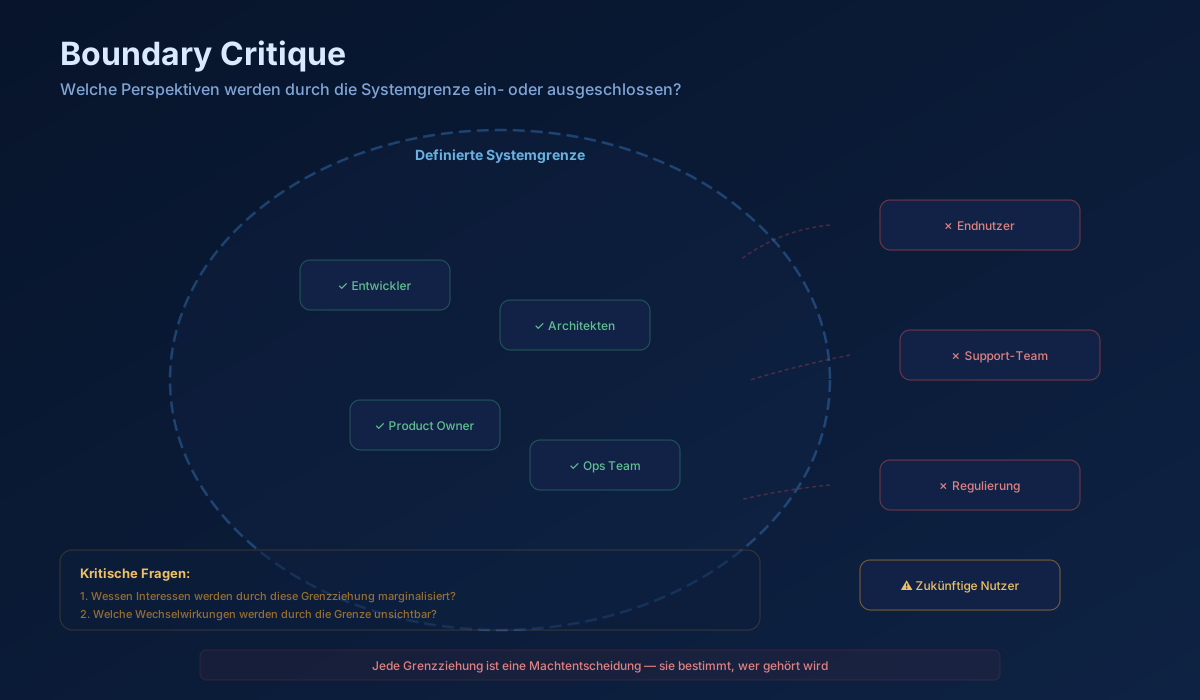
Boundary Critique, derived from Werner Ulrich's Critical Systems Heuristics, is an advanced ethical and operational diagnostic method. In architecture we draw mental lines: "This is our microservice, everything outside is the external world." Every boundary decides who belongs to the system, who gets the benefits and power, and who is excluded and forced to absorb the harmful side effects. Boundary Critique demands an explicit analysis of that line before a new structure goes live.
Context of Use
This diagnostic is a lifesaver during tightly coupled sociotechnical reorganizations. Whenever you centralize or decentralize systems, for example through a large enterprise service bus or a major platform reorg, you make decisions that reshape the cognition and daily work of hundreds of people who are not even present in the governing meetings. Boundary Critique exposes that collateral damage.
Step by Step
The method often uses the twelve guiding questions of CSH, grouped into four core blocks, to weigh the current design against what it ought to be:
1.Motivation (values): What purpose defines the system, such as cloud cost savings versus developer speed?
2.Power (control): Who controls the resources, the architecture board, the CTO, or autonomous teams?
3.Knowledge (expertise): Whose expertise counts as relevant, and whose empirical knowledge is dismissed as unimportant?
4.Legitimacy (the excluded): Who bears the pain and cost of the system without having a voice?
Example
An architecture committee decides to migrate every repository into one large monorepo with Bazel or Turborepo in order to solve dependency conflicts centrally. Technically the system is brilliant. Then the boundary critique session asks: "Who pays the cost of this boundary choice?" The answer is the frontend developers whose local build times jump from five seconds to four minutes even though they had no say in the tooling decision. The architects had placed frontend pain outside the boundary. Without this diagnosis, the rollout would have ended in a full revolt from the web teams.
Diagram
How Diagnosis Turns into Action
Software developers love drawing technical boundaries such as APIs and bounded contexts. They hate admitting that every technical boundary is also a political and social boundary that creates silos, status loss, or power shifts. Boundary Critique pulls architects out of the ivory-tower illusion that architecture is purely logical. Technology always operates inside a human value system.
When This Method Fits Best
Boundary Critique overlaps somewhat with CATWOE, but it is much more radical in its focus on power dynamics and on the people who suffer outside the line. While Stakeholder Mapping often asks, "Who might complain?", Boundary Critique goes after the deeper philosophical question of which external agent is paying for an architectural salvation story.
How to Use the Diagnosis in Everyday Work
Add a new section to architecture decision records called "Excluded Agents and Negative Externalities." Never accept the sentence, "This middleware has no downside for anyone, it is a pure win." Cybernetics does not permit free lunches. Either operational effort rises, latency increases, cognitive load grows, or core maintainability drops. Somebody pays. Name that person or group.
First Analysis Steps
Practice empathic role reversal. Put the lead backend engineer in the chair of the junior scrum master during the workshop and force them to defend the decision for five minutes from the pure pain perspective of team processes.
How You Recognize a Useful Diagnosis
When defining bounded contexts in event storming, did the team critically question whether the boundary is being drawn because it is logically sound or only because department head A refuses to talk to department head B?
Sources
Werner Ulrich — Critical Heuristics of Social Planning (Haupt, 1983)
Authors & Books
Go to referencesRelevant references for Boundary Critique.
Example analysis artifact
Boundary map to make excluded stakeholders and blind spots visible.
Continue reading
Explore related topics from Diagnostics
Assumption Mapping
A diagnostic tool for strictly exposing, categorizing, and deliberately testing unspoken assumptions in architecture design.
Behaviour over Time Charts
A visualization tool that reveals how system variables such as metrics, debt, or productivity change over time.